Another Tool Auction

If you follow my blog, then you know I have an addiction to going to tool auctions and buying a boatload of planes. Well, not much has changed over the years except this auction was online a couple of nights ago. Today I went to the house to pick up my winnings to see what I won in person. Needless to say, I was pleasantly surprised with the quality of the tools I bought.

 photo blog 001_6.jpg

When looking on the lots, the auctioneer was very vague with their descriptions. They just grouped about ten to fifteen tools together and listed them as “Stanley Metal Planes”. One of the lots was nine Stanley Bed Rock planes with only four pictures of the total lot. I took a chance that they were in good shape so I placed my bid until I outbid all the other bidders. When I picked them up, I noticed that six of the nine were corrugated which put a big smile on my face.

 photo blog 002_5.jpg

The other planes I ended up winning were a couple of Stanley circular planes. Theses planes work really well and come in handy when properly tuned.

 photo blog 003_7.jpg

They had this Stanley No 77 Dowel Making machine as a “drill”. These machines are sweet to use. I only wish I could afford the extra heads they came with as they usually sell for over $100 a piece on eBay.

 photo blog 005_7.jpg

I also picked up this Stanley No 150 miter box with a Cincinnati Steel Saw Co back saw. I’ve owned one of these for twenty years and work great cutting small moldings.
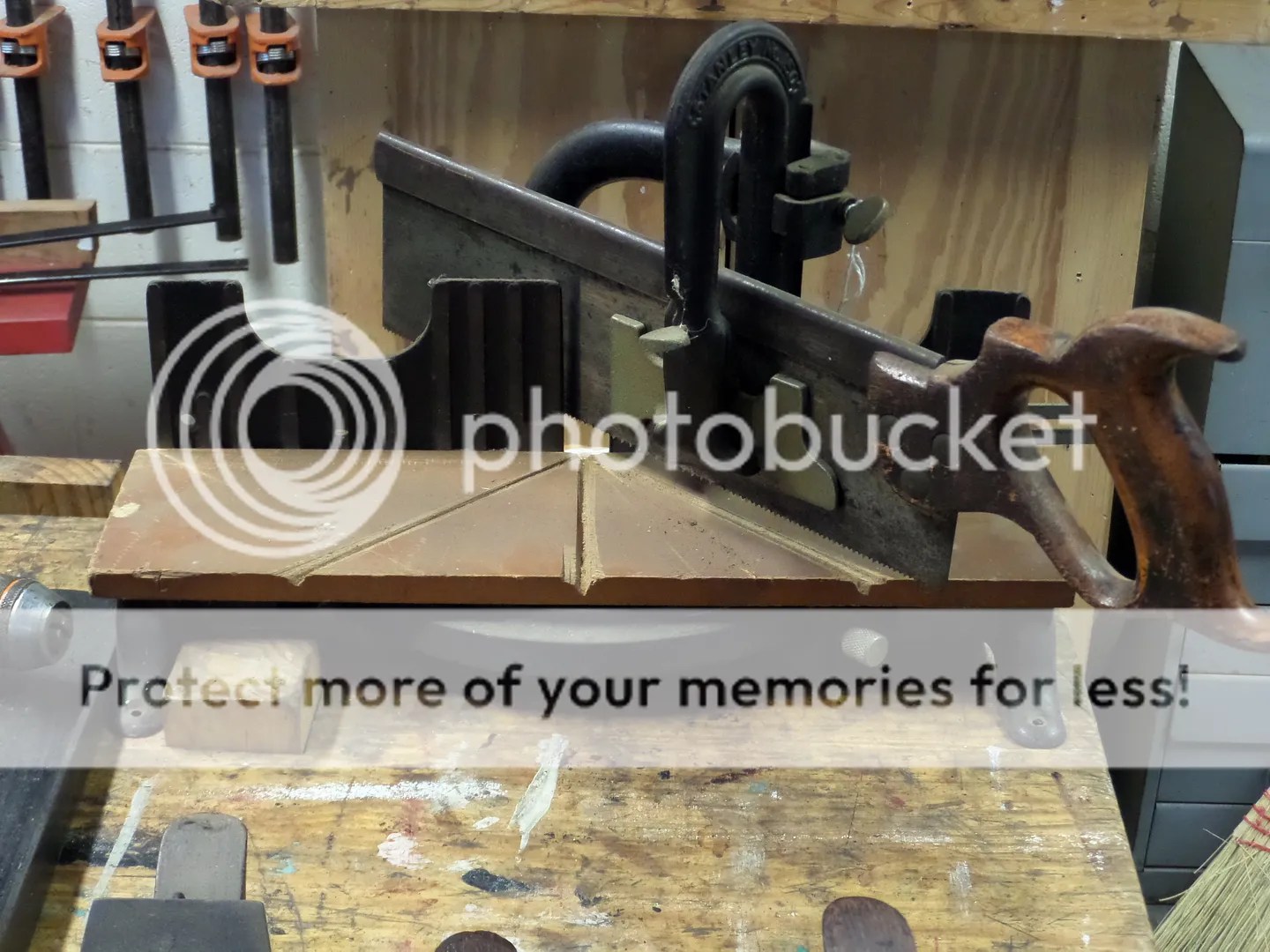
 photo blog 006_3.jpg

Here are a couple of Stanley No 112 scraper planes. Another tool that you’re glad you own when you need it.

 photo blog 007_1.jpg

A couple of Stanley No 10 Rabbet planes. The one in the back has been welded as that is a common repair for these when they break in two.

 photo blog 008_2.jpg

I ended winning six pre-lateral Stanley bench planes. One of them has the wrong lever cap and a couple others have the wrong style of tote, but all have the proper blades which is good as usually these are found with an improper blade.

 photo blog 012_1.jpg

Most of these tools will eventually be restored and sold in my eBay store. http://stores.ebay.com/mvflaim. The pre-lateral planes are too collectible to be restored. Just a light cleaning will do. The tools in the bottom photo are the tools I’ve been working on the past few weeks and will be listed for sale soon.

 photo blog 015.jpg

Revamped Dining Room Table and Chairs

As promised, I decided to throw up some before and after pictures of the dining room table and chairs my wife and I have been working on for the past few months. As you can see, the $10 chairs Anita picked up at a thrift store weren’t that attractive, but she saw the potential in them.

 photo chairs.jpg

A little bit of chisel work, paint and new fabric brought them from the ’70’s into the new millennium. Anita picked out the fabric at IKEA in order to save some money so the chairs end up being super cheap.

 photo chairs3.jpg

My farmhouse table I made twelve years ago was a massive beast, but it served it’s purpose. After replacing the top with 2×10’s and reducing the width of the table, it fit better in the room.

 photo 20150713_192149.jpg

In the end, the chairs and table look great with the decor of the room. I’m not sure if the Windsor chairs at the ends of the table will stay, but for now they provide extra seating for when we have company over (which is never).

 photo table_1.jpg

Revamping Ugly Dining Chairs

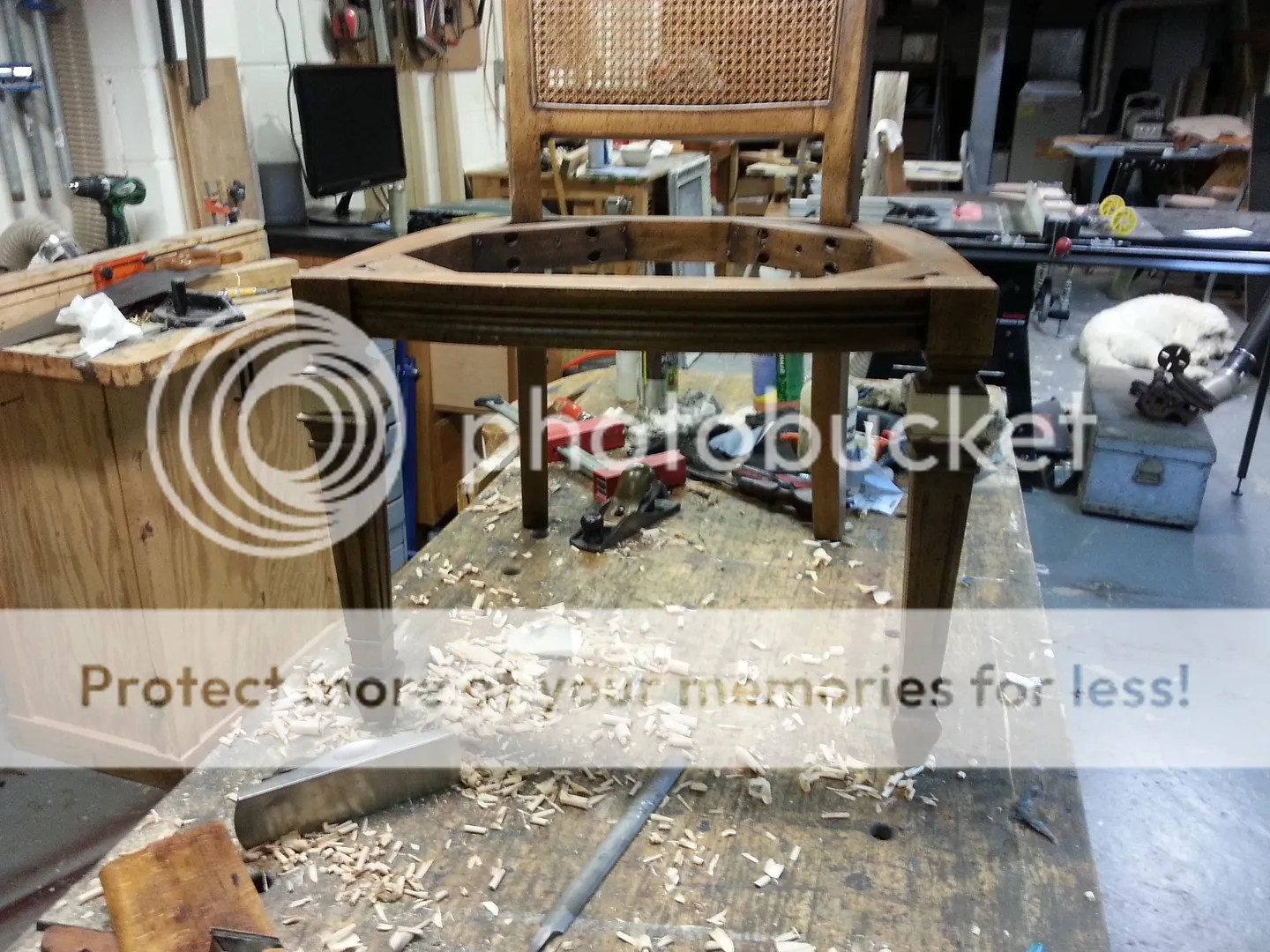
The remodeling of our dining room continues. This time with new chairs. My wife was never that fond of the Windsor chairs I made about twelve years ago, so she bought four french style caned back chairs at a local thrift store for $10.00 each. They were in good shape, the only issue with them was that they had an ugly ass imitation claw bubble design thing on the front legs. Honestly, I have no idea what they were suppose to be or how they made the chair look more formal, but they were ugly.

 photo 20150524_110441.jpg

My wife Anita and I both agreed they had to go so I took out my low angle block plane and some files and I shaved away the bubbles on all four sides of the front legs. Since Anita was going to paint the chairs, it wasn’t a big deal that the original finish was removed exposing the bare wood.

 photo 20150523_215818.jpg

After Anita painted the chairs white, I made a template for the seats with 1/4″ hard board. I simply traced around the chair with the hard board on top and cut it out on my band saw. I had to pay attention to the two notches in the back of the chair seat so that when Anita put fabric on the seat, they would still fit.

 photo 20150822_171934.jpg

I didn’t have scrap 3/4″ plywood lying around in my shop, but I did have the original oak plywood top from my dining table I revamped last month. I removed some of the extra plywood around the edges where it thickened up the top and laid out my seat pattern on the board. I then used my jig saw to cut the seats out.

 photo 20150822_173649.jpg

After a little fiddling, the seats fit well to the chair frames.

 photo 20150822_184445.jpg

The rest of the work was in Anita’s hands. She used the seat bottom to trace around the batting for the chair and cut it using a pair of sharp scissors.

 photo 20150822_184924.jpg

 photo 20150823_105217.jpg

Then she started to staple the fabric on with upholstery staples. She used a Senco pneumatic stapler to make the job go much quicker.

 photo 20150823_121400.jpg

Here is one of the chairs finished. I have to admit, it looks a lot better than the Windsor chairs I made a few years ago. Once she finishes all four chairs, I’ll post some pictures that show the revamped chairs along with the revamped table together as a set.

 photo 20150823_123327.jpg

Revamping a Dining Table

About twelve years ago I built a dining table from the plans out of Woodsmith magazine. While it served it’s purpose, it wasn’t exactly the nicest thing in the house. I made the top out of a piece of low-grade oak plywood that I bought at Home Depot. Not only that, but the table was huge being 44″ wide. My wife Anita asked if I could make a new one, or at least make a new top that was more in style. We decided that making a new top out of southern yellow pine and try weathering it making it look aged.

 photo 20150713_192149.jpg

The easy part was buying four 2 x 10’s, ripping them 9″ wide by six feet long and gluing them together. After they were glued, I planed the tops of the boards straight removing all the mill marks in the process.

 photo 20150713_181813.jpg

After the top was planed and sanded with 150 grit sandpaper, Anita applied mixture of steel wool and apple cider vinegar onto the boards to tone down the yellowness of the southern yellow pine.

 photo blog 002_4.jpg

We thought it would be a good idea to stain the top while it was already on the table. I removed the original top of the table and flipped over the base onto the new top to decide how much I would need to cut the sides down.

 photo blog 004_6.jpg

After messing around with the legs for a few minutes, I decide that the sides should be 24″ wide.

 photo blog 005_6.jpg

I cut the sides to 24″ and rerouted the dado on both boards for the corner brackets. I then used pocket screws to re-attach the sides to the legs.

 photo blog 006_2.jpg

Using metal corner brackets, I simply attached the top to the base. The new top made the table look more like a farm table.

 photo blog 008_1.jpg

Anita then stained the table with Special Walnut, then Classic Gray stain from Minwax.

 photo 1437251379798.jpg

Once dry, she applied hemp oil and gave the top a good waxing. She then painted the base with grey chalk paint. When done, it looked like a completely different table.

 photo 20150724_171103.jpg

A close up the table you can see how the southern yellow pine took on a deep rich tone. You can also see how the original black paint shows through the grey paint after Anita sanded the base a little bit. This has been one of those projects we should have done years ago.

 photo 20150724_171113.jpg

A Saturday Afternoon at an Estate Auction

Not much has been going on lately with woodworking, but I have been picking up some more tools. Yesterday I went to a local estate auction and scored some serious tools. I saw the auction on AuctionZip a few days ago, but they only had a couple of pictures of a few tools. When I arrived at the auction and took a look around, I nearly crapped myself when I saw all the tools that were sitting on the tables.

 photo 20150627_152847.jpg

I have a blast at auctions as you can see with my winnings. I always try to remain reasonable and not get too carried away with my bidding. Fortunately, there weren’t a lot of tool collectors at the auction, so I was able to buy a whole bunch. In fact, most of the time I was bidding on several tools at once in one box.

 photo 20150627_152851.jpg

At the end of the day, I brought all the tools down to my basement and tried to calculate how many tools I actually bought. I had to separate the good tools from the junk that was packed in the boxes. I won a about a dozen junky block plane beds that ended up in the garbage can.

 photo 20150627_152909_1.jpg

In the end, I bought over 150 tools with nearly 100 planes. I’ll be busy over the next few months cleaning all these babies up.

 photo 20150627_152920.jpg

My first winning bid was for a box of steel wool for $8.00. I use a lot of steel wool when cleaning tools and I’m sick of buying those little packs for $5.00 at Lowe’s. I should have enough steel wool here to last me a couple of years.

 photo 20150627_152929.jpg

Probably the best buy of the day was this old BedRock 605 plane. It should be cleaned up and for sale in a few weeks.

 photo 20150627_152950.jpg

One of my Favorite Plane Restores

Over the years, I’ve restored hundreds if not thousands of tools. In every instance, I usually think of the same thing. “I wonder who owned this tool and when did they buy it?” The question is something I can almost never answer until now.

 photo ebay 034.jpg

I bought this Kruse & Bahlmann Hardware No 6C at the Springfield Antique Show last month. Kruse & Bahlmann Hardware operated several hardware stores in the Cincinnati area. The guy who had it had a couple of other bench planes for sale so I bundled them all up and offered him a price for all three. I knew the plane wasn’t a Stanley, but still felt it was worthy of a restore. A lot of competitors of Stanley like Union, Sargent, Ohio Tool Co, and even old Craftsman’s made quality planes back in the day. In fact, Sargent often private labeled their planes for hardware stores around the country so sometimes, I’ll end up finding odd ball “No Name” planes in the market. However, they are still Sargent planes.

 photo ebay 035.jpg

This plane was quite different from any other plane I restored in the past. Not in the way it was made, but when I took off the rear tote, I saw this little piece of paper in the slot.

 photo ebay 044.jpg

When I opened it up, inside it was written “Fred G W Meyer, Property of Sept 10, 1938”. It had to be a note from the original owner of when he bought the plane. It was like opening a time capsule that has been locked away for nearly 70 years.

Just think, in September of 1938, Hitler had just taken over control of Czechoslovakia a year before invading Poland starting WWII. Then it got me thinking again. I hope this poor guy wasn’t drafted into the army and was killed during WWII. The blade of the plane had been used, but the remaining length of blade remaining is about the same as if Fred would have used it daily for three years until 1941 when Japan attacked Pearl Harbor. I’ll never know the answer if Fred served in WWII, but the penmanship of the hand writing reminds me of someone who was young in age at the time. If Fred was a young man in 1938, it’s quite possible that he did serve in WWII.

 photo ebay 040.jpg

I loved seeing the note, so the only right thing to do was to fold it back up and stick it back under the tote where it belongs.

Chairmaker’s Notebook: The Best Chairmaking Book on Earth

A few weeks ago I stopped by the home office of Popular Woodworking to go to their Lie-Nielsen Hand Tool Event. It’s always fun to take a break out of my day to play around with their tools. While I was there, I tried their No 5 1/2 jack plane that cut such nice shavings it almost got me thinking of quitting restoring my old Stanley planes.

Along with Lie-Nielsen, Lost Art Press was there selling their books and apparel. I took a peek inside one of their newest offerings, “Chairmaker’s Notebook”, to see if it was something I wanted to open my wallet for. I love books about making chairs. I’ve read over a half-dozen of them over the years including John Alexander’s “Make a Chair from a Tree: An Introduction to Working Green Wood” as well as Drew Langsner’s “The Chairmaker’s Workshop”. In fact, if I was ever a professional woodworker, I’d probably be a chair maker. So, I decided to bite the bullet and purchase the book. Needless to say, I’m glad I did.

I read a few chapters a night as I wanted all the information to absorb. What I love about this book is that it takes you through all the aspects of building a chair. From buying a log at a sawmill, to setting up a chairmaker’s workshop, to modifying and sharpening your tools, to assembly and finish. Peter even gives you a scaled model of a “sightline ruler” so you can photocopy it and make one yourself. It’s by far the most complete woodworking book I’ve ever read. Absolutely nothing was missed when writing this book.

As an example of how well this book is written, in the beginning, Peter talks about buying a log from a sawmill and what to look for when picking a log. He tells you not to buy the veneer logs as they tend to be too expensive and go for a premium. He says you should ask for “veneer rejects” because those logs will work just fine for building chairs and will be a whole lot cheaper. He then goes on to recommend that you bring a chain with you to wrap around your log so that the guy on the forklift can gently lower it down on your trailer instead of slamming it down breaking your trailer in half. It’s first hand stories like this that really sets this book apart from other books I have read.

A few years ago I made a few Windsor chairs of my own, but I used kiln dried lumber because I had no idea how to go buy a log. Regretfully, had I owned this book at the time, I would have made my chairs a whole lot better.

 photo ef7d23d7-3262-4d97-8202-2d51a3494aa6.jpg

Along with the excellent information in the book, Peter is also one hell of an artist as he drew all the pictures in the book. In fact, the pictures are so well drawn, that you know exactly what he is describing in his illustrations.

 photo 20150421_200208.jpg

If you have ever been intrigued with building a chair, then I highly recommend that you add this book to your library. You can buy it from The Lost Art Press.

Updating a Hallway

The past few days, Anita and I have been working on finishing up the dining room and hallway. After I struggled to throw up the crown molding, attaching chair rail felt like childs play. The trickiest part was coping both ends at the end of the hallway.

 photo hallway1.jpg

After the chair rail was nailed up, I attached the rectangular boxes I made with my molding planes. Then Anita caulked and painted everything white on the bottom, and a light grey on top. She bought a custom rug from Pottery Barn that fits the hallway nicely. Now she plans on hanging some pictures on the wall and get a new light fixture to spruce things up. This was a cheap and easy way to make a hallway look more elegant.

 photo hallway2.jpg

Here is a close up of the faux wainscoting boxes I made. They add quite a bit of detail to the walls.

 photo hallway3.jpg