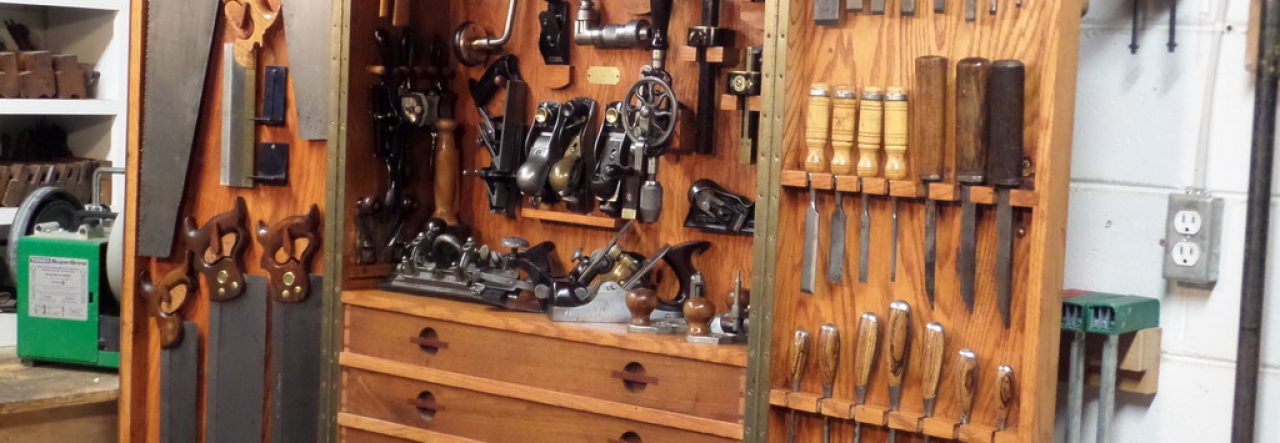
A real Stanley No 55 Plane

A few weeks ago I picked up an old Stanley No 55 plane at an auction. In all my years in buying old tools, I’ve never seen an old Stanley No 55 quite like this one. Stanley referred to the 55 as a molding machine in itself. It came with 55 blades which interchange with the plane to cut different profiles. Stanley even provided a booklet with the plane to help the user create some of the different profiles.


When I won the plane at auction, all the parts where there except the screwdriver but who cares about the screwdriver other than a collector anyway? What made this 55 special were the two dozen extra blades that the original owner cut and used with the plane.

If you know anything about a Stanley 55, you know that one of the reasons that most examples that are found out in the wild are in pristine condition is because they were hardly ever used. The plane is notorious for being too complicated to set up with its various fence and sliding section adjustments. Most craftsmen simply gave up and stuck it on the shelf to sit and collect dust.

However, this plane was different. Most all of the blades were sharpened and ready to cut. Even some of the complex cutters had scuff marks on them from where they were used.

But what was most intriguing part of the plane was the extra cutters that came with it. These cutters weren’t special cutters available from Stanley at the time. These were probably handmade by the craftsman himself. The mere fact that this craftsman knew not only how to use the blades that came with the plane, but went so far as to make a couple of dozens of extra cutters and put them to use makes me green with envy.

I admit that I have messed around with a Stanley 55 plane in the past. And while I was able to make some of the simple profile blades cut well, I had very little luck with the complex ones. The biggest problem with cutting complex profiles with a Stanley 55 is the fact that the plane rides on skates and does not compress the wood in front of the blade like a wooden complex molding plane does. You often end up getting a lot of tear out in the grain ruining the piece you’re cutting.

So how this craftsman got the plane to work well enough to motivate him to make his own cutters and put them to work baffles me. The one thing I do know about making the Stanley 55 work well is to use straight grain wood and have a very sharp blade to avoid tear out. Apparently this guy was a master with the plane getting these complex blades to work. I just wish he would have left a pamphlet on how he did it.

Turning a Door into a Headboard

My wife Anita and I bought an old door off of Craigslist a few months ago with the intentions of using it as a headboard for our full size bed in our spare bed room. This type of “recycled” work is new to me but it’s all the rage nowadays and my wife has just opened up a business called Bella Chic Decor where she rehab’s old furniture. We’ve been antiquing for a few weeks picking up a whole bunch of old furniture to build up her inventory and she spends time sanding and repainting it. She also has rented a space at a local antique store to sell her stuff.  She’s been doing really well and the furniture she rehab’s looks the bomb so her future looks bright.

Once we got this door home I needed to measure it and decide where to cut it in half so it would work as a headboard. I ended up using three panels of the five panel door in order for the design to make sense. Cutting the door was the easy part. I whipped out my Festool panel saw and cleanly ripped the door in half. Then I filled the door knob hole and latch with scrap wood and putty.

Turning the door into a headboard was a sinch. I knew the headboard needed to be at least 54″ long in order to fit the bolt holes for the full size bed frame so I added extra wood on each side from a 2×8 ripped down to 6 1/2″.

For the top, I simply added a piece of 3 1/2″ wide ash I had lying around and nailed it to the top with my pneumatic finish nailer. From there I cut and nailed a piece of crown molding I bought at Home Depot.

After I was done, Anita painted the headboard with chalk paint and applied a coat of dark wax then clear wax on top in order to protect the finish. The old door really came out nice and makes a stunning headboard.

Thanks USPS

So I sold this Stanley No 8 plane on Ebay two weeks ago for about $82.00. I get an email from the buyer last week claiming that he received it broke. It’s not too often that tools I ship end up broken during shipping but when it happens it makes me want to go down to the post office and go postal on someone.

Over the years, I’ve shipped hundreds of planes all over the world to places like Canada, Italy, Australia, England and France. Every time I take care in making sure the plane is well packed and well protected. But when I finished packing this boy to California, a little voice in my head told me I better add insurance to the bill.

A couple of years ago it was the buyers responsibility to pay for insurance when they paid for the item. Now Ebay turned that responsibility onto the seller. So if you sell something expensive through Ebay without insurance and it breaks during shipping, you’re responsible even though the buyer didn’t pay for insurance. I don’t ship everything I sell with insurance because it adds expense to the shipping and handling charge and buyers often get turned off to an auction if they feel the shipping charge is too high.  But thankfully I had enough foresight to pay the insurance for this plane.

When the buyer emailed me it broke, I told him to file a claim through Ebay so they would know the plane broke during shipping. I used Ebay’s third-party shipping insurance called ShipCover and not the USPS. Once the claim was filed, I went through Ebay’s dispute center where they acted as a mediator between the buyer and seller.

As soon as the buyer filed his claim, Ebay immediately froze the money he sent me through PayPal until the dispute was resolved. That can be a hairy situation if you already spent the money your buyers sent you. If there isn’t enough money in your account to cover the disputed item, Ebay will often take the money from your bank account. Talk about a sticky situation if you start bouncing a bunch of checks because Ebay froze your money.

Luckily I had enough money in PayPal and after he filed his claim, I filed mine to ShipCover through Ebay. A few days go by and I received the plane back from the seller. My frozen money went back to him and I was rewarded the $82 from ShipCover. The dispute was settled and life goes on.

Sofa Table

Last fall my wife Anita and I redid our screened in porch. Since then we’ve slowly added furniture to the room but what we really need is a table to put our 20-year-old TV on. Right now the TV sits on a big clay pot with a piece of plywood on top. Not an ideal place for a TV so she asked me to build something quick to use for out there. So I designed this table which measures 56″ long x 17″ deep x 30″ tall.

Because the table will be outside, I decided to build it out of 2 x 8’s in case it gets destroyed by the weather. Plus, I really didn’t feel like spending the money on something more weather appropriate like cedar or teak. The 2 x 8’s around here are Southern Yellow Pine and if you scavenge through a pile, you can find some clean board free from knots. Once I bought the boards I let them acclimate in my shop for a couple of weeks.

Since 2 x 8’s are 7 1/4″ wide, it was a no brainer to make the sides of the table 7″. In some cases I was able to rip the boards in half on my bandsaw to yield two thinner pieces. Because the boards are a 1 1/2″ thick, cutting them in half yielded a two boards 11/16″ thick rough sawn. I kept planing those boards to 1/2″ thick and used them as the drawer stock.

I tried using the grain to my advantage as best as I could. The bottom slats only being 1/4″ thick are susceptible to warping so I cut them with quarter sawn or rift sawn wood.

Those aren’t dovetails!

What can I say, I wasn’t in the mood to cut half blind dovetails. I’ve used this pin joint in the past when I built my toolbox ten years ago. Those have held up fine over the years and these drawers are going to get minimum use so I’m not too concerned.

Anita plans on painting the piece with gray chalk paint and distress it a little to make it look old. Painted gray with some nice old style handles and this table will be a show stopper in our screened in porch. But I have a feeling a new flat screen will be on top of it instead of a 20 year old dinosaur.

SawStop injury video

I felt what happened to me last weekend on my SawStop was so eye opening that I decided to post a video explaining what happened to help other people not make the same bonehead move I did. Plus I wanted to implant it in my brain so I never do something that stupid again.

I contacted SawStop and sent the damaged cartridge to them for inspection. They contacted me a few days later and told me that will be sending me a free replacement cartridge since it was a “save”. I’m glad because at $69.00 a pop, they’re not exactly cheap to casually have a spare around.

My SawStop Works

I’m a little too embarrassed to post this but I figured I should. I always thought I would be one of those SawStop owners who would own a SawStop for thirty years and never had to use the safety trigger. Today put an end to that dream.

I was ripping a piece of 3/4″ walnut 1″ wide when the next thing I knew I heard a large bang. I looked and saw the blade was gone. I backed away from the table saw and looked at my left thumb. Somehow my thumb caught the blade. I wish I knew how I did it, but it happened so fast I’m not entirely sure how. I wasn’t rushing and I was paying attention to what I was doing, even using a push stick.

I was using my left hand to gently hold the wood away from the blade and using my push stick with my right hand pushing the wood through.  I think what happened is right before I got cut, I felt some vibration in the wood and it caused my left hand to slide into the blade. I mean, it had to have happened that way. It’s only logical explanation of how I got cut. I just can’t believe how fast it actually happened.

The damage to my thumb is not that bad. The blade took a chunk of skin off and ripped my fingernail but no stitches are required. I can’t even imagine the damage that would have been caused had I not owned the SawStop. More likely I’d be in the emergency room tonight trying to have the top of my thumb reattached.

After I got my thumb taken care of, I took the cartridge and blade out of the saw. I’ll have to go buy a new cartridge tomorrow at Rockler and use another blade but it’s still far cheaper than an emergency room bill. I think my table saw has just paid for itself!

Improving my branding iron

A few years ago I invested in a nice branding iron featuring my company logo and website underneath. I love the thing to death and have never regretted the pretty penny I spent on it. The only issue I ever had with it was user error. When my branding iron gets hot it works like a charm. The problem is that sometimes I think the iron is hot enough and when I go to press the iron to the wood, I get an imperfect burn. With the iron being free hand, there was no way for me to line back up the iron perfectly with what was already burned in the wood. I basically had one chance to get it right. When I made my kitchen cabinets a few summers ago, some of the burns turned out not so pretty.

Then last year I attended the Marketplace at The Woodworking In America conference in Cincinnati. There I met a guy who was selling branding irons that attached to a drill press. With his iron being in a fixed position, if you don’t burn enough of the logo into the wood, you simply lower the head back down and burn again. I knew that was my answer but my branding iron wasn’t equipped to be attached to a drill press. I had the idea of buying one of those old jigs that turns a hand drill into a drill press but they were $45 on amazon and I wasn’t sure if it would even work.

Then last week my wife and I attended the Springfield Antique Show Extravaganza in Springfield, Ohio. As soon as I walked into the show, I spotted this thing lying on the ground. The old man saw me looking at it and yelled out “ten bucks” to me. I yelled back “Sold!” I immediately walked it back to my truck with delight.

This drill press attachment was made for a 1/2″ drill with the collet being a 1 3/4″ in diameter. I knew I had to make some sort of spacer in order for it squeeze my 1/2″ branding iron shaft tightly. I grabbed some scrap poplar, drew a 1 3/4″ circle around and drilled a 1/2″ hole in the middle. I had my spacer made but needed to make it work so I had to cut in half so it would wrap around my branding iron shaft.

After a few minutes tinkering around, I got it to squeeze tightly on the branding iron and the collet of the drill press. It fitted, but now it needed to work.

I lined up the cutter head so that it was perpendicular to the base on all four sides with my small try square. Once it was square I tightened the collet wing nut with all my might.


Now it was time to see how this thing actually worked. I heated up the iron, grabbed a piece of scrap wood and gave it a go. What do you know, it worked. I pressed down, and checked to see how it burned. If it didn’t do a well enough job, I just lowered the arm and gave it a little more heat. I definitely got a more consistent burn versus free hand.

The only downside to the jig is the wood that I used as a spacer for the collet started to burn at the bottom. Now I’m not sure what to do about this. Since I won’t being using the iron all that much, the wood should last a long time. Plus it was super simple to make and would be a snap to make a new one if the this one burns up too much. I think I’ll just let it be.

The importance of making a prototype

So I was hired to make a case for this thing. It’s a custom-made electric guitar amplifier. The guy who made it has no woodworking ability and was looking for someone to make a case for him. He really didn’t care how it was made, just so that the inner components could be taken out and put back in if need be.

I’ve never made an amplifier case before and wasn’t sure how to design one with a removable back so I knew that making a prototype would be a must. Scrounging around in my shop I looked for old pieces of scrap plywood and off cuts of hardwood. I gathered up some wood and made a simple box put together with pneumatic staples and drywall screws.

The idea for a removable back was simple. Screw on the top and route grooves down the side so that the back could slide up and out-of-the-way. The prototype worked and was easy to make which is what I was after because I wasn’t making a killing on the box anyway. More of a favor for my stepson’s friend.

Now it was time for the real deal which was easy because I already knew how to make it and already made my mistakes on the prototype. Anytime I make something, it’s usually the first time I make it. As I measure and cut and drill, I inevitably make a mistake or two. I often find out that the second time I make something, that I learned from my mistakes on the first one and make the second one so much better. It’s one of the reasons I cringe when people ask me to do commission work. I’d much rather have a product line of pieces that I already know how to build and build quickly.

I made the amplifier out of hardwood cherry and maple plywood for the front and back. It came out flawless! The only real differences I made between this and the prototype is I rounded over the edges to give it a better look, added a piece of wood to the sides so that I could move the screws that hold down the top away from the edges so they wouldn’t interfere with the round overs and eliminated the vent holes on the back panel.

The good thing was making the prototype only took about an hour but it saved me so much time and material working out some of the bugs in the design process. Plus I screwed up on the cheap throw away wood instead of ruining the nice expensive stuff.

Library Card Catalog Cabinets

My wife and I were browsing around an antique mall this weekend when I stumbled upon these things underneath an old trestle table. As soon as I saw them I knew I had to have them. My wife gave me a strange look wondering why in the world I would want these ugly things.

When I bought my house ten years ago, the old man who had a workshop left several library card catalog cabinets behind. I didn’t know what to do with them at first but quickly realized how handy they were. Basically, they’re a great way of storing all the miscellaneous crap you collect in your shop.

In one drawer I keep my Tormek sharpening jigs, another one I keep all my lathe accessories and so on. Plus being made out of metal, they’re incredibly strong and can hold a ton of weight. After a while, I used up all the drawers so I kept my eye out for some more file cabinets to buy. 


Library card catalog cabinets come in different sizes so some drawers are more useful than others for storing various tools. In my old cabinets, the drawers are long enough that I can store all the lathe chisels while the new ones I just picked up are too short for that. But the new ones are wider and deeper so I can store my pneumatic finish nails a lot easier. It definitely pays to have different sizes.


The true beauty of these cabinets is that no one really wants them so they’re reasonably cheap. I was able to snag all three cabinets for $15.00. I’m sure as soon as it becomes popular to spray paint these things white with pink stenciled flowers on them like people do with old suitcases, I’m sure their prices will skyrocket to $100 a pop. But for now, I’m glad I was able to pick these up dirt cheap.

Getting back in the shop

They say you should never take your life for granted and in the past few weeks I’ve learned that lesson well. It started a couple of weeks ago when I was having trouble seeing out of my left eye. It was cloudy at the bottom right of its vision field. At first, I thought it was a dirty contact but after I replaced the contact my vision didn’t improve at all. Concerned, I went to see my optometrist so she could check it out. She dilated my eye and took pictures of the inside and found nothing wrong. She told me to take some Advil for the pain and come back in a week.

A few days later, the pain increased and my vision decreased, so I went to the Cincinnati Eye Institute to have more tests done. The doctor examined my eye and conditions and told me that what I have is more likely Optical Neuritis or inflammation of the optic nerve to the brain. Nothing is wrong with the eye itself, just that the message from the eye is not reaching the brain. He told me to come back in the morning to take a vision field test to get a better diagnosis. I came back the next day, took the vision test and it confirmed that it was Optic Neuritis. The bad news was Optic Neuritis is often the initial episode a patient has who will subsequently develop Multiple Sclerosis later in life. He told me that I needed to have a MRI done to determine if there were any white-matter lesions on my brain. He also said that I need to see a Neuro-Opthalmologist in a few weeks to see if I regain any vision.

At this point my wife and I were freaking. I’m 38 and don’t go to the doctor because I rarely get sick. But the thought of developing MS during my life was not something I wanted to accept. I kept thinking about my life with MS and the limitations it would bring. Not being able to move my arm or the loss of my legs scared me to death. How was I going to work with wood? How would I ever keep my job as a sales rep having to travel around and build displays? What would eventually happen to me and how would my wife take care of me? It was a very stressful time for the both of us.

A few days later l stopped in and had my MRI done. They sat me down on the machine, strapped me in and put on a helmet on my head that made it feel like I was scuba diving. I laid inside the machine for 40 minutes as they took numerous pictures of my brain. The sound was horrible as it felt like I was in some strange space alien testing contraption. The only good part of the experience was they pumped in Sirius Satelite Radio; BB King’s Bluesville through some headphones. I listened to Albert King’s “Born on a Bad Sign” during the procedure and started to cry. I felt my life was coming apart at the seams and nothing would be the same again.

After the MRI, I waited for the doctor to call me back to inform me of the results. The doctor’s assistant called and told me that the MRI came back “abnormal” but wouldn’t clarify what that meant. My wife got on the phone and asked if the doctor would call us himself so he could clarify what the abnormalities were. A few hours later, the doctor called and said that they had found scattered white-matter lesions on my brain and with the symptom of Optic Neuritis, that it was likely that I would have the possibility of developing MS during my life. I asked if I need to be on steroids and if I did, why do I have to wait three more weeks to see the Neuro-Ophthalmologist? He said he’ll call the doctor and see if they can schedule me in sooner. The next day, the Neuro-Ophthamologist’s office called and scheduled an appointment the following morning.

So my wife and I got up and went to the doctor’s office first thing in the morning. By this time I’m devastated and not expecting any type of good news. My wife and I spent hours looking up symptoms of MS and Optic Neuritis on the internet over the past few days. The only symptom I had was vision loss, otherwise I felt fine. How could I have MS? I’ve never had any symptom of falling down, dizziness, numbness or tingling in my hands or legs my entire life.

The doctor came in the room and asked me how I was doing. He dilated my eye to get a better look at the optic nerve. He told me that my optic nerve was very inflamed and there was some hemorrhaging. He also told me that the white-matter lesions on MRI were old and not in the right spots to be causing my Optic Neuritis. Apparently white matter-lesions are common as you age and sometimes you can develop a white spot for every ten years of life. Considering I’m nearly 40 years old, that made sense. He said that what I have is Atypical Optic Neuritis (AON). This type has no association with developing MS. AON is sometimes brought on by an infection or virus. He asked me if I had a cat. I told him I did. He said sometimes people can develop cat scratch fever (even without being scratched by a cat) that can cause AON. He told me to go to the hospital and have some blood work done. There they will be able to determine why I developed AON however he cautioned, sometimes a person can develop it for no known reason. It just a fluke. I expect to get the results on Monday. If  the blood work confirms it is an infection, they will prescribe some antibiotics for me to take.

I was relieved that I wouldn’t develop MS during my life but I’m still concerned about my vision loss. When it started a couple of weeks ago, my vision kept getting worse over the course of a few days until I lost 95% of vision in my eye. Only in the last few days has the vision been getting any better, but I still have 90% vision loss. Optic Neuritis usually last 6-8 weeks in people then usually goes away. However, I have Atypical Optic Neuritis which may last just as long if not longer. Also, because I have AON, there’s a chance I may have some permanent vision loss once the swelling ceases. The doctor said that the majority of people with AON do regain all their vision but in some cases, some do not. He put me on steroids for the next month and I have to go back in a couple of weeks for a check up. Hopefully by then I’ll have the majority of my vision back.

This morning I went downstairs to my shop and started picking up some tools again. I stopped for a few weeks as I have been too afraid to work with only one good eye. I messed around drilling a new hole in my workbench for a placement of an overhead swing light. It wasn’t much, but it was the first step on the road to recovery both physically and emotionally.

I never really took my health for granted. Well maybe I did since I don’t have a primary care physician yet. But all I know is that I will never take my life for granted again. The things we do everyday just seem so mundane that we hardly ever think anything will change but when you have a health scare like I do, it wakes you up quick. Even though I’m not out of the woods yet being legally blind in one eye, I’m hopeful I’ll get better soon with good medicine and a lot of prayer.