Early Taylor Bar Clamps

Every 4th of July I travel to Adams County, OH to attend an antique tool auction held by the Amish. It’s been something I’ve been doing for the past fifteen years and it has become a tradition for me as something I always looked forward to all year. Every year I would come home with a ton of tools I picked up at a bargain hoping to make a little cash selling them on eBay. It started to decline the past couple of years and I was afraid it might end as the tools weren’t much to choose from and the quality of them were lacking. Well with the economy in the tank and $4 gas hitting the streets, the auction didn’t happen this year.

Bummed out, my wife asked if I wanted to go to an antique mall on the other side of Cincinnati and look around. We go there from time to time as she looks for things to sell in her booth. I rarely if ever find tools so I wasn’t too optimistic finding anything.

After we arrived, I spotted these clamps on the floor of a booth. They intrigued me because while I’ve seen old clamps before, I’ve never seen a clamping action like these. They worked off a cam action from the handle. As you pull the handle up, the shell shaped curve pushes the pad out. I debated getting them because old bar clamps are not very collectible and I really didn’t need them. Plus they were $22.00 a piece. But my wife said if I wanted them I should get them because the next time we were here, they’d be gone. So I used my wife’s 10% vendor discount and picked them up.

These are clamps after I dipped them in citric acid/water mix and cleaned the rust off with steel wool. The clamping range is about 20″. I thought it was a little odd that they weren’t designed to hold 24″ between center but I guess the inventor had his reasons.

Here’s the detail of the handle. You can see how the pad gets pushed out as the handle is raised. It’s simplicity is what makes the design so beautiful.

You can clearly see “The Taylor” on the face. I googled “taylor clamp co” and came up with www.jamesltaylor.com a manufacturer of mass production clamping and gluing machines. After I cleaned the rust off the bar I could faintly see the “The Taylor Manufacturing Co, Poughkeepsie, NY” so these clamps are obviously there’s. However, I was left with a big question.

l

On the jaw there was a patent date of Jan 2, 1900. On the Taylor website they claim that the company was founded in 1911. How were these clamps patented in 1900 while James Taylor didn’t start his company until 1911? obviously John Taylor must have been a sole proprietorship for a few years tinkering around with designs before developing the typical design used today. Are these clamps some sort of prototypes or first edition models?

You can faintly see the logo “The Taylor” in an oval logo very similar to the Taylor logo used today. John must have simplified his logo when he incorporated in 1911. I looked all over their website the to see if they mention these style of clamps with no luck. I even tried searching the US Patent office on the internet for more information but came up empty.

James L. Taylor Manufacturing Co. Inc logo used today.

While the origins of these clamps remains a mystery, the real question is how do they perform? The answer is amazingly well. While they may not provide as much torque as typical bar clamps, they are extremely quick and easy to use. Where they excel is in gluing up cabinetry where you need speed on your side. Simply put the clamp around the stock and pull the handle up. I clamped a piece of wood to my workbench and tried moving it with no luck. They hold rock solid.

Another advantage with these clamps is they would appeal with people with arthritis. Often the screw handle on regular clamps can be tough to tighten with people who suffer from arthritis. With these clamp, they can easily tighten them up. There may be a real market for these clamps being manufactured and sold today as woodworkers are getting older every year. Hmmm….

Oh Boy, I Did It Again

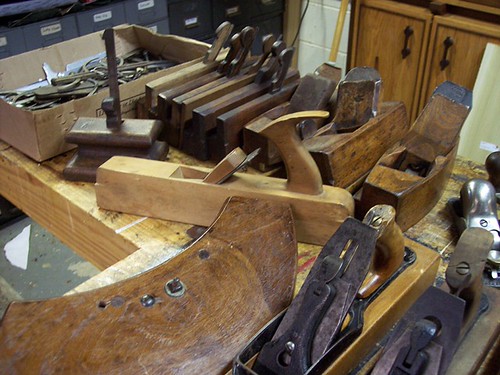
Well I went to another antique tool auction yesterday. This one was in Jeffersonville, OH about half way between Cincy and Columbus and good deals were to be had as you can see in the photo.

I only picked up a few Stanley bench planes. After the auction I went to in Indy a couple of weeks ago, I have enough Stanley planes to last me awhile.

I’m a sucker for molding planes and these were too good of a deal to pass up. Several of them I snagged for under $10.00 each.

All the profiles of the molding planes I bought. I realize that you can make nearly every molding profile with a good set of hollow and rounds which I already have, but I can’t resist the opportunity to buy some complex molders. Some of these I’ll keep for myself, the rest I’ll sell.

I also picked up a few hand saws as well for under $5.00 a piece. Three of them were Disston thumb hole saws that are gaining popularity on eBay lately. I’ll clean them up and throw them on eBay to see what they bring.

Here’s a neat pair of shears I picked up for $6.00. I really don’t know anything about old shears and have no idea what they’re worth but my wife will stick it in her booth for sale.

A couple of sash molding planes a froe. I had a nice sash molding plane before and sold it only to regret it later so I’ll probably keep one of them. I’m definitely keeping the froe. Working green wood has always been an ambition of mine and this froe will come in handy. It looks like it was made from old leaf spring from a car.

The two scores I got were a Stanley No 141 with the fillister bed and blade and a Stanley No 603C corrugated bench plane. I may hold onto the 141 until I find some regular blades for it and then sell it.

All I know is that I’m going to be very busy for a while cleaning all the tools I bought this past month.

A day at a tool auction

Last weekend I went to an antique tool auction in Indianapolis and picked up a few planes. Needless to say I went hog-wild with my bidding. All the planes were sold in lots which brought the price per plane down a bit. Even with all the good deals I got, I never spent so much at a tool auction.

I bought several Stanley circular planes as well as No 3’s, 4’s, 6’s, Gage 5C, block planes, and No 71 1/2 router. All of them are in nice shape with nice clean rosewood handles, full blades and no rust.

I also bought a lot of transitional planes but they were all sold in lots with five or more so I couldn’t refuse.

I also won a box of woodies which had a cooper’s croze, old woman’s tooth router and two cute little panel raisers. One of those panel raisers I’ll keep while the rest I’ll sell.

I’m a sucker for old molding planes. I have over 150 in my arsenal and still counting. I’ll more likely keep all these unless I already own that profile then I’ll sell it.

Box of measuring instruments. Lots of calipers and dividers in there and a few do-dads I have no idea what they do.

Some of the tools that were in the box I’ll keep for myself. Buy a box full of tools, sell the ones you don’t need to pay for the ones you keep. End up getting free tools which is not a bad deal.

Once I get all these tools cleaned up I’ll throw them on eBay. The money I make will help pay for my medical bills from when I was in the hospital last month. Wish me luck.

User vs Collectible Stanley Planes

Sometimes I’ll see people ask the simple question on woodworking forums on whether or not an old plane they picked up at a garage sale is worth anything. While chances are it’s worth what they paid for it, every once in a while they found a real gem. The key is finding out what Type of Stanley plane you have.

About twenty years ago Roger K Smith wrote a Type Study on the different features of Stanley planes through the years.  It was originally printed in Patented Transitional and Metallic Planes in America Volume I and then later used in John Walter’s book Antique and Collectible Stanley Tools Guide to Identity and Value. Unfortunately both books are out of print and tough to acquire but fortunately for us, some people have uploaded the info to the internet. Below is one of the links. http://www.tooltrip.com/tooltrip9/stanley/stan-bpl/bailey-types.htm

This Type Study is considered to be the most accurate information to date on the manufacturing of Stanley planes, however it should be noted that Stanley Works never built planes based on these Type Studies. They simply build planes with whatever parts they had lying around. So it is quite possible to have a plane that fits all the criteria of a certain Type Study but may have a part or two with an earlier or later Type to it.

Below are two Stanley No 5 planes that to an untrained eye, may look quite similar to one another but are worlds apart as far as value. The plane on the left is a Type 2 which was made from 1869-1872. The one on the right is a Type 13 made from 1925-1928.

The easiest way to tell if your plane is collectible or not is to see if there is a lateral adjustment on the frog. Planes without this lever are known as Prelateral planes. There are four Type Studies that were Prelateral planes, Type 3 being the most rare. If you come into contact with a Type 3 plane, don’t do anything to it. It’s gold to tool collectors.

The second easiest way to see if you have a collectible Stanley plane is to see where the round hole on the plane’s blade is. If it’s on top like the blade on the left, it’s a Prelateral plane blade. Why Stanley changed the position of the hole from the top to the bottom, I have no idea. The hole is there to put the cap iron nut through the blade without having to fully remove it. Seems like a silly feature  to me but that’s just me. Every plane blade ever made has this feature so I’m obviously missing something.

Another feature that distinguishes really old Stanley planes from the users is the lever cap. If your lever cap is solid without any recesses, it’s rare. I guess metal was a precious commodity back then and every ounce counted. Do the solid lever caps work better? I doubt it. It’s just a lever cap.

The fourth feature that separates the collector from the user is the brass adjustment knob in the back of the frog. I guess Stanley was trying to save money anyway they could back in the 1870’s and putting a recess in the adjustment knob saved them $.001 in brass. But hey, $.001 was a lot of money back then.

A fifth major feature is the shape of the tote. It was still being made out of rosewood but the shape on later Stanley’s became more streamed line. Stanley probably heard complaints from customers about the totes being uncomfortable so they redesigned  the shape. But that’s my guess. It wasn’t cost savings because they didn’t switch to birch hardwood until the 1940’s.

Now it’s your call of you want to use one of these old planes in your shop on a day-to-day basis. All I know is I sold the Type 2 on eBay for $175.00 while the Type 13 commonly goes for $40.00. With the economy the way it is today, if I had an old collectible Stanley plane, I’d sell it and buy a later version with a little bit more bells and whistles for a quarter of the price and fill up my truck with a tank of gas and take my wife out for dinner with the remainder of the money.

A moment with the absurd

So my wife and I are browsing through an antique store this weekend when I came across this lamp.

At first I didn’t know what it was but then it dawned on me. I hesitated for a minute and looked around at the tools that were glued and soldered together hoping that none of them were valuable. Fortunately they were not. Then I looked at the price tag. $425.00 for this piece of shit.

For $425 I could buy a 13″ DeWalt planer; a Lie-Nielsen #8 jointer plane; a Festool Rotex Sander; hell I could even buy a used copy of “The Art of Joinery” by Joseph Moxon and Chris Schwarz on Amazon.  

Now I understand that beauty is in the eye of the beholder and whoever built this thing was proud of it. Which they should be. But why in the world someone else would try to sell this thing for over $400 is beyond me. Are they trying to recoup the cost of the tools? If so, $40 should do it. None of the tools are worth more than $10.00. An old molding plane, fore plane, marking gauge, twist auger, clamp, a set of calipers and a beat up old draw knife. What the lantern is doing on the side I have no idea. I would think having a lantern on a lamp is an oxymoron.

It just makes one realize that you need to be careful when shopping in antique stores where vendors ask ridiculous amounts for their junk. More likely the next home for this lamp is in the dumpster. All I know is for $425.00, the thing should have at least come with a freaking shade.