Restoring a Stanley No 10 Carriage Maker Rabbet Plane

Several months ago I picked up a Stanley No 10 Carriage Makers Rabbet plane with a welded sole at a local auction. I wanted to restore the plane and make it usable again so I took it all apart and soaked everything in a citric acid solution for a few hours.

SAMSUNG CAMERA PICTURES

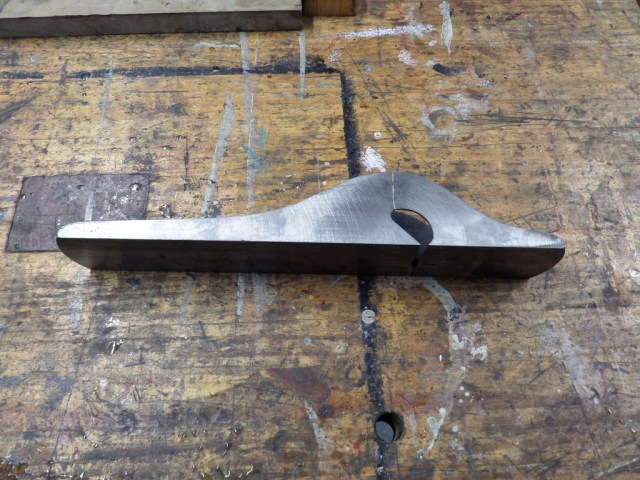
Even thought the weld was done fairly well, the plane’s sides were no longer straight. Not the best situation for a plane that needs straight sides in order to cut a clean rabbet.

Fortunately, because the plane cracked only on one side, the bed was still relatively flat when it was welded back. If the bed would have been out of whack, I may have resorted to the garbage can as it would have been too much work to fettle flat.

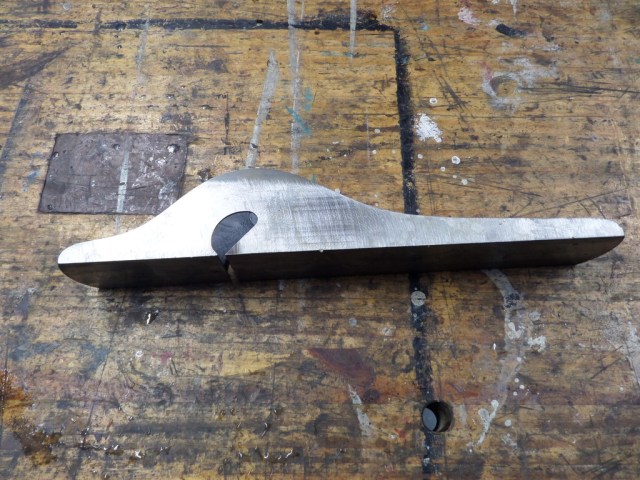
I wanted the black removed from the sides as the previous owner painted the sides to cover up the weld. I spread some paint remover on it and let it sit for a few minutes before removing it with a putty knife. I then needed the sides to be straight so I started to fettle them with sandpaper on a marble base. Rubbing the bed back in forth, I could see the high and low spots on each side.

There was a lot of metal to remove, so I decided to take the bed to my stationary disc sander and carefully grind the bed using 80 grit sand paper.

SAMSUNG CAMERA PICTURES

Using the disc sander saved a lot of time, but it scratched the hell out of the surface. I made sure I moved the bed back and forth so that I wouldn’t do more damage than good.

Because the disc sander made a lot of scratches on the sides, I took the bed back to my marble base and used a variety of sand paper grits to remove as many scratches as I could.

SAMSUNG CAMERA PICTURES

I then focused on the bed, fettling it flat. I used a variety of sand paper from 150-400 grit. I worked on it for a few minutes until I was satisfied with the results.

SAMSUNG CAMERA PICTURES

Once the bed was done, I sharpened the blade using my Tormek sharpening wheel and water stones.

SAMSUNG CAMERA PICTURES

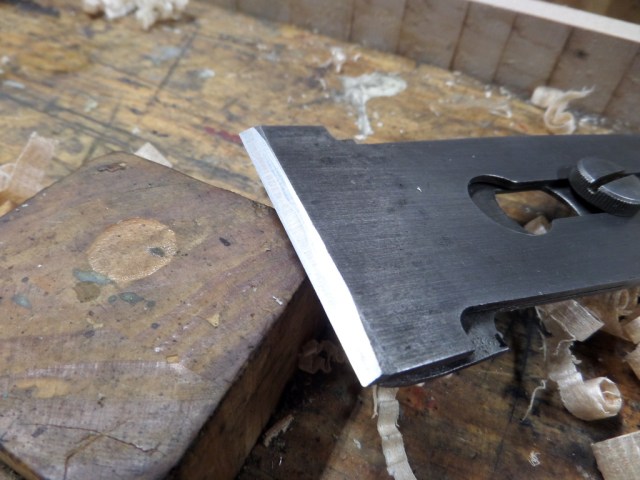
Since I ground some of the thickness of the sides away, you can see where the blade protrudes farther out of the side than normal. I could grind away the sides of the blade, but I wanted to wait and see how it performs first. If I was able to cut a clean rabbet with the way it was, I would just leave it alone.

SAMSUNG CAMERA PICTURES

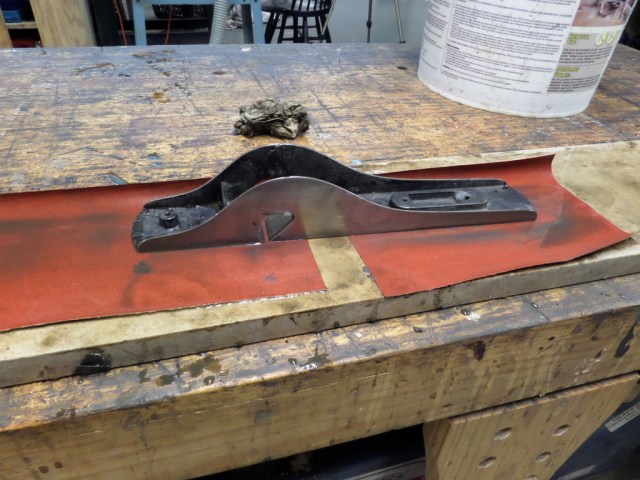
Here she is after all the work has been done. It looks a lot better than the way I bought her, but I still needed to see if she works.

SAMSUNG CAMERA PICTURES

After setting the blade to the right depth, I tried it out on a scrap piece of wood. It cut nice little shavings with ease and can now be put in my arsenal of planes for use. Even though I spent a good day tuning this plane up, it gives me great satisfaction resurrecting an old tool back to life. Plus it saved me a ton of money versus buying a new rabbet plane.

SAMSUNG CAMERA PICTURES

A Saturday Afternoon at an Estate Auction

Not much has been going on lately with woodworking, but I have been picking up some more tools. Yesterday I went to a local estate auction and scored some serious tools. I saw the auction on AuctionZip a few days ago, but they only had a couple of pictures of a few tools. When I arrived at the auction and took a look around, I nearly crapped myself when I saw all the tools that were sitting on the tables.

 photo 20150627_152847.jpg

I have a blast at auctions as you can see with my winnings. I always try to remain reasonable and not get too carried away with my bidding. Fortunately, there weren’t a lot of tool collectors at the auction, so I was able to buy a whole bunch. In fact, most of the time I was bidding on several tools at once in one box.

 photo 20150627_152851.jpg

At the end of the day, I brought all the tools down to my basement and tried to calculate how many tools I actually bought. I had to separate the good tools from the junk that was packed in the boxes. I won a about a dozen junky block plane beds that ended up in the garbage can.

 photo 20150627_152909_1.jpg

In the end, I bought over 150 tools with nearly 100 planes. I’ll be busy over the next few months cleaning all these babies up.

 photo 20150627_152920.jpg

My first winning bid was for a box of steel wool for $8.00. I use a lot of steel wool when cleaning tools and I’m sick of buying those little packs for $5.00 at Lowe’s. I should have enough steel wool here to last me a couple of years.

 photo 20150627_152929.jpg

Probably the best buy of the day was this old BedRock 605 plane. It should be cleaned up and for sale in a few weeks.

 photo 20150627_152950.jpg

Using a Lion Miter Trimmer

A couple of weeks ago I posted on a Facebook page called “The Collectors of Antique/Vintage Tools” about a Lion Miter Trimmer I just restored. A few people in the group replied to my post asking what the tool did. I was surprised that so many people weren’t aware of this tool, that I decided to talk about it here.

 photo mitertrimmer002.jpg

I’ve owned an AMT miter trimmer for over twenty-five years and love it. They are simple tools that were popular for people who made picture frames back in the day. You use it by swinging the arm pulling the knife through the piece of wood, slicing off perfect little curls precisely at whatever angle you set the fence at.

 photo mitertrimmer030.jpg

The miter trimmer has fences on each side that can be positioned between 90 -45 degrees. There are adjustable stops at 90 and 45 that can be fine tuned with a screwdriver. Once you swing the fence to whatever angle you want, you tighten the wing nut on top locking the fence in place. As you can see in the photo, this machine also has layouts for 60 and 67 1/2 degrees.

 photo mitertrimmer004.jpg

After fiddling with the machine for a few minutes, I positioned the adjustable stops precisely were they needed to be. As you can see, the stop is a little shy from the 45 degree scribe line on the bed. I’m not sure why this is, but the tool is probably over 100 years old, so it’s allowed to be off a little.

 photo mitertrimmer005.jpg

You can see how the tool slices off perfect little shavings. When I was restoring the tool, I took the knives off and sharpened them on my Tormek using the Tormek knife jig. Before I sharpened them, the knives couldn’t cut butter.

 photo mitertrimmer031.jpg

 photo mitertrimmer007.jpg

The main reason I love my miter trimmer is that it cleans up the cuts that are made from my miter box and saw. For safety reasons when doing delicate trim work, I like to use my little miter box instead of a powered miter saw.

 photo mitertrimmer022.jpg

However, the saw doesn’t leave the wood with a nice enough cut.

 photo mitertrimmer026.jpg

Not only that, the miter box doesn’t even produce a perfect 45 degree angle throwing the two pieces out of square.

 photo mitertrimmer025.jpg

Here are the two pieces after they’ve been trimmed up with the miter trimmer.

 photo mitertrimmer019.jpg

The proof is in the pudding here. All the joints fit nicely together and the frame is a perfectly square inside. No wonder why picture framers loved these things.

 photo mitertrimmer006.jpg

Another good use of a miter trimmer is doing outside corners like attaching molding to a bookcase or cabinet. Here is a piece of molding that I cut with one of my molding planes.

 photo mitertrimmer012.jpg

If I stick the piece in my miter trimmer and try to trim it up normally, you can see how the inertia of the cut pulls the molding off the bed. There’s simply not enough surface area in the front of the molding to keep the piece stable.

 photo mitertrimmer011.jpg

The cut it produces this way is garbage. Not only is it not 45 degrees, it’s not even a straight cut.

 photo mitertrimmer027.jpg

The way to get around this, is to take the body off a combination square and clamp it to the fence of the trimmer. Use a scrap piece of wood and cut a 45 degree angle to the end with the trimmer. Then use the cut as a gauge to accurately place the combination square under it. It’ll take a little time and a few test cuts, but once you have the combination square properly position, you’re ready to go. Note: You can buy an attachment from Grizzly for about $30 which does the same thing as this, but I’m not sure if it will work on old Lion Miter Trimmers.

 photo mitertrimmer010.jpg

Now you can use the bottom of the molding to rest against the fence for support and make a perfect 45 degree cut.

 photo mitertrimmer013.jpg

 photo mitertrimmer015.jpg

Repeat on the other side of the trimmer for the other side of the molding and you’ll get a super clean and accurate joint.

 photo mitertrimmer017.jpg

Unfortunately, the website for the original Lion Miter Trimmer no longer works which makes me believe they are no longer in business. http://www.lionmitertrimmer.com It’s a shame because the tool is truly an awesome piece of machinery.

Roubo Style Workbench

Walking around an antique store called Ohio Valley Antique Mall in Cincinnati this weekend, I ran upon this massive beast in one of the aisles. An eight foot long authentic Roubo style workbench. I’ve seen dozens of old workbenches before, but for some reason this guy stuck out to me. The previous owner screwed nickel-plated hooks on the front of it for someone reason. Probably to hold coffee cups or some other nonsense.

 photo 20140831_125018.jpg

What made this bench stick out was the splay of the front leg along with the leg vise. I imagine this was done to prevent the workbench from racking when sawing. The cast iron vise hardware turned smooth and could still tighten with something with a good grip.

 photo 20140831_130955.jpg

It had an old planning stop hole used for planning boards. Oddly the area around the hole was all worn down. When I see wear marks on old pieces like this, it makes me wonder what type of work the craftsman did to make those types of marks. Though it does appear he was sawing on the right side of the planning stop.

Another interesting clue is that it is quite possible that at one point there was another vise installed on top. The three holes around the lighter circular area is possibly where he bolted down a machinist vise onto the bench.

 photo 20140831_130947.jpg

The legs were jointed together with a simple bridle joint however, the legs were not jointed into the bench’s top. More likely the top was just bolted down to the legs somehow. I didn’t feel like moving everything around in the booth to get a better look.

 photo 20140831_131003.jpg

The bench top was a good 12″ wide x 4″ thick piece of pine. It had a tool tray in the back that appeared to be in real good shape given it’s age. Notice how there are no bench dog nor holdfast holes in the top.

 photo 20140831_131011.jpg

Who knows where this bench will end up. Probably in someone’s home as a kitchen island, but for a cool $700 it can be all yours.

 photo 20140831_125018.jpg

World’s Longest Yard Sale: US127 Corridor

My wife and I just returned from a five-day excursion on the The World’s Longest Yard Sale down US 127. The yard sale runs every year during the first weekend of August from Michigan down to Alabama. Last Wednesday, my wife Anita rented a Ford F-250 cargo van and we headed down to Chattanooga TN to spend the night. We picked up 127 around the Kentucky Tennessee border stopping at multiple yard sales running all the way to our hotel in Chattanooga. The next day we started heading up 127 back home.

Anita was looking for old furniture to fix up as well as things she could sell in her booth. I was looking for antique tools. We traveled over 1200 miles in five days traveling from Chattanooga, TN to Castine, OH and had an absolute blast. Nothing more fun than the thrill of the hunt. We ran into a little trouble at the top of Tennessee though. It was around 7:00 pm and we didn’t have a hotel booked. We drove all the way to Danville, KY hoping that a hotel on US 127 would have a room but they were all booked. We ended up driving all the way to Lexington, KY to find a room. The next day we got up and had a nice breakfast in neat little restaurant and headed back to Danville, KY to continue up US 127.

I picked up mostly a bunch of planes, some of them needing major cleaning, with a few miter boxes near the end of the trip. What’s amazing about my finds is that most of the planes I had bought had corrugated bottoms. I wasn’t specifically looking for corrugated planes but when I turned over a plane I was interested in, its bottom was corrugated. Twelve of the fifteen planes were that way. Amazing since corrugated planes are not as common as flat bottom planes in the market.

This is the shot of the bottoms of the planes with nearly all of them being corrugated. It’ll take a while but every one of these planes will be cleaned up and ready to be put back to use.

Near Danville, KY I ran into a guy selling a trailer full of cherry hardwood. I couldn’t buy the whole trailer but I did manage to pick up one of his slabs. This piece is 2″ x 16″ x 100″ and the offer was too good for me to pass up. Does anybody want to guess what I paid for this slab of cherry? Post a comment and I’ll let you know.

Oh Boy, I Did It Again

Well I went to another antique tool auction yesterday. This one was in Jeffersonville, OH about half way between Cincy and Columbus and good deals were to be had as you can see in the photo.

I only picked up a few Stanley bench planes. After the auction I went to in Indy a couple of weeks ago, I have enough Stanley planes to last me awhile.

I’m a sucker for molding planes and these were too good of a deal to pass up. Several of them I snagged for under $10.00 each.

All the profiles of the molding planes I bought. I realize that you can make nearly every molding profile with a good set of hollow and rounds which I already have, but I can’t resist the opportunity to buy some complex molders. Some of these I’ll keep for myself, the rest I’ll sell.

I also picked up a few hand saws as well for under $5.00 a piece. Three of them were Disston thumb hole saws that are gaining popularity on eBay lately. I’ll clean them up and throw them on eBay to see what they bring.

Here’s a neat pair of shears I picked up for $6.00. I really don’t know anything about old shears and have no idea what they’re worth but my wife will stick it in her booth for sale.

A couple of sash molding planes a froe. I had a nice sash molding plane before and sold it only to regret it later so I’ll probably keep one of them. I’m definitely keeping the froe. Working green wood has always been an ambition of mine and this froe will come in handy. It looks like it was made from old leaf spring from a car.

The two scores I got were a Stanley No 141 with the fillister bed and blade and a Stanley No 603C corrugated bench plane. I may hold onto the 141 until I find some regular blades for it and then sell it.

All I know is that I’m going to be very busy for a while cleaning all the tools I bought this past month.

Repairing a Desk’s Legs

My wife Anita won this desk at a local auction a couple of weeks ago. She loved the curves of the desk and wants to use it for sewing. What she’s going to sew I have no idea but that ‘s what she wants it for. It was in decent shape with a few spots where the veneer needed to be glued down and the leg needed to be glued back to the frame but that’s easy stuff to fix. What really needed attention were the two legs in the back that were missing part of their feet.

More than likely, sometime in the past the desk sat in some water and both back feet became unglued from their leg. I knew Anita was planning on painting it so I just grabbed some straight grain cherry about 1″ thick and glued it onto both back legs.

Once the glued dried, I started filing away the wood trying to recreate the swoop of the pad. Since the bad legs were in the back, it wasn’t entirely necessary to make perfect matching feet with the ones in the front since no one would really see them while the desk was against the wall but I still wanted to give it my best shot.

I used a variety of rasps and MicroPlanes to shape the curve into the foot. I’ve made cabriolet legs before so I had a basic understanding of how to shape them. Once the general shape was created, I drew the bead onto the blank and used my Dremel to carve it in.

After shaving was completed, 80 and 150 grit sandpaper finalized the foot. I was quite pleased with the results.

One foot down, one to go. It took about 30 minutes for me to finish one foot listening to the Bengals game on the radio.

After I was done with both feet, I flipped over the desk to see how it looks. Not too shabby. Once the desk is painted no one will know that the feet where redone. Anita was impressed as well. She didn’t think I would have been able to match the two in the front. I guess I’m good for something.