
A few moths ago my wife, Anita, and I picked up some old barn wood flooring in Dayton to be used for a harvest table she wanted me to build for her booth. While the wood sat in the basement, she kept looking for the right legs to use for the table. In the end, she opted for me to make some out of Douglas Fir 4×4’s I could buy from Lowe’s. She searched Pinterest for a leg she liked and printed off a picture so I could make it.

I looked at the picture and started to turn something like it on the lathe. I kept the top of the leg similar to the picture, but changed the bottom to be a bit more simpler. After a few tweaks, I was happy with the end result. Now the challenge was to make three more legs that matched this one.

I used a piece of scrap wood and marked every major location where there was a bead or valley in the board. I then used calipers to measure those increments and carefully tried to copy them to the next turning.

After several minutes of careful turning, my second leg looked very similar to the first one on top. Even if the legs weren’t exactly the same, it was fine as they would be far enough away from one another that your eye wouldn’t be able to see the difference.

If you’ve never turned Douglas Fir, I highly recommend it. It sucks..sucks bad. The crap chips like crazy even with sharp turning tools. Fortunately since the harvest table was suppose to look old, the chips wouldn’t be a big deal.
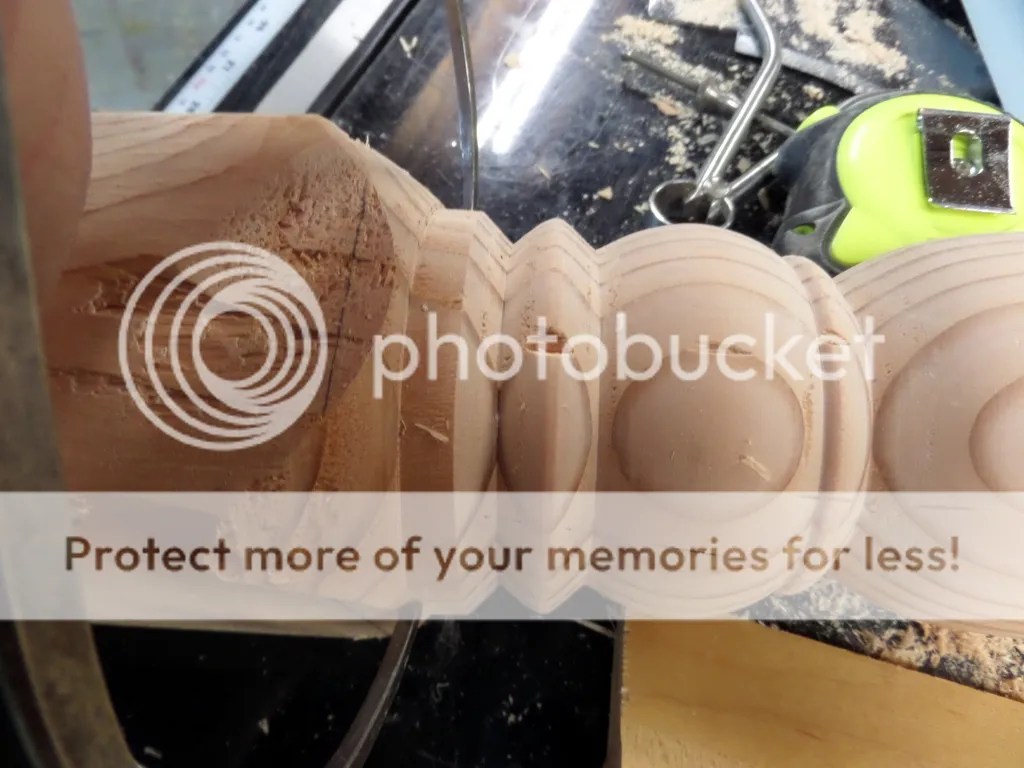
After a couple of hours, I turned four legs that sort of looked like one another. The final step was to put them back on the lathe and use my parting tool to cut them at all the same length which was 30″ tall.

The simplest part about building the harvest table was actually building it. I simply screwed the skirt onto the legs using 2″ screws. I didn’t even bother plugging the holes.

I used cleats and pocket hole screws to keep the sides from bowing. I then attached the top onto the cleats using 1 1/4″ screws. Super simple.

This was the table before sanding the grime off the boards.

This is the table after a couple coats of white milk paint.

As you can see, once sanded, the milk paint gives the table a nice worn look. Even though this table breaks three of the seven deadly sins of woodworking, it works for it’s intended purpose. Just don’t expect to see it in a woodworking magazine anytime soon. All that matters is that Anita is very happy with it and finally has the harvest table she has always wanted.


 MVFlaim Furnituremaker