

I just hope I can clean him off before my wife gets home.
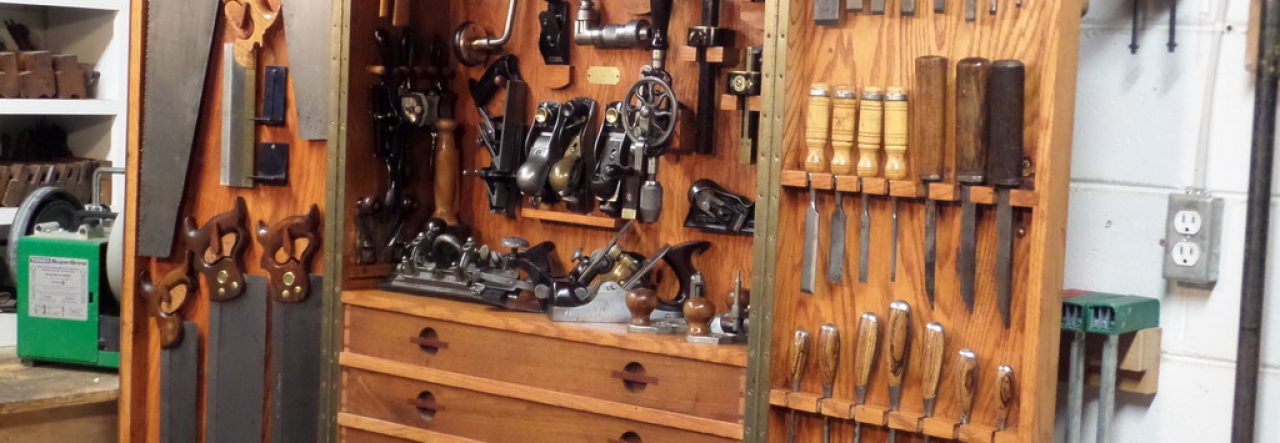
I just hope I can clean him off before my wife gets home.
If you get into woodworking much, you’re bound to get tired of always building square cabinets and start incorporating curves into your work. With modern woodworking equipment, it’s easy to cut shapes on the band saw then clean up the edges with random orbit sanders but if you’re a hand tool enthusiast, there is a long forgotten plane you should bring into your arsenal.
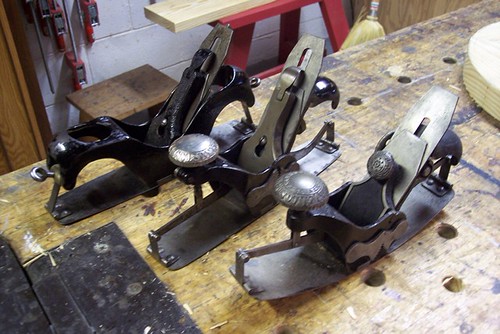
Stanley made several versions of circular planes in their hay-day. Out of the three versions; Stanley No 13, No 20, and No 113, the No 113 is by far the most commonly available in the marketplace. When Stanley introduced it, sales took off because its top center wheel allowed the user to adjust both sides of the bed at the same time.
The 113 came in different versions as the years went by. A side-wheel blade adjuster later became the more common Bailey blade adjuster. My personal No 113 is the side-wheel adjuster. It was the first 113 I ever bought and I tuned it up nicely. However many people prefer the Bailey adjuster since it works just like a normal bench plane.

By turning the top center wheel, you flex the bed in a concave or convex shape. The shape of the bed doesn’t necessarily have to be the exact shape of the wood you’re planing. The idea is to support the bed enough so that the blade will make constant contact with the wood.

The blade on a 113 is the same width of a Stanley No 3 so finding replacement blades shouldn’t be a problem. In fact, the mouth is a large enough at the base you can even use after market blades from Hock or Lie-Nielsen. However, after market chip breakers will not work because of the position of the frog adjustment tongue hole.

Using a circular plane is much like using a spokeshave. You want to plane down the grain as much as possible which means you’re going to constantly change the position of the plane on the work piece. If you plane up the grain, you’ll get blade chatter and tear out as the plane will literally bounce off the work piece. Skewing the blade at an angle will help produce a better cut as the blade will shear the wood fibers the same way a vegetable slicer cuts a cucumber.

Because of the divergent and changing grain, it’s critical that your blade be sharp. When planing, you’ll often produce two types of shavings. The first being regular shavings as you plane with the grain, then finer curly shaving as if you were planing end grain.

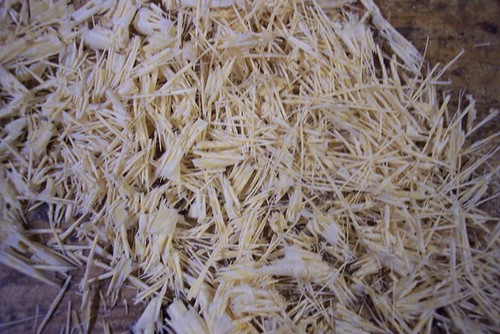
The true benefit of using a circular plane is the consistency you get when shaping the curve. Any high spots will get planed first revealing low spots in the work piece. After more planing, the piece will take on a consistent shape.

If worst comes to worst and you can’t remove plane chatter and tear out due to the grain rising, you can always remove it and smooth the shape with a sharp spokeshave.

One of the most common misconceptions about using circular planes is that people think that they only work with wood that is circular in shape. That’s simply not true. You can plane ovals and soft curves just as well. In fact a few years ago when I built my Roubo workbench, I used the No 113 to finalize and smooth the shape of my crochet.

The only manufacturer that makes a new circular plane nowadays is a company called Kunz which will run you $300 on Amazon. I have never used one so I can’t tell you how well they work. Neither Lie-Nielsen nor Lee Valley have versions of their own so buying an old Stanley may be your best bet. They run between $100-200 depending on condition. All I know is that if you’re in the market for one, buy it now before Chris Schwarz writes a blog about them making their prices double.

When I was thirteen my Grandpa gave me this Stanley No 77 dowel making machine. I was just getting into woodworking at the time and the machine sitting on top of a cabinet in his shop caught my eye. When I asked what it did, he told me it makes dowels out of any wood you shove into the cutter. It was the coolest thing I had ever seen. A few months later he ended up giving it to me and I have kept it to this day as something I would never sell.
After being diagnosed with NMO/Devic’s Disease earlier this week, I started to put things into perspective. With treatment, I should be okay but the vision loss in my left eye and the tightness in my legs and groin may never get better. Nevertheless, I realize what is truly important in life. I think of all the tools I own and the tools I’d like to buy if I’d just had the money.

I have wanted a Apollo HVLP sprayer for the past few years but they’re about $800-1200. Not the kind of cash I have just lying around. So I keep looking at some of the tools I own but never use to help pay for the sprayer. The dowel making machine is on top of the list.
I’ve kept the dowel machine for sentimental reasons along with its cool factor. The only problem, is that I never use it. I’ve owned it for over twenty-five years, probably longer than my Grandpa, and have only played with it a few times. I really don’t think my Grandpa used it either. My Grandpa was more of a mechanic than a woodworker restoring old Model T’s when he was alive. The only time he got involved with woodworking was when he repaired the spoked wheels on the cars. I never saw dowels lying around his shop where he was cranking them out with his Stanley No 77. So why did he own it? I have no idea. Maybe he picked it up at a yard sale thinking it would come in handy someday.
It may be the very reason he gave it to me. Since he never used it, he thought with my budding woodworking aspirations that maybe I would. But I never have. I don’t use dowels all that much, and when I do, I go to the store and buy some. Even if I needed a dowel out of a certain hardwood, I could simply turn it on the lathe. Not only that, but the only cutter I have for the dowel machine is 3/8″ so I’m screwed if I need a different size. Forget about buying additional cutters for it. They run about $100 a pop and a $100 will buy a whole bunch of dowels.
Screw it, I’m done. I’m selling the machine and using the money toward a HVLP sprayer. Something that I’ll actually use. I don’t think my Grandpa would care.
 MVFlaim Furnituremaker