Building a Shed Part XII

While browsing through the Weaver Barn catalogue, Anita saw this cool looking arbor over a couple of doors. We decided that an arbor like this would look really nice over our side window.

 photo 20161022_120709.jpg

To begin construction on the arbor, I grabbed some scrap cedar I had from building the shed and made about 24 slats. The slats were about 1  3/4″ wide by 13″ long with a little 1″ arch at one end.

 photo 20161022_115046.jpg

Designing simply from a picture can be tough, so I grabbed a scrap piece of 6″ wide cedar, cut out a 4″ diameter arch and placed it around my corbel to see how to design the overall arbor.

 photo 20161022_121136.jpg

The distance between the corbels is 6′ with the overall length of the arbor being 87″. I originally planned 25 slats about 3 1/2″ apart, but Anita thought it was a little too many slats.

 photo 20161022_144036.jpg

We ended up deciding to use 21 slats 4″ apart. I wanted the slats to fit in place so I cut some dadoes in the wood to house the slats. Using  my dovetail saw, router plane, and rasps, I easily cut the dadoes in no time.

 photo 20161023_131336.jpg

I cut a small dado on each of the slats as well and test fitted the arbor together.

 photo IMG_20161023_130104.jpg

Since the slats had a dado, I decided the corbels should have dadoes as well to keep everything in line.

 photo 20161023_111052.jpg

I also wanted the arbor to fit inside the corbels so I cut notches in both the front and back where the corbels would go.

 photo 20161023_115614.jpg

I fit everything back together and drilled the slats to fit on the front and back. I used stainless steel screws so that they wouldn’t stain the arbor like galvanized screws would.

 photo 20161023_133945.jpg

Dry fitting everything together the arbor started to come together nicely, so it was time to stain it.

 photo 20161023_134513.jpg

I stained the arbor the same Benjamin Moore Cedar Bark stain we used on the shed.

 photo 20161023_145637.jpg

However, after living with the color of the stain on the shed for a few weeks, we weren’t too happy with the color. So, after the first coat of Cedar Bark from Sherwin Williams, Anita mixed in a pint of Leather Saddle Brown with a touch of Fresh Brew stain from Benjamin Moore. Since all three stains were water based, they mixed together well.

 photo 20161027_152844.jpg

After I applied the new coat, the cedar took on a much warmer color. We were very pleased.

 photo 20161027_152903.jpg

Anita helped me install the arbor so I don’t have any pictures of it being installed as I wasn’t in the mood to tell her to hold onto the arbor while I stop and take some pictures. I started out measuring the length of the window frame and calculated how much on each end the corbels would need to be in order for the arbor to be in the middle of the window. The window frame was 67″ while the distance between the corbels was 72″. That left me with 2 1/2″ on each side of the window. I marked the spot and then decided how far above the window I wanted the arbor to be. Once I got that measurement, which was 2 1/2″ as well, I nailed the left corbel in place with 2 1/2″ galvanized pneumatic nails. Then, I placed the arbor on top of the corbel, leveled it, and then shot nails in the arbor itself, attaching it through the siding into the studs of the shed. I then screwed my stainless steel screws through my pocket holes attaching the arbor to the corbel to tighten everything up. Next, I took the right corbel and stuck it up into the recess of the arbor, nailed and screwed it up just as I did to the left one. Finally, I screwed and nailed the back side of the arbor to the shed.

 photo IMG_20161030_155615.jpg

As you can see, I think we made a good decision darkening the cedar stain. The cedar looks richer and blends better with the gray paint.

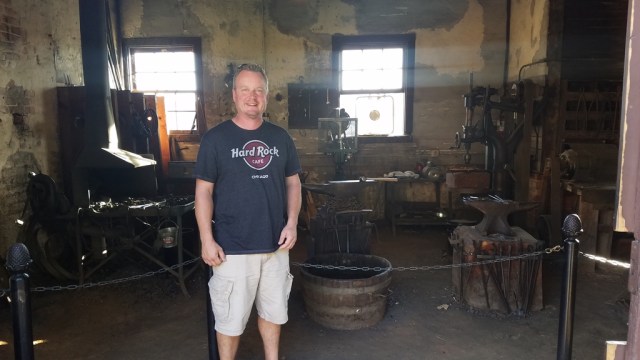
 photo IMG_20161031_100223.jpg

The Workshops of Biltmore

Last week, my wife and I went to the Biltmore Estate again for the fourth or fifth time. If you’ve never been there, there’s a little village on the estate where you can visit a farm, workshops and the ever important winery. Every other time we’ve been to Biltmore, we spent too much time at the house and the winery that by the time we arrived at the village, the workshops were closed. This year we decided to see the village before we headed inside the winery.

20161018_172504

I took some quick shots of the blacksmith shop and the tools they use. After I took these pictures, the blacksmith came back and showed us how he made coat hooks with a rose on the top (sorry, no pic). It was late in the day, so all the anvil work was done, he was simply polishing them up on a wire wheel. Biltmore sells these coat hooks in their gift shop for $42.00 each, but they sell as soon as he’s done making them.


If you’ve never used a blacksmith vise, you need to get one. I use on in my workshop and they are far superior than a table top machinist vise.


Not sure of the weight, but it looks like a 300 lb anvil. He had a smaller one in his shop right next to this one.


The overall working space of his shop was about 10′ x 15′


Right next door to the blacksmith shop was the woodworking shop.


Inside was a bunch of tools I’ve seen before except for this cool little foot powered mortise machine.


The woodworker wasn’t around so I don’t know what his responsibilities are for Biltmore. He could just make things for the gift shop, or he may do some repair work around the estate.


The majority of the tools were old, but he did use electricity. I couldn’t really see what was inside the tool chest on the right.


By the looks of these planes, I question whether or not he uses them, or if they are there just for show. A little too much dust and cobwebs on them for my taste.


A newer lathe sat in front of the older one. He spent his day making these turn of the century ball in the cup toys.


If you ever get a chance to go to the Biltmore Estate, make sure you give yourself enough time to visit the village before you head into the winery and get drunk like we did. haha

Building a Shed Part XI

We’ve been building this shed for over a year now. Between the cold of the winter and the heat of the summer, this has been the biggest project I have ever taken on. The past few weeks, we’ve been preparing the shed for paint.

 photo IMG_20160925_104425.jpg

I sanded the body of the shed with 80 grit sand paper with my random orbital sander. This allowed me to take off the glaze from the mill when the wood was being processed.

 photo 20160925_123326.jpg

The doors and corbels were sanded to 150 grit because we were planning on staining these elements. I filled the nail holes with some outdoor wood putty as I wanted the doors to have a finished look without a bunch of nails holes in them.

 photo 20160925_123301.jpg

My wife, Anita, went to Ace Hardware and bought Aura paint and primer by Benjamin Moore. This paint isn’t cheap at $70 a gallon, but we wanted to make sure the shed had the best finish on it so we wouldn’t have to repaint it every other year.

 photo 20160925_123338.jpg

With two coats of primer on it, we let the shed sit for a few days before we applied the top coats.

 photo 20160927_161607.jpg

The body was painted with two coats of Galveston Gray.

 photo IMG_20161002_134906.jpg

The shed was starting to look really nice. The top trim and the windows would be painted with Iron Mountain.

 photo IMG_20161002_164602.jpg

We picked Cedar Bark stain from Sherwin Williams for the doors and corbels. The shed is nearly done, but I still need to make a trellis over the side window and build a small deck underneath the doors. Getting real close.

 photo IMG_20161015_150738.jpg