Making a Roubo Style Workbench Part 3 – revisited

When I went to Woodworking in America Conference in Berea, KY last year I saw Roy’s Roubo bench. The bench’s back legs were splayed out because he had a tool tray at the back. When I went to shake the bench, it was a solid as a rock and I knew right there and then that I wanted to incorporate that feature into my bench even though I didn’t want a tool tray on my bench.

The legs of my workbench are made from 6 x 6 pressure treated post. I planed them down in a surface planer to about 5 1/4″ square as I wanted to remove as much of the wane form the post as I could. After surfacing them, I check to see how square the legs actually were. It turns out they weren’t square at all but rather each one was a rhombus. So I took each leg over to the jointer and squared one side to a face then returned to the planer to true them up to 5″ square.

I measured the back legs by laying a framing square flush to the top of the leg and measuring up 90 degrees to the top to mark where the leg hit 33 on the tape measure.

Now I was ready to cut them to length. The bench will be 33″ tall so the two front legs will be 33″ long since they will protrude through the top. I cut each leg using my circular saw flipping it at each pass and cleaning up the end using my low angle jack plane. I measured the back legs by laying a framing square flush to the top of the leg and measuring up 90 degrees to mark where the leg hit 33″ on the tape measure. I cut the leg to size with a pass on each side finishing up in the middle with a handsaw.

Back leg tenons are 2x 3x 4 long and are cut at a 20 degree angle. 

Bench top is upside down. Layout the mortises as accurately as possible.

I used a bevel gauge to align my drill and cut out the mortise with a 1 1/4 forstner bit. Drill half way through then flip the top over and finish.

I then laid out the tenons and cut them to size with my bandsaw finishing it up with my handsaw and chisels. Once I made the tenon I laid out the mortise on the bottom of my bench top. I used a 1 1/4″ forstner bit and drilled several holes at a 20 degree angle. Then I flipped the top over and finished the mortise from the other side. I pared to the line with chisels until the tenon slipped into the mortise with ease.

Once the back legs were cut, I laid out the rising dovetail on the front legs and cut to the lines using a back saw and trimmed to the line with a chisel. I then laid out the dovetailed mortise on the bottom and top of my workbench top and cut on the waste side of the line with a backsaw. Then I chopped away the center with chisels the same way you would chop out the waste material on a half blind dovetail joint. The trick in making a rising dovetail work is for the ability of the top of the dovetail to fit at the back end of mortise on the bottom (if that makes any sense). In order to truly understand it, you need to read Roy’s book “The Woodwright’s Guide; Working with Wedge and Edge” where he describes the joint far better than I can. I read over the details of the rising dovetail in the book but it wasn’t until I actually tried to make the joint did I fully understand how it is done. The best thing about the joint is that it looks impossible when you see it for the first time. The joint can not slide down nor can it pull out due to the double dovetails. The trick is the joint drops down at an angle.

Once all the joints were cut, I fitted them in the mortises and examined how well each leg was level with one another. Luckily they all lined up fairly well. Then, I flipped the bench over to see how well it sat on the floor. There was a little bit of rocking due to my basement floor not being level but when I cut the through mortises in the legs and temporarily fit the side stretchers, the bench became a lot sturdier. Next, I’ll work on the base and install a shelf to hold my air cleaner.

Disclaimer: Some people may be apprehensive working with pressure treated lumber since it contains the harsh chemicals ACQ (Alkaline Copper Quaternary). If you’re uncomfortable working with pressure treated lumber, don’t use it. The main reason I decided to use it was for the additional weight it would give to the base. While building the base I did no sanding so there was no airborne dust present. In fact the only time I experienced any dust from the ACQ pressure treated lumber was when I emptied my dust collector bag from my surface planer.

I used to work for a pressure treated lumber company and have been exposed to CCA (Chromated Copper Arsenate) which was supposedly more volatile than ACQ due to the arsenate in the material. I handled CCA lumber on a daily basis for years yet I experience no side effects. I also experienced no side effects from handling the ACQ lumber i.e.; rashes, sneezing, congestion, etc. while building this bench as well as building my deck a few years ago. However that doesn’t mean you won’t. Use your best judgment if you decide to use pressure treated lumber.

As far as being in constant contact with the ACQ lumber, I believe it will be minimal at best. My top is built with regular southern yellow pine which is where I will be doing much of the handling of the bench. The base will just sit there undisturbed. I will have very minimal contact touching the base for any reason.

Making a Roubo Style Workbench Part 2 – revisited

Well after letting the wood acclimate and dry in my shop for about a month, I finally had the time to assemble the top. I took each board and planed them down to 1 1/4″ thick. Be prepared to have a boat load of shavings coming from your planer. I ended up filling four garbage cans with planer shavings. After surface planing, I straightened the boards the best I could with my transitional jointer. The boards were just too long for me try to joint them over my 6″ motorized jointer so I clamped each one to the bench and did it with a hand plane. It didn’t take that long at all and honestly I wasn’t looking for a perfectly straight edge anyway. I just wanted to get rid of the crook in the board so I could rip them to size on the tablesaw. After each board was ripped to 4 1/4″ wide, I laminated them into sections using five boards per section. The shorter part of the bench was laminated with seven boards.

After each section was dry, I ran them through the surface planer and planed them to 4″ thick. Then I glued two sections together. After that section dried, I glued the third. Then when that dried I glued the forth (you get the idea). I did my best to dry fit and line up the sections to minimize any hand planing once the top was formed. However, even after all the careful planning, I still ended up with an 1/8″ bow in my top. I’m not entirely sure why that was but if I had to guess, I say the bowing of my pipe clamps played a part. I’ve always heard of the limitations of pipe clamps and I think I found one of them. Clamping this massive behemith of a top was no easy task. I had to apply an extreme amount of pressure to get each section to bond tightly with one another. It was times like these where I wished I owned twice the amount of pipe clamps!

Once the top was glued together I grabbed my Stanley No 8C jointer and No 5C fore plane and went to town. I planed across and diagonal to the grain to level out the top as easily as possible. The 5C worked well to remove a lot of stock quickly. The No 8 was effective in leveling the high and low spots. Periodically I would check my progress with a straight edge (the side of my No 8 plane) and plane where necessary. I also used winding sticks to make sure the top did not twist from one end to the other. It took me an hour and forty five minutes to plane down the entire top but the funny thing was that I actually enjoyed all the planing.

Next I’ll make the legs and build the frame. I’ll keep you posted.

Making a Roubo Style Workbench Part 1– revisited

I wrote this blog three years ago at Fine Woodworking.com and decided that I should bring it home to my blog. It’s in five parts but I will add a sixth part at the end to tell how the bench has held up. Enjoy!
It’s 2009 and I still haven’t made a new workbench I promised myself when I bought an Emmert patternmakers vise at an antique tool auction in Indianapolis last spring. After the auction I bought Workbenches by Chris Schwarz and was planning on building the Andre Roubo bench he built in the book. Then a couple of months ago, while attending  Woodworking in America Conference in Berea KY, I  saw Roy Underhill’s version of the Roubo bench and fell in love with it. The bench was solid as a rock with its back legs splayed out and it didn’t rack from side to side. Something my current bench is horrible with. Luckily there’s a write up of Roy’s Roubo bench in his new book The Woodwright’s Guide; Working Wood with Wedge & Edge. Because there were things that I liked in both benches, I decided to incorporate some of the features of both and design something that would fit my needs.
The two books that are instrumental for building the bench.
The design of the workbench. My Sketchup skills are still nonexistent so I have to design the old fashion way.

The bench will be eight feet long and made out of Southern Yellow Pine with my Emmert vise installed at the end. I’m going to try something that I’m not sure has ever been done before and build the legs and the stretchers out of pressure treated wood. I just like the idea of the added weight with pressure treated wood. Plus, I was able to buy 6×6’s for the legs and save some money verses buying more 2x stock and gluing them up to create a 5”x5” legs the way Chris does. I calculated how much material I need and bought (12) 2x10x8’s, (4) 2x12x8’s and (2) 6x6x8’s. The total cost was $132.00. Not bad considering I paid $150 for a piece of 8/4”x 8”x60” walnut when I built my Pennsylvania Secretary a few year ago.  The reason I didn’t make the entire bench out of pressure treated lumber is because ACQ lumber is very corrosive to metal. You need to use hot dipped galvanized or stainless steel fasteners when working with it. Since my vise is cast iron, it would end up corroding if I used ACQ pressure treated lumber for the top.

The lumber stickered and ready to dry. I need to find my moisture meter so I can see how dry the lumber is before I mill it to size.

After letting the lumber acclimate in my shop for about a week, I ripped the boards in half so that they would dry faster. My wimpy little table saw doesn’t have enough power to rip through 2x stock without binding, so I had to set the blade a little under ¾” high and make two passes, flipping the board over after the first pass. Due to the high moisture content some of the boards started to crook immediately once I took them off the table saw. Once the ripping was complete, I stickered all the boards to let them air dry for a couple of more weeks. Once dry I’ll start milling them to size.

I don’t know how this bench will turn out using pressure treated lumber but I figure I can describe some of successes and pitfalls I encounter while building it. I’ll keep you posted

My Tool Cabinet is Ten Years Old

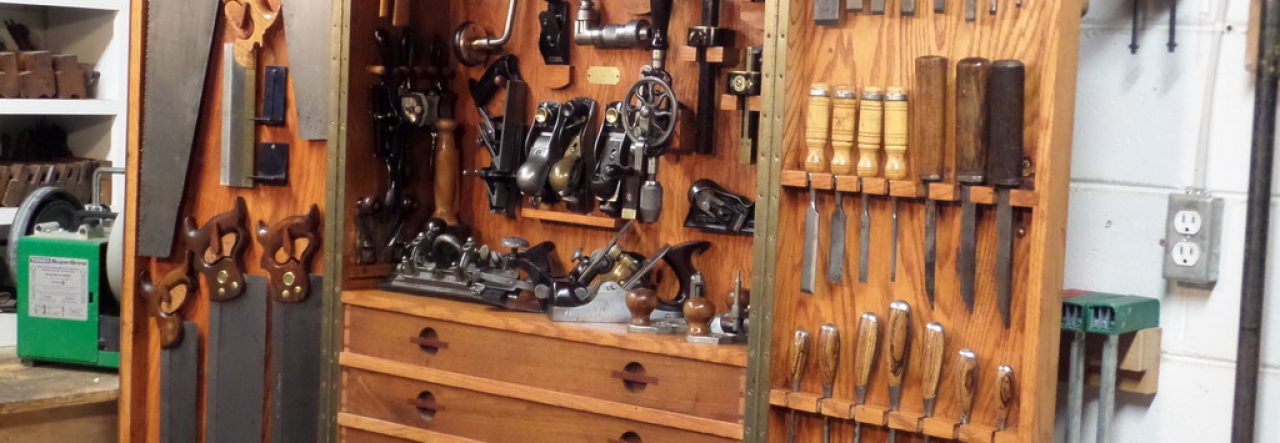
Ten years ago I finished up my tool cabinet that I built based off of Greg Radley’s tool cabinet in the Taunton Press’s book “The Toolbox Book”. Made out of red oak and walnut the cabinet stands 77″ high by 32″ wide and has served me well over the years but has repeatedly taken on a different look inside.

As you can see, when it was done in 2001, it stored a modest amount of tools. I had a few saws and chisels with a small amount of hand planes. The cabinet was complete but to me it was somewhat bare inside.

Fast forward ten years and you can see the transformation it has taken. A lot of the tools are still in the same place but a lot more have been added.

Today the cabinet stores a lot more hand planes. A symbol of my expanding woodworking knowledge. As my skills increased over the years, so too has my collection of specific hand tools. Today I understand the difference between using one type of plane versus another so my collection of old planes has grown. I’ve added scraper planes, rabbet block planes, infill smoothers, low angle bench planes, beading planes, specialized spokeshaves, microplane rasps, etc….

I usually update the tool cabinet about once a year pulling out tools I don’t use very much and hanging up tools that I will use more frequently. Removing old tools from the cabinet is no easy task as I am often left with the scars of where the old tools use to be. Cleaning out the cabinet you can see old holes where pegs once stood, ripped veneer where the block of wood holding up a tool tore of the face of the plywood and mis-tinted stain as I forgot what color stain I used to originally finish the oak.This is one of the reasons I used red oak for the carcass of the cabinet. Had I used a more expensive wood like cherry or mahogany, I would have been too apprehensive to change the design of the interior ruining perfectly good wood.

Today I use a lot of rare earth magnets to hold up tools and keep them in place. It’s far easier to drill a hole and super glue a magnet in it than to design some sort of holding system to hold up a tool. I wish I would have used rare earth magnets ten years ago when I designed the interior. It would have made it a lot easier to redesign the interior.

How the cabinet will look ten years from now is anyones guess. I will never call the cabinet complete. To me, this tool cabinet is like a website, it’s never done just updated with more usable content.

Making a Bed Part 3

Well it’s been a tough few days with my dog Rylee passing away but I finally pulled myself together and put the finish on the bed.

After sanding the parts to 220 grit sandpaper, I applied a Brown Walnut analine dye to the bed. I diluted the dye to a 4:1 distilled water:dye solution and applied a liberal amount to the bed with a sponge wiping off the excess. I’ve been told to use distilled water instead of tap water because the minerals in tap water may change the color of the dye.

The dye turns all the wood to a uniform color creating a base for the gel stain that will cover it. After I washed the bed with the dye, it looked like I grabbed a handful of mud and smeared it all over the place but I realized it’s just the first step in the process.

After the dye dried, I needed to coat the bed with de-waxed shellac so that the gel stain won’t penetrate the wood too much making the wood appear blotchy. I create my own 2 lb cut shellac by diluting 4 ounces of shellac flakes to 16 ounces of denatured alcohol. I keep the shellac in an empty glass maple syrup container.


Once the shellac is applied, the bed turned darker but was still nowhere the color I wanted it be. My wife came downstairs to look at the progress I was making and told me she hated the way it looked. I told her not to worry as I was only half way done.

Allowing the shellac to dry overnight, I was ready to apply my first coat of stain. I used one coat of General Finishes Nutmeg Gel Stain applying it with a piece of an old t-shirt and wiping off the excess with another piece of old t-shirt. I used a dry paint brush and brushed away any swirl marks left by the t-shirts. Fortunately the bed started to take on a brownish color removing the mud look after I applied the stain .

For the next color I used Minwax Rosewood Gel Stain but before I applied it, I coated the bed with another coat of shellac so that the new color won’t affect the nutmeg color giving the finish more depth.

Now the bed has the reddish hue color I’m looking for. All that is left to do is apply the top coat with Arm-R Seal polyurethane oil combo. Three coats of the Arm-R-Seal coat and a lightl sanding of 600 grit sandpaper and parrafin oil, the bed was ready to be put back together.

The bed is finally done and I was pleased with the outcome. It took me longer than the month I promised my wife but she was fine with the delay. I forget how much the bed actually cost me to build since I threw away the receipts, but if I believe it was around $300-$400. A far cry from the $1699 Pottery Barn wanted for their bed. Now to take it apart again and drag it upstairs.

Making a Bed Part 2

Well it’s been a few weeks since I blogged about making a bed for my wife but the month of October had some really nice weather. So nice that my wife and I decided to use the days to redo our screened in porch. Once that project was done, I moved back to the bed.

After the feet were turned and the top legs were made, I cut a couple of mortises in them to accept tenons for front panel. The tenons were cut using a router and hand saws and are about 3″ wide.

Next I needed to make the beaded details for the front panel and sides. I used my sticking board and a No 6 hollow molding plane to shape a round over on one side of a piece of wood that was 1/2″ thick x 1 1/8″ wide.


Glueing the beaded detail onto the boards was a synch with my Bow Clamps. The front panel only needed one bead on the bottom while the sides needed two. One on top and one on the bottom.

The top of the front panel is glued down in place with biscuits so that no visible fasteners will be seen. Once everything is glued together, the front panel is complete. The next part is focusing on the headboard.


The headboard started with a design on a 1/4″ piece of melamine hard board . I traced the pattern onto a piece of 1 3/4″ soft maple stock and cut it out on the bandsaw. Then I took another piece of 1 3/4″ and laminated a piece of 1/2″ on top of it to make the thickness I needed for the top rail of the headboard.


I shaped the bed rail into form by using my hollow molding planes. Using the right sweep of plane makes the job simple and quick to do. After cutting the tenons on the bed rail, I cut a sample tenon to use as a gauge to figure out where I needed to bore the mortise on the headboard sides.


Once I determined the location of the mortise, I simply bored it out with an auger bit and cleaned up the sides with a chisel. I then worked on the headboard rail bottom and the bottom rail for the slats. To make sure everything fitted fine, I tested fitted all the parts together.


Next I wanted to focus on the coopered panel front. The bed at Pottery Barn had coopered panels that were flush with its sides. My wife wanted the same look so cutting a groove in the sides and in setting the panel pieces into the groove wasn’t going to work. After studying the Pottery Barn bed, I decided to build it in much the same way they did. I shaped two pieces in an S curve and glued it to the sides. I use this curved part as the way to connect the slats onto the headboard by screwing them through the back.


Making the slats was fun. I took 1/2″ thick by 3″ wide boards and cut tongue and grooves in them with my Stanley #49 plane. I opened up the joint a little bit so the boards would fit sloppy in the groove and bend around the S curve.


Once all the slats were cut, I dry fitted them to the headboard and attached them with screws.


Once all the slats were in place, I glued the feet to the bottom. My headboard was assembled.

Now I needed to assemble all the parts. I test fitted the bed hardware and how the rails would attach to the front panel and headboard with a scrap of plywood.

Once I figured out where each piece of hardware went, I screwed it on and test fitted the bed. Cutting out some bed support slats out of poplar and glueing a support bar on to the sides, the bed was ready for final assembly.

Now I need to sand the entire bed and stain it a dark mahogany stain my wife wants.

Making a Bed

So my wife wants to buy this bed she found in a Pottery Barn catalog. They want $1500 for it but I told her I could make it for $400 and be done in a month. Neither promise I’m sure I can keep but she gave me the okay to give it a shot.

After looking at the picture I calculated how much would I would need. I bought enough to get me started. I glued up 3/4″ material for the sides and the front frame and bought some 1 3/4″ stock for the sides of the headboard and feet.

I wanted to start on the front legs and feet. Both are 4″ thick but I didn’t want to use that much material for the legs so I glued up four pieces of 4″ material and cut them at 45 degree angles.

I then filled the middle of legs with a laminated piece of 2×4 material about 4″ long. This is so that I can drill a hole in the middle and glue the feet upon them.

Next were to work on the feet. I glued up two pieces of 1 3/4″ and one piece of 3/4″ maple 10″ long to become the feet. I then squared it up on the bandsaw and marked out the center.


I didn’t want to take a full square stock over to the lathe so I marked out an octagon on the ends to cut off at the bandsaw. The easiest way to mark out an octagon is to take you compass and place one end on the center and the other end at one of the corners. Now take that layout and move it to each corner and swing a mark on both sides. When you mark around all four corners you’ll have eight marks. Connecting the two marks at each corner creates your octagon.

Now take the wood over to the bandsaw with the table set at 45 degrees and cut off the corners. Now you’ll have a block of wood that is a lot easier and probably safer to turn.

I studied the picture as best as I could but had to rely on guess-work as to where the curves started and stopped on the foot. I drew out a drawing of what I thought it looked like but only used the drawing as a guide. In the end I just used my own guess-work to determine the overall design of the foot.

Next was the hard part. I had to duplicate the next three feet to look like my first one. I used the original foot as a template and measured the diameters of all the curves and valleys with calipers so I could duplicate them. In the end I was happy with the way they came out even if they aren’t exact duplicates. Being that they will eventually be five to six feet away from one another, I don’t think anyone will tell.

I’ll keep you posted on my progress and let you know when my wife gets impatient.

Citric Acid, the new Evapo-Rust

I’ve been cleaning old tools ever since I was a kid. I fell in love with the way they looked and wanted to make them look better by cleaning all the rust off of them. After all, when they were in use in someone’s shop, the blade was sharp, the parts moved freely and the tool didn’t have a speck of rust on them. It was only after they were left for dead did rust start appearing on the metal making them appear unusable. I knew early on that with a little love, these tools could come back to life.

In the beginning, cleaning the rust off the plane was attacking it with 220 grit sandpaper. With lots of elbow grease I got the job done. Then after a few years, I moved onto using a flap wheel on my drill press. Rust removal was faster but left a cloud of rusted dust in the air. Something I had a hunch was not too healthy to breathe. I tried electrolysis for a while but thought it was too cumbersome and time-consuming hooking each part to a positively charged metal rod and battery charger.

Then while reading internet woodworking forums, I ran across a member talking about Evapo-Rust. I was intrigued and had to give it a try. I bought a gallon of it, poured it into a container, dropped the parts in, and let them set overnight. The results were amazing! Nothing I had ever tried worked so well with so little effort. There was only one problem; the price. I bought a five gallon bucket form a company called Nebraska Hotrod for $65.00. It would last about five servings worth of tool cleaning, pouring about a gallons worth of it in a container at a time.

Then this spring I read about citric acid. I’ve heard it mentioned before but I was so in love with Evapo-Rust that I thought nothing would work better. But the economy was tight, my wallet was thin and I was open to the idea of using it. Plus I was curious to see how it would compare to my beloved Evapo-Rust. I looked in my local grocery store for it but came up empty. I was told that it could be found at health food stores but eBay was easier and I found it available there. I bought 15 lbs of it for about $42.00 and received it within a week.

I poured one cup of citric acid in about a gallons worth of water and dropped my parts in just like it was Evapo-Rust. I use a 30″ window planter box as my container as it’s long enough for #8 jointers. I waited overnight for the results and was pleasantly surprised! My parts turned out just as well as if they had been sitting in Evapo-Rust.

The true benefit of citric acid is the price.  A cup of citric acid weighs about one pound and a five gallon bucket of Evapo-Rust would last me five servings worth of tool cleaning. So when you do the math, A gallon of Evapo-Rust cost me about $13.00 ($65.00/5 gallons) while a pound of citric acid cost me a meer $2.80 ($42.00/15 lbs). Now that’s a price that I can live with.

Restoring a Stanley No 7 Jointer Plane

Every time I see an article in a woodworking magazine about restoring an old plane, it’s usually a Stanley No 4 smooth plane. While a smooth plane is probably one of the most important planes to own, it certainly shouldn’t be the only plane you have in your arsenal of tools. A jointer plane is extremely handy for jointing the edges of boards straight as well as leveling the tops of wide panels flat. In fact I probably use my jointer just as much as I use a smoother.  So I decided to write a blog and show how easy it is to refurbish an old jointer and put it back to use.

The first thing I do when cleaning a plane is take it completely apart. Remove every single bolt and screw you can and lay them on the bench so you won’t lose them. Don’t worry about not knowing where each screw will go as the guts of a plane are quite simple and easy to put back together.

Next you need to get yourself a product called Evap-O-Rust. I buy it in a five gallon bucket as I clean a lot of tools but a couple of gallons at your local auto parts store should do you just fine. Fill a container with the Evap-O-Rust and submerge the parts in so that they are completely covered in the solution. If you don’t have the part completely covered, you will end up with an oxidized line on the part where the air and the solution meet. It’s also important to make sure that the parts of the plane are not lying on top of one another in the solution. You want to make sure that the Evap-O-Rust has the ability to penetrate the entire part. Let the parts sit in the solution overnight.

Once the parts have soaked overnight, take them out and wash them under the tap to remove any residue from the part. You’ll notice that the parts will be completely clean from rust but will have a dull finish to them. I like to take them over to a flap wheel sander and buff them to a nice satin shine.

After buffing the parts, wipe them with an oil protector called Kramer’s Antique Improver. I have been using this stuff for twenty years and have never come across anything that works better or is simpler to use than Kramers. It simply brings the metal and wood back to life. After wiping all the parts with Kramers, put the majority of the plane back together.

Now that the plane is clean, you’ll need to make it work. The first thing to do is grab something that is perfectly flat and place soaking wet 220, 320, 400, and 600 grit wet and dry sandpaper on top of it. I use an old marble window sill but the top of your table saw will probably work just fine. You will need to flatten the bottom of the plane so that it will be able to cut crisp clean shaving off. Start with 220 grit and work it over until you have uniform scratches upon the entire body. You actually don’t need to have the entire bed perfectly flat. Only the front of the bed, the front and back of the mouth and the back of the bed need to be co-planer with each other. If you happen to have a hollow area between the back of the mouth and the back of the bed, it’s perfectly fine. Once you have uniform scratch marks with 220 grit paper, switch to 320, then 400 and so forth until you have a nice clean bed with the 600 grit paper.


Next and most importantly, you need to sharpen the blade. I own a Tormek sharpener so I use my Tormek to grind a 25 degree bevel on my irons. After I sharpen and flatten the back of the iron with the fine grit of stone I switch over to my 4000 grit water stone and continue to sharpen the burr off. I then finalize the edge with my 8000 water stone. Sharpening to this magnification gives me an edge that stays sharper than simply using my Tormek alone.


Now it’s time to see the results of your work. Take a piece a wood and start planing it. You will need to adjust the position of the frog and depth of the blade in order to achieve a clean cut. Since you’re using a jointer plane the tolerances of mouth opening isn’t as critical as it would be for a smoother. You’re not trying to achieve .002″ thick shavings with a jointer. A jointer is a medium cut plane that is used to clean up joints and panels so that other planes can finish the job. A shaving of .005 to .010″ should work just fine.

With about an hours worth of work, you can a have a perfectly usable plane and save hundreds of dollars as opposed to going out and buying a brand new plane off the shelf.

**** Word to the wise: If you’re a beginning woodworker and are considering spending a few hundred bucks on a 6″ motorized jointer, pick up one of these hand jointers for $30.00 and learn to use it. I no longer even use my 6″ motorized jointer anymore.

UPDATE 4/17/17 — Forget about buying a Stanley No 7 for $30.00. Prices have gone way up since I wrote this post in 2011. If you buy one on eBay, you’ll pay $100 or more. If you’re lucky, you may find one at a flea market or antique show for less, but don’t count on it.

Discovering the faults of production type chairs

My wife and I were browsing Half Price Books tonight when a wooden chair caught my eye. What I saw was a screw on the top of the chair where the side was mortised into the top.  So I grabbed my phone and took a couple of pics.

I turned the chair around and I saw the tenon and how small it was in relation to the size of the mortise.

The amount of slop on the tenon was astonishing. Seemed like there was a 3/16″ play all around the tenon. I couldn’t tell how much difference there was between the thickness of the tenon and the width of the mortise but there wasn’t any glue residue on the tenon. You would think with all of the stress put on a chair that the manufacturer would be more attentitive to the proper size of the mortise and tenon joints in their furniture. Just another reason why it’s better to buy furniture from craftsmen who care about their work.