Using a Circular Plane

If you get into woodworking much, you’re bound to get tired of always building square cabinets and start incorporating curves into your work. With modern woodworking equipment, it’s easy to cut shapes on the band saw then clean up the edges with random orbit sanders but if you’re a hand tool enthusiast, there is a long forgotten plane you should bring into your arsenal.

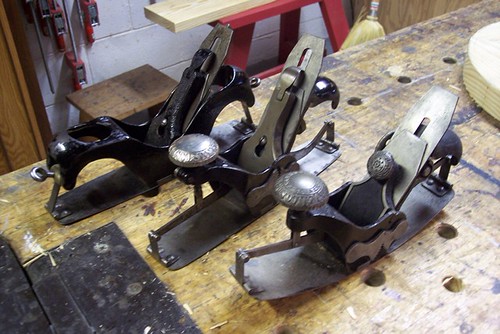
Stanley made several versions of circular planes in their hay-day. Out of the three versions; Stanley No 13, No 20, and No 113, the No 113 is by far the most commonly available in the marketplace. When Stanley introduced it, sales took off because its top center wheel allowed the user to adjust both sides of the bed at the same time.

The 113 came in different versions as the years went by. A side-wheel blade adjuster later became the more common Bailey blade adjuster. My personal No 113 is the side-wheel adjuster. It was the first 113 I ever bought and I tuned it up nicely. However many people prefer the Bailey adjuster since it works just like a normal bench plane.

By turning the top center wheel, you flex the bed in a concave or convex shape. The shape of the bed doesn’t necessarily have to be the exact shape of the wood you’re planing. The idea is to support the bed enough so that the blade will make constant contact with the wood.

The blade on a 113 is the same width of a Stanley No 3 so finding replacement blades shouldn’t be a problem. In fact, the mouth is a large enough at the base you can even use after market blades from Hock or Lie-Nielsen. However, after market chip breakers will not work because of the position of the frog adjustment tongue hole.

Using a circular plane is much like using a spokeshave. You want to plane down the grain as much as possible which means you’re going to constantly change the position of the plane on the work piece. If you plane up the grain, you’ll get blade chatter and tear out as the plane will literally bounce off the work piece. Skewing the blade at an angle will help produce a better cut as the blade will shear the wood fibers the same way a vegetable slicer cuts a cucumber.

Because of the divergent and changing grain, it’s critical that your blade be sharp. When planing, you’ll often produce two types of shavings. The first being regular shavings as you plane with the grain, then finer curly shaving as if you were planing end grain.

The true benefit of using a circular plane is the consistency you get when shaping the curve. Any high spots will get planed first revealing low spots in the work piece. After more planing, the piece will take on a consistent shape.

If worst comes to worst and you can’t remove plane chatter and tear out due to the grain rising, you can always remove it and smooth the shape with a sharp spokeshave.

One of the most common misconceptions about using circular planes is that people think that they only work with wood that is circular in shape. That’s simply not true. You can plane ovals and soft curves just as well. In fact a few years ago when I built my Roubo workbench, I used the No 113 to finalize and smooth the shape of my crochet.

The only manufacturer that makes a new circular plane nowadays is a company called Kunz which will run you $300 on Amazon. I have never used one so I can’t tell you how well they work. Neither Lie-Nielsen nor Lee Valley have versions of their own so buying an old Stanley may be your best bet. They run between $100-200 depending on condition. All I know is that if you’re in the market for one, buy it now before Chris Schwarz writes a blog about them making their prices double.

When it’s Time to Say Goodbye

When I was thirteen my Grandpa gave me this Stanley No 77 dowel making machine. I was just getting into woodworking at the time and the machine sitting on top of a cabinet in his shop caught my eye. When I asked what it did, he told me it makes dowels out of any wood you shove into the cutter. It was the coolest thing I had ever seen. A few months later he ended up giving it to me and I have kept it to this day as something I would never sell.

After being diagnosed with NMO/Devic’s Disease earlier this week, I started to put things into perspective. With treatment, I should be okay but the vision loss in my left eye and the tightness in my legs and groin may never get better. Nevertheless, I realize what is truly important in life.  I think of all the tools I own and the tools I’d like to buy if I’d just had the money.

I have wanted a Apollo HVLP sprayer for the past few years but they’re about $800-1200. Not the kind of cash I have just lying around. So I keep looking at some of the tools I own but never use to help pay for the sprayer. The dowel making machine is on top of the list.

I’ve kept the dowel machine for sentimental reasons along with its cool factor. The only problem, is that I never use it. I’ve owned it for over twenty-five years, probably longer than my Grandpa, and have only played with it a few times. I really don’t think my Grandpa used it either. My Grandpa was more of a mechanic than a woodworker restoring old Model T’s when he was alive. The only time he got involved with woodworking was when he repaired the spoked wheels on the cars. I never saw dowels lying around his shop where he was cranking them out with his Stanley No 77. So why did he own it? I have no idea. Maybe he picked it up at a yard sale thinking it would come in handy someday.
It may be the very reason he gave it to me. Since he never used it, he thought with my budding woodworking aspirations that maybe I would. But I never have. I don’t use dowels all that much, and when I do, I go to the store and buy some. Even if I needed a dowel out of a certain hardwood, I could simply turn it on the lathe. Not only that, but the only cutter I have for the dowel machine is 3/8″ so I’m screwed if I need a different size. Forget about buying additional cutters for it. They run about $100 a pop and a $100 will buy a whole bunch of dowels.

Screw it, I’m done. I’m selling the machine and using the money toward a HVLP sprayer. Something that I’ll actually use. I don’t think my Grandpa would care.

The Perfect Drawer Bottom Plane

I recently won an auction for a Record No 043 plow plane on Ebay from a seller in England. I have always wanted one of these but the prices for these things is a bit high in the States. Not too many of them were sold on this side of the pond so the collectors who have them want about $100 for theirs. The sad part is that Record is no longer in business so buying a new one is virtually impossible.

What makes this plane so nice is its size and simplicity of use. Its small stature and ease to set up makes it an ideal tool to cut the grooves in bottoms of a drawers. In the past, I cut these grooves on the table saw which meant I had to take off the riving knife on my table saw, set the blade to cut a kerf about a 1/4″ high, then move the fence over to widen the groove to the size of a piece of 1/4″ plywood that I was using. This set up was time-consuming and making the groove the perfect width on the table saw was not always fool proof accurate.

Setting up the plane is a synch. I simply used a 3/16″ brass bar to set the blade from the fence and the height of the depth stop. It came with a 3/16″ and 1/4″ cutter but I’ll probably just use the 3/16″ exclusively as 1/4″ plywood is actually 3/16″ thick.

I own a Stanley No 45 and could use it as a drawer bottom plane but the 45 is a little too big and awkward to use when planing such a delicate groove. At 5 1/2″ long, the Record No 043 is half the size of the 11″ long No 45 and grips easily holding the back of the plane in the palm of my hand. With a little practice one could learn to use the plane with only one hand as long as you can keep the fence against the stock tightly.

As you can see, it creates a perfect fit for 1/4″ plywood which is what I primarily use when building drawers. As far as speed, it’s just as quick to plane these grooves as it is with a table saw. A few passes with the plane and the groove is cut.

http://www.leevalley.com/US/Wood/page.aspx?p=69788&cat=1,41182

Even though the Record 043 is no longer made, Lee Valley released a small plow plane a few years ago. The Veritas Small Plow Plane is a nice plow as I was able to use one at The Woodworking in America show last year. At 9″ long, that plane is smaller than a Stanley No 45 but still a little bigger than the Record No 043. You can buy the plane with a set of five blades for $275.00 so the guys who want $100 for the Record No 043 on Ebay may not be such a bad deal after all.

Oh Boy, I Did It Again

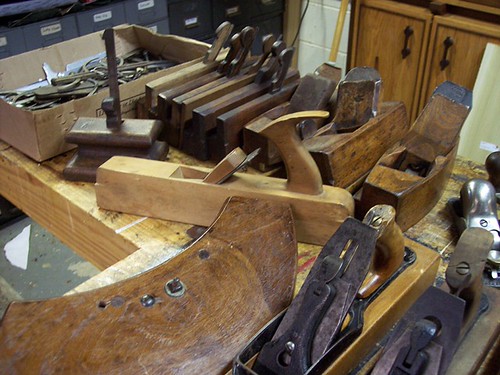
Well I went to another antique tool auction yesterday. This one was in Jeffersonville, OH about half way between Cincy and Columbus and good deals were to be had as you can see in the photo.

I only picked up a few Stanley bench planes. After the auction I went to in Indy a couple of weeks ago, I have enough Stanley planes to last me awhile.

I’m a sucker for molding planes and these were too good of a deal to pass up. Several of them I snagged for under $10.00 each.

All the profiles of the molding planes I bought. I realize that you can make nearly every molding profile with a good set of hollow and rounds which I already have, but I can’t resist the opportunity to buy some complex molders. Some of these I’ll keep for myself, the rest I’ll sell.

I also picked up a few hand saws as well for under $5.00 a piece. Three of them were Disston thumb hole saws that are gaining popularity on eBay lately. I’ll clean them up and throw them on eBay to see what they bring.

Here’s a neat pair of shears I picked up for $6.00. I really don’t know anything about old shears and have no idea what they’re worth but my wife will stick it in her booth for sale.

A couple of sash molding planes a froe. I had a nice sash molding plane before and sold it only to regret it later so I’ll probably keep one of them. I’m definitely keeping the froe. Working green wood has always been an ambition of mine and this froe will come in handy. It looks like it was made from old leaf spring from a car.

The two scores I got were a Stanley No 141 with the fillister bed and blade and a Stanley No 603C corrugated bench plane. I may hold onto the 141 until I find some regular blades for it and then sell it.

All I know is that I’m going to be very busy for a while cleaning all the tools I bought this past month.

The Nicest Plane You’ll (Probably) Never Buy

If you’re in the market for a smooth plane, chances are you’ll probably consider one of two options. Buy a new one from a top tool-maker like Lie-Nielsen or Veritas which can set you back $200-350, or buy an old Stanley and fix it up. However there should be a third option on your list.

The Millers Falls No 9 smooth plane is one of the nicest production smooth planes you can buy for the money. In most cases, you can buy one for a lot less than a comparable Stanley No 4 plane and get the same quality of plane.

The differences between a Stanley No 4 and a Millers Falls No 9 are minimal. Both planes use 2″ wide blades. Both are about 9″ long and weigh about 4 lbs. They both have a frog adjustment screw in the back (some older Stanley’s don’t have this feature). In fact, the only main difference between the two is that the Millers Falls uses a two piece hinged lever cap that supposedly holds more pressure on the blade and chip breaker reducing blade chatter.

Both planes are about 9″ long with the Millers Falls being 1/8″ longer. If the bed is pitted a little bit it’s not a big deal as the pits won’t affect the plane’s performance. Consider them micro corrugations.

These two planes both have a frog adjustment screw in the back making it easier to adjust the opening of the mouth for the blade. Stanley’s made before 1907 don’t have this feature but I don’t think it’s a really big deal since once you set the opening of the mouth, you rarely reset it.

The handles on Millers Falls are made of beech hardwood with some older ones being made from cherry. In my experience, these are actually better than the rosewood Stanley used. Although prettier than the stained beech, a lot of Stanley’s with rosewood handles tend to break at the tip since the rosewood is more brittle than beech or cherry.

The nicest difference the Millers Falls No 9 has over the Stanley No 4 is the price you can pick one up for. Basically nobody really wants these things because all the collectors want Stanley’s. Even woodworkers when buying old tools typically gravitate toward Stanley’s more than their competitors since there are far more Stanley’s in the market place. However, if you keep a keen eye out, you can buy an old Millers Falls for about $10.00. I know because I just picked up a few Millers Falls No 9’s for $10.00 each a few weeks ago at antique shows.

As far as the price of Stanley No 4’s expect to pay $40.00 or more for a nice one since dealers will want top dollar for them. I’ve seen some mint Stanley No 4’s go for $150 on eBay.

Getting the Millers Falls No 9 cleaned up and ready to use is no different from an old Stanley. If rusty, dip the parts in citric acid for a few hours and then polish the metal to a shine with steel wool. If necessary, fettle the bed flat with 220 – 400 grit sand paper then sharpen the blade. The results will be stunning for a $10.00 plane as I was able to achieve a plane shaving of .003″ by only sharpening the blade. So thin in fact, that you can literally see through the wood shaving.

As a final note, if you’re the type of person who likes to use several smooth planes with a different cut setting, (hence the reason you don’t need to reset the blade with the frog adjustment screw), a good idea is to have a Stanley No 4 set to a medium-cut and a Millers Falls No 9 set to a fine-cut so it’s easy to determine which plane has the proper cut set to it.

A day at a tool auction

Last weekend I went to an antique tool auction in Indianapolis and picked up a few planes. Needless to say I went hog-wild with my bidding. All the planes were sold in lots which brought the price per plane down a bit. Even with all the good deals I got, I never spent so much at a tool auction.

I bought several Stanley circular planes as well as No 3’s, 4’s, 6’s, Gage 5C, block planes, and No 71 1/2 router. All of them are in nice shape with nice clean rosewood handles, full blades and no rust.

I also bought a lot of transitional planes but they were all sold in lots with five or more so I couldn’t refuse.

I also won a box of woodies which had a cooper’s croze, old woman’s tooth router and two cute little panel raisers. One of those panel raisers I’ll keep while the rest I’ll sell.

I’m a sucker for old molding planes. I have over 150 in my arsenal and still counting. I’ll more likely keep all these unless I already own that profile then I’ll sell it.

Box of measuring instruments. Lots of calipers and dividers in there and a few do-dads I have no idea what they do.

Some of the tools that were in the box I’ll keep for myself. Buy a box full of tools, sell the ones you don’t need to pay for the ones you keep. End up getting free tools which is not a bad deal.

Once I get all these tools cleaned up I’ll throw them on eBay. The money I make will help pay for my medical bills from when I was in the hospital last month. Wish me luck.

Removing a rusted bolt on a Stanley plane

I’ve cleaned up a lot of planes over the years and most of them come apart pretty easy. However once in a while I’ll get one that’s a bugger to take apart. 

This Stanley No 5 I bought was pretty rusted when I picked it up. In fact the only reason I bought it was because the rosewood handles were in nice shape. I as took it apart, one of the bolts that holds the frog down was seized. I sprayed it with BP Blaster several times and tried numerous flat-headed screw drivers to loosen it with no luck.

I knew it was lost cause to save the bolt so I ended up drilling a 1/4″ hole through the top of the bolt and then use a 5/16″ drill bit to widen the hole.

Once the bolt was weakened, I used a cold chisel and a hammer to smack the head of the bolt off and then I was able to remove the frog.

The only part of the bolt that remained was the bottom half that was still screwed into the bed.

I gently unscrewed the threads with some channel lock pliers making sure the threads wouldn’t break off in the bed.

I have a lot of spare bolts from Stanley planes I have taken apart over the years so finding a suitable replacement was a breeze. Not the prettiest Stanley No 5 but with a coat of black japanning, it would look a lot better. Since the body of the plane is so rusty and pitted, the blade will need to be replaced since it too is pitted.

A real Stanley No 55 Plane

A few weeks ago I picked up an old Stanley No 55 plane at an auction. In all my years in buying old tools, I’ve never seen an old Stanley No 55 quite like this one. Stanley referred to the 55 as a molding machine in itself. It came with 55 blades which interchange with the plane to cut different profiles. Stanley even provided a booklet with the plane to help the user create some of the different profiles.


When I won the plane at auction, all the parts where there except the screwdriver but who cares about the screwdriver other than a collector anyway? What made this 55 special were the two dozen extra blades that the original owner cut and used with the plane.

If you know anything about a Stanley 55, you know that one of the reasons that most examples that are found out in the wild are in pristine condition is because they were hardly ever used. The plane is notorious for being too complicated to set up with its various fence and sliding section adjustments. Most craftsmen simply gave up and stuck it on the shelf to sit and collect dust.

However, this plane was different. Most all of the blades were sharpened and ready to cut. Even some of the complex cutters had scuff marks on them from where they were used.

But what was most intriguing part of the plane was the extra cutters that came with it. These cutters weren’t special cutters available from Stanley at the time. These were probably handmade by the craftsman himself. The mere fact that this craftsman knew not only how to use the blades that came with the plane, but went so far as to make a couple of dozens of extra cutters and put them to use makes me green with envy.

I admit that I have messed around with a Stanley 55 plane in the past. And while I was able to make some of the simple profile blades cut well, I had very little luck with the complex ones. The biggest problem with cutting complex profiles with a Stanley 55 is the fact that the plane rides on skates and does not compress the wood in front of the blade like a wooden complex molding plane does. You often end up getting a lot of tear out in the grain ruining the piece you’re cutting.

So how this craftsman got the plane to work well enough to motivate him to make his own cutters and put them to work baffles me. The one thing I do know about making the Stanley 55 work well is to use straight grain wood and have a very sharp blade to avoid tear out. Apparently this guy was a master with the plane getting these complex blades to work. I just wish he would have left a pamphlet on how he did it.

Thanks USPS

So I sold this Stanley No 8 plane on Ebay two weeks ago for about $82.00. I get an email from the buyer last week claiming that he received it broke. It’s not too often that tools I ship end up broken during shipping but when it happens it makes me want to go down to the post office and go postal on someone.

Over the years, I’ve shipped hundreds of planes all over the world to places like Canada, Italy, Australia, England and France. Every time I take care in making sure the plane is well packed and well protected. But when I finished packing this boy to California, a little voice in my head told me I better add insurance to the bill.

A couple of years ago it was the buyers responsibility to pay for insurance when they paid for the item. Now Ebay turned that responsibility onto the seller. So if you sell something expensive through Ebay without insurance and it breaks during shipping, you’re responsible even though the buyer didn’t pay for insurance. I don’t ship everything I sell with insurance because it adds expense to the shipping and handling charge and buyers often get turned off to an auction if they feel the shipping charge is too high.  But thankfully I had enough foresight to pay the insurance for this plane.

When the buyer emailed me it broke, I told him to file a claim through Ebay so they would know the plane broke during shipping. I used Ebay’s third-party shipping insurance called ShipCover and not the USPS. Once the claim was filed, I went through Ebay’s dispute center where they acted as a mediator between the buyer and seller.

As soon as the buyer filed his claim, Ebay immediately froze the money he sent me through PayPal until the dispute was resolved. That can be a hairy situation if you already spent the money your buyers sent you. If there isn’t enough money in your account to cover the disputed item, Ebay will often take the money from your bank account. Talk about a sticky situation if you start bouncing a bunch of checks because Ebay froze your money.

Luckily I had enough money in PayPal and after he filed his claim, I filed mine to ShipCover through Ebay. A few days go by and I received the plane back from the seller. My frozen money went back to him and I was rewarded the $82 from ShipCover. The dispute was settled and life goes on.

User vs Collectible Stanley Planes

Sometimes I’ll see people ask the simple question on woodworking forums on whether or not an old plane they picked up at a garage sale is worth anything. While chances are it’s worth what they paid for it, every once in a while they found a real gem. The key is finding out what Type of Stanley plane you have.

About twenty years ago Roger K Smith wrote a Type Study on the different features of Stanley planes through the years.  It was originally printed in Patented Transitional and Metallic Planes in America Volume I and then later used in John Walter’s book Antique and Collectible Stanley Tools Guide to Identity and Value. Unfortunately both books are out of print and tough to acquire but fortunately for us, some people have uploaded the info to the internet. Below is one of the links. http://www.tooltrip.com/tooltrip9/stanley/stan-bpl/bailey-types.htm

This Type Study is considered to be the most accurate information to date on the manufacturing of Stanley planes, however it should be noted that Stanley Works never built planes based on these Type Studies. They simply build planes with whatever parts they had lying around. So it is quite possible to have a plane that fits all the criteria of a certain Type Study but may have a part or two with an earlier or later Type to it.

Below are two Stanley No 5 planes that to an untrained eye, may look quite similar to one another but are worlds apart as far as value. The plane on the left is a Type 2 which was made from 1869-1872. The one on the right is a Type 13 made from 1925-1928.

The easiest way to tell if your plane is collectible or not is to see if there is a lateral adjustment on the frog. Planes without this lever are known as Prelateral planes. There are four Type Studies that were Prelateral planes, Type 3 being the most rare. If you come into contact with a Type 3 plane, don’t do anything to it. It’s gold to tool collectors.

The second easiest way to see if you have a collectible Stanley plane is to see where the round hole on the plane’s blade is. If it’s on top like the blade on the left, it’s a Prelateral plane blade. Why Stanley changed the position of the hole from the top to the bottom, I have no idea. The hole is there to put the cap iron nut through the blade without having to fully remove it. Seems like a silly feature  to me but that’s just me. Every plane blade ever made has this feature so I’m obviously missing something.

Another feature that distinguishes really old Stanley planes from the users is the lever cap. If your lever cap is solid without any recesses, it’s rare. I guess metal was a precious commodity back then and every ounce counted. Do the solid lever caps work better? I doubt it. It’s just a lever cap.

The fourth feature that separates the collector from the user is the brass adjustment knob in the back of the frog. I guess Stanley was trying to save money anyway they could back in the 1870’s and putting a recess in the adjustment knob saved them $.001 in brass. But hey, $.001 was a lot of money back then.

A fifth major feature is the shape of the tote. It was still being made out of rosewood but the shape on later Stanley’s became more streamed line. Stanley probably heard complaints from customers about the totes being uncomfortable so they redesigned  the shape. But that’s my guess. It wasn’t cost savings because they didn’t switch to birch hardwood until the 1940’s.

Now it’s your call of you want to use one of these old planes in your shop on a day-to-day basis. All I know is I sold the Type 2 on eBay for $175.00 while the Type 13 commonly goes for $40.00. With the economy the way it is today, if I had an old collectible Stanley plane, I’d sell it and buy a later version with a little bit more bells and whistles for a quarter of the price and fill up my truck with a tank of gas and take my wife out for dinner with the remainder of the money.