Save Shopsmith by Buying the Company

After nearly 70 years in production, Shopsmith, the maker of the Mark V and Mark 7 woodworking machines, is on its last legs and facing liquidation unless a person or group buys them.

https://www.shopsmith.com/store-closing?fbclid=IwVERDUANqJURleHRuA2FlbQIxMAABHr6hUpmcULQ58Iv_Ns7bzi1SLTYOG–pFk9Erde5_bNM2cEVgvyzn43hlAWa_aem_gZwCa98Nw06dGSo3BI0wFA

I never used a Shopsmith but always see used ones for sale on Marketplace. My understanding is that the accessories were proprietory so you were locked into only their brand of stuff. It didnt seem very user friendly to me, so I never considered buying one.

Did you own and use a Shopsmith? How is the machine? Was it a “jack of all trades, master of none” type of tool? I’ve always been curious.

Do you have a boatload of money and want to buy the company? Now is your chance. They may be liquidated by the end of the month. They are located in Dayton, OH and apparently it’s how Scott Phillips got his start with his TV show “The American Woodshop”.  The story goes he worked for Shopsmith at the time and did some How-To videos on using the machine. Someone saw his videos and asked him to do a new woodworking TV show (or something like that. He knows the story a lot better than I do).

3D Printed Tools

A few weeks ago, my buddy Rich and I went out to Wings and Rings to watch the Bengals football game. While there, we shot the breeze and I mentioned that I bought these pipe clamp lifters online. I told him that they were made on a 3D printer. He told me that he could make those on his 3D printer and that there is a website called http://www.yeggi.com where you can search for free downloads of woodworking tools and jigs.

I checked out Yeggi and saw that they had Golden Ratio calipers and asked if he could make a pair. I bought a pair on Etsy years ago but they were smaller than I thought they would be. Rich made me two larger size on his 3D printer.

Then this weekend, he came over and gave me more stuff he printed for my birthday. I was shocked when he handed me this box. It was completely printed with my logo on it on his printer. Then inside were over twenty french curves I can use for designing furniture.

Then he gave me a really cool set of roundover jigs. This was another free plan he downloaded. It comes with seven different sizes. It’s an awesome gift!

So now my mind is spinning with what else he can print for me. I told Rich I’d pay him for his time, but he said when he puts in the download, he just goes to bed and when he wakes up in the morning, the item is printed. He told me just to pay for the filliment. What do you think I should have Rich make next?

Pipe Clamp Holders

Life has been keeping me busy with my job and antiquing with my wife on the weekends. It seems my shop time is a few minutes a week and even then, I spend that time restoring old tools. But when I saw these pipe clamp holders on an Instagram ad, I had to have them.

I’ve been fighting with my Jorgensen pipe clamps for decades. When they came out in 1980’s they were a must have woodworking tool, so I bought as many as I could afford as a teenager. Fast forward 35 years, I still use the heck out of them. The issue, is that when I use them, they have a tendancy to roll over during glue ups.

These fixtures allow you to slide the foot of the pipe clamp into a pocket and lifts it a few inches to allow you to turn the handle without hitting the bench. Simple and straight forward. Even the height of the fixture is short enough that if it is in front of back clamp pad, it won’t hit the wood being clamped, which is nice if I’m clamping a panel that is wider than my bench.

The guy who sells these makes them on a 3D Printer. They’re about $30 for four of them but they’ll last a lifetime. If you have these style of Jorgensen pipe clamps, it’s a no-brainer. I know they sell newer versions of pipe clamps with a taller base that do the same thing, but I don’t want to spend the money to replace all my pipe clamps.

You can find this guy on instagram @artisanmadethings.

Making a Yardlong Frame

Several weeks ago, I bought a yardlong picture at an antique shop. Finding a frame to fit the picture is next to impossible, so I knew I had to make one.

I looked around for some wood and found a piece of ash from a project I made a few years ago. Ash is not the ideal wood to use with molding planes as it has a lot of moving grain. Preferably poplar or mahagony would be the ideal wood, but ash is what I have.

I ran my complex molding plane over the board and slowly cut the profile in the wood. It took about 20-30 minutes for me to cut the profile.

I then took the board over to the table saw and ripped the molding 1″ wide.

I didn’t want the sides of the frame to be flat, so I carefully gouged out the middle, starting with carving gouge, then switched over to my No 6 hollow plane. Then I finished up with a piece of sand paper wrapped around a 1/2″ dowel.

I cut the rabbets for the frames on the table saw. I made three moldings that were longer than what I needed. I wasn’t concerned about the ends of the molding because I was going to cut them away anyway.

Using my Stanley No 150 Miter Box and my miter trimmer, I cut the piece out.

The molding pieces are now looking like a frame.

After I cut all the pieces, I dried fitted them together to see how the corners met. If they needed attention, I would carve and sand the ends to meet each other.

The final frame looks pretty good. Now it’s up to my wife, Anita, if she wants to stain or paint it.

This is the first time this year where I have had time to work in the shop, and it felt great. My job keeps me busy during the week, and the weekends are often antique hunting with Anita. I’m glad I had the time yesterday.

I’m not sure which branch of the military these men served or when the picture was taken, as there is no stamp on the picture, but they may have served in WWI as many of the yardlongs I’ve seen are early 20th century. All I know is that these men fought and may have died for our country, so they need to be honored by being put into a frame and hung on someone’s wall.

Happy Easter!

Making a Brass Fence

I’ve owned this Ohio Tool Co Moving Fillister Plane for a while now. It was missing its fence and screw when I bought it, so I decided it was time to make a new one for it.

I started by cutting a blank from some brass stock I bought on eBay. The blank I cut out was 3/8″ x 2″ x 3″.

Luckily, I have another fence off another moving fillister plane I could use as a template. While the dimensions weren’t the same, I custom drew what the fence should look like on the brass stock.

After I cut out the shape on the band saw, I punched a spot where my 3/8″ drill bit will drill a hole for the center on the fence. Then I kept moving down the fence drilling holes in the center.

I needed to remove some of the back of the fence, so I went back to the band saw to do the job.

Then, I cut off some of the face of the fence to thin it up and shaped the bottom of it with my files.

In the end, I was happy with my results. Not too shabby, as this was the first thing I have ever fabricated out of brass.

Now I needed to make the screw to hold it in place. Again, I had a screw from another plane that I could use to find something similar at the hardware store. I ended up buying a 5/16″ x 1″ screw from Home Depot, but I had to grind it round on my belt sander. 

I then filed the top to a dome shape and used a hacksaw to file a slot in the top.

I polished the screw up, cleaned the body of the plane, and put everything together. The plane came out really nice and performs well after I sharpened the blade.

Another plane has been saved from the garbage bin of life and is back to use for the next hundred years. 

Roubo Style Holdfasts

A couple of months ago, I went over to a local blacksmith’s shop to take a class on making Roubo style holdfasts. I’ve been following Jamie Gier on Facebook for some time now and I knew he lived right down the street from me, but when I saw him making holdfasts on his page, I contacted him to see how much they would cost.

When he told me they were only $60.00, but he could teach me how to make them, I jumped at the chance and scheduled a time to meet with him after work.

When I got to his shop, he started by throwing a couple of steel rods in his furnace and heating them until they got hot. Then, he sent each one over to his power hammer to draw them out until each rod was about 16″ long.

That’s when he gave me the reigns and had me finish up drawing out the rods until they were about 20″ long.

Next, we took the steel bar over to his other power hammer and hit the middle of the bar into a form to create the 90-degree bend. This is what I’m doing in the photo here, but there is no photo of the actual form. sorry.

Next, I formed the goose head shape of the holdfasts between two round heads and played with how the head of the holdfast should look.  Took some trial and error until I was happy with the result.

After the holdfasts were shaped, Jamie knocked off the burrs from the steel with a wire brush and coated each one with boiled linseed oil. I ended up with four holdfasts as he loves just being in his shop and making things.

The next day, I drilled a hole in a scrap piece of wood to test the holdfasts. They almost worked. Unfortunately, they were off just a few degrees as the pads weren’t hitting the wood where they should be.

I showed Jamie that they needed to be adjusted, so I went back over a few weeks later. He threw the holdfasts back in the furnace and adjusted the pads down about 6 degrees.

The next day, I tested them again. Sure enough, that did the trick! I now have four usable holdfasts in total but will only need to use two at the most. I drilled some more 13/16″ holes on my bench so that I could have total reach with holdfasts. The holdfasts are pretty big, with each one having a swing of 18″ in diameter.

Having a guy down the street who is willing to teach me blacksmithing is a godsend. While I was at his shop adjusting the holdfasts the other night, he taught me how to heat treat some plane blades I made for my Stanley No 48 plane out of O1 steel.

We had such a good time together that we’re talking about making Japanese style chisels next, as it’s something he has always wanted to try. This is going to be fun!

If you want to follow Jamie on Facebook,  here is his link.  https://www.facebook.com/jamie.gier?mibextid=ZbWKwL

You can also follow the blacksmith group, the Goshen Historical Society School of Blacksmithing, on Facebook as well, of which him and I are members of.

Cool Little Workbench

My wife, Anita, and I were antiquing in Madison, IN, yesterday when I stumbled upon this little workbench. 

It was cute little Sloyd style workbench from the 1800s. I couldn’t believe how small it was, so I imagine it had to be built for a little kid.

It had to be about 3′ 6″ tall by 5′ long. What was so amazing about the bench was how well worn out and used it was. The child that worked on this bench used it a lot as the top is full of tool marks.

Obviously, it could have been for multiple children in a school shop class, but I never had a bench like this in elementary school, let alone a shop class.  Can you imagine being the kid lucky enough to work on this bench?

No, I didn’t buy the bench as I couldn’t afford the $350.00 price tag as I’m too cheap. Plus, I didn’t want to drag it home because I had no place to put it. But it’s definitely the coolest old workbench I’ve ever seen.

My 15 Year Old Workbench

This year, my Roubo workbench turns fifteen years old. All I can say is that it’s one of the best things I’ve ever built as it has held up a lot better than I thought it would. It’s pretty beat up with a bunch of tool marks and stains, but it looks like every antique workbench I have ever seen in the wild, so I must be doing something right.

The bench is designed based off two Roubo workbenches, one from Roy Underhill in his book Working Wood with Wedge and Edge and Christopher Schwarz’s book Workbenches. Made from 2x material and 6×6 pressure treated wood for the legs, the bench is incredibly beefy and does not wrack when I’m planing or doing any other task on it.

The leg vise is still strong and tight, and the crochet at the end has never let the wood slip when I jammed my board into it.

Amazingly, the top is still level even after all these years. I did have to flatten the top a year or so after I first made it, but the wood is now stable and is done drying out.

The king of the bench is my Emmert Patternmakers Vise. It’s by far the best antique tool I’ve ever bought as it is extremely versatile, holding wood at various angles. I can even swivel the jaws 90 degree to raise my work pieces height higher so I can cut dovetails easier without having to bend over.

I restore a lot of tools and do a lot of sharpening, so the top is constantly dirty. I occasionally will break out my random orbital sander or even plane and remove all the gunk when I’m sick of looking at it. The downside to all the dirt and grease on top is that if I don’t lay down a protective sheet on top of the bench, the workpiece will get dirt marks on it. (which brings me to grab my sander and clean the top).

The drawer I built to go under the top is full of miscellaneous tools that I use, like pencils, hold fasts, bench cookies, etc. It’s also full of sawdust that falls through the holes on top.

I’m getting old (50), so more light is always a plus. Last year, I bought an old desk lamp at the thrift store for $8.00 and use it so I can see what I’m doing.

My fancy sliding double dovetail is still holding strong. It’s not pretty enough with my sloppy joinery and wood shrinkage to be featured in a magazine, but it has never let me down.

The bench can be disassembled so I can move it out of my shop when I eventually move someday. If I take off the Patternmakers vise, I’m hoping the top can be moved upstairs without too much trouble, but I’ll cross that bridge when I come to it.

My Next Shed

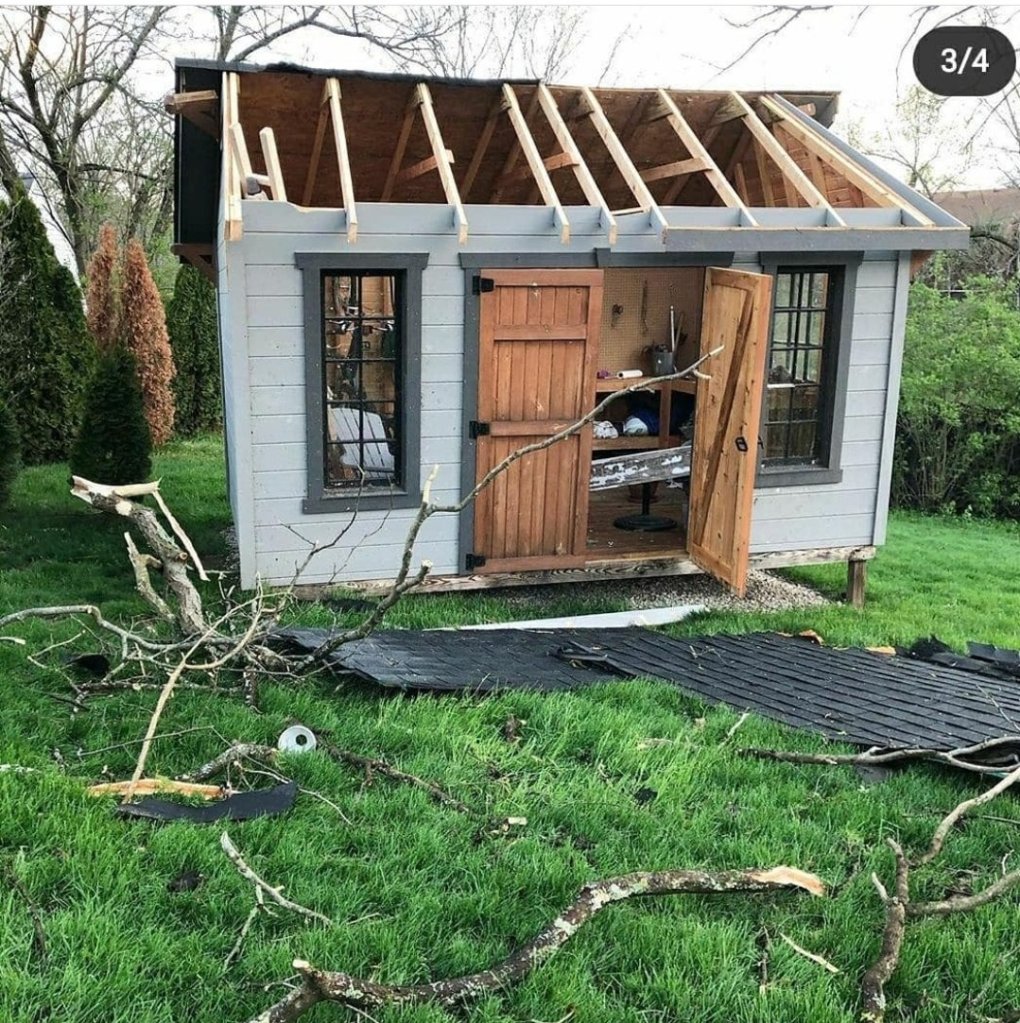
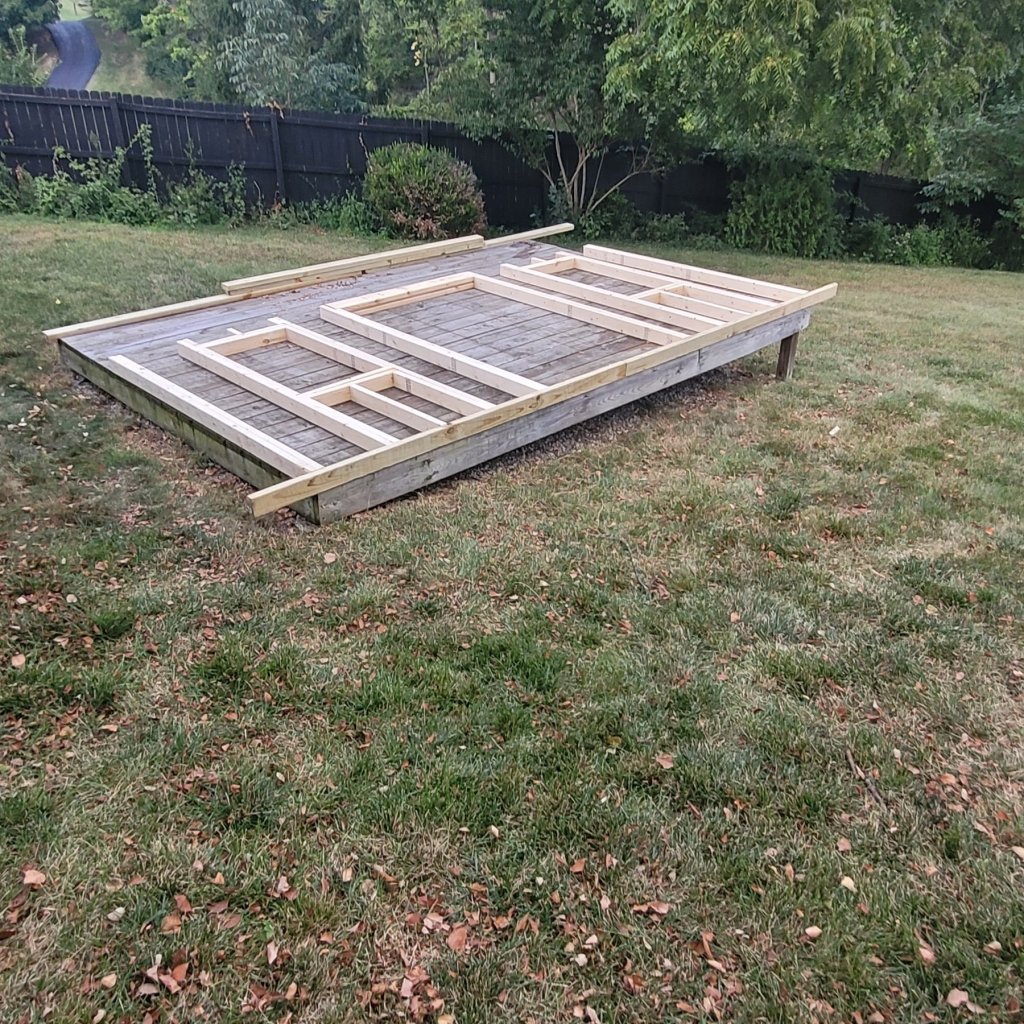
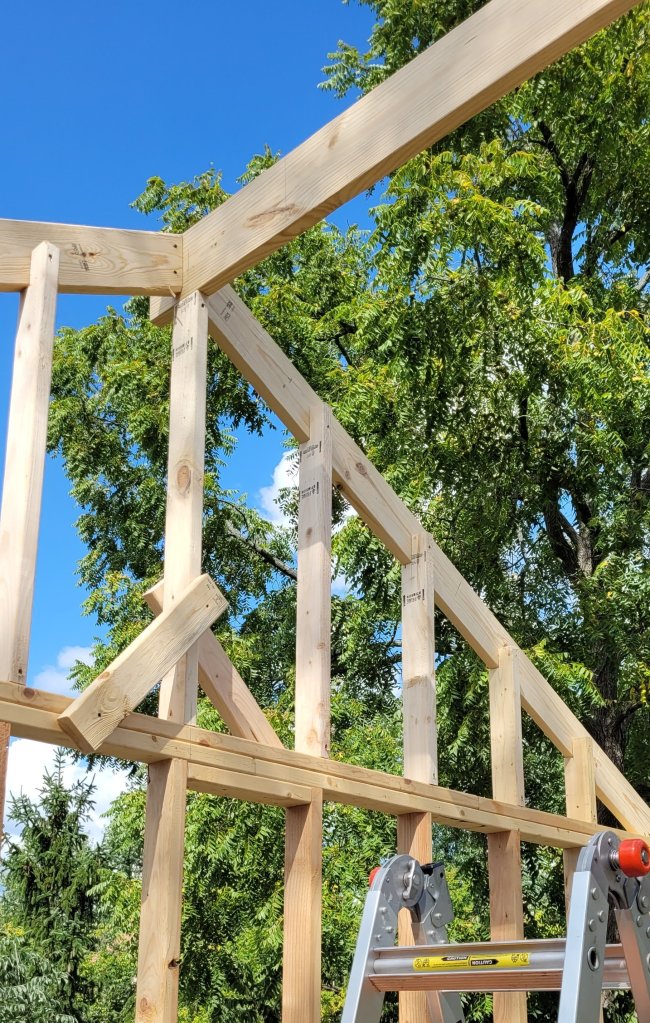
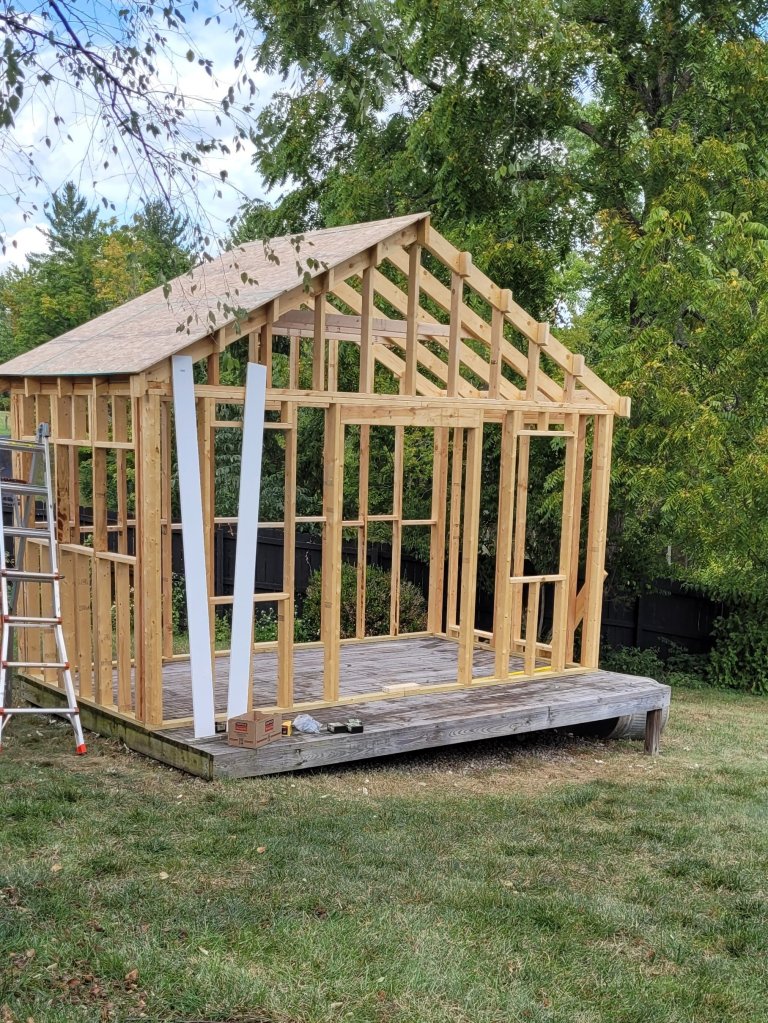
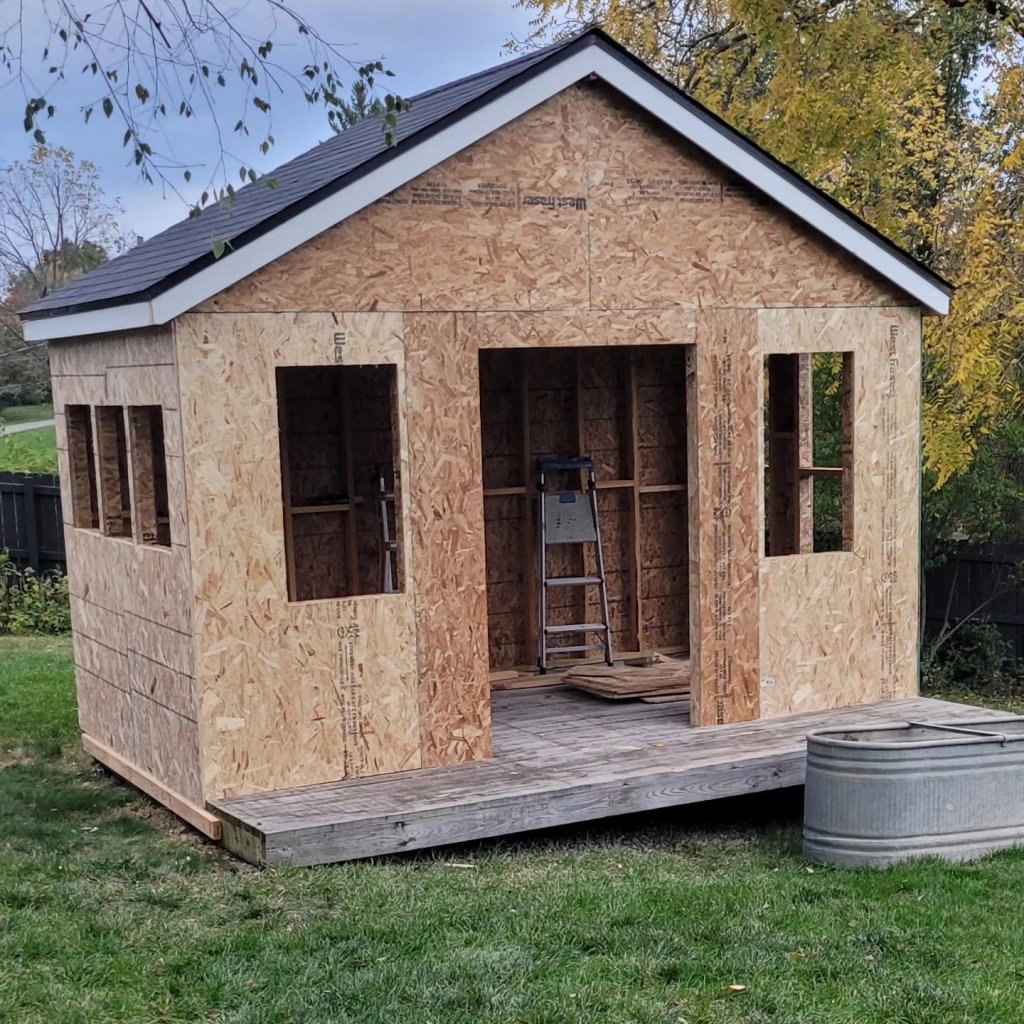
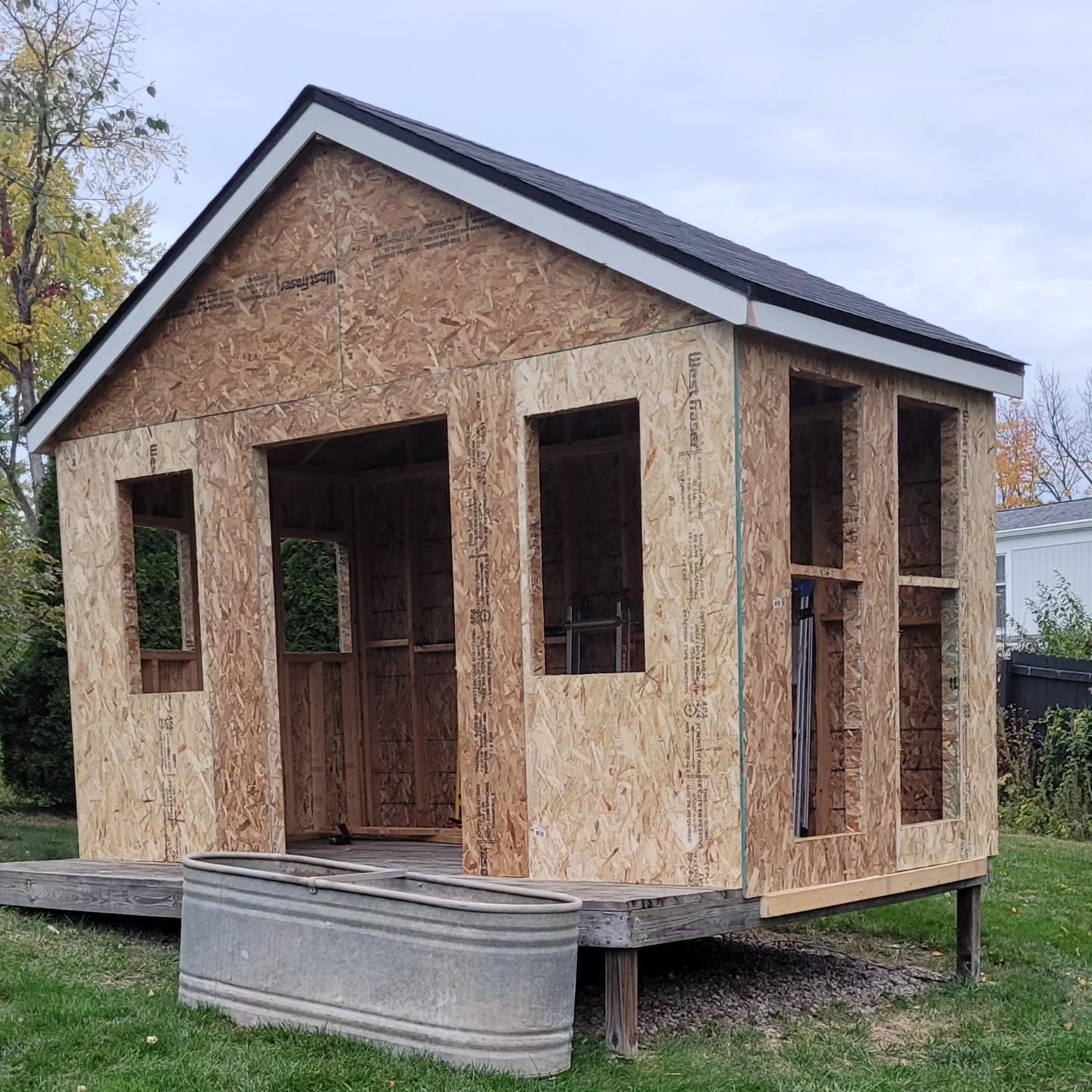
Three years after my original shed was destroyed in a tornado, I finally decided it was time to rebuild a new one. I designed a new shed that would only be 7’x 10′ on the original 10′ x 14′ deck platform where the original stood. My wife and I wanted to have a little deck to step onto instead of stepping directly from the grass.

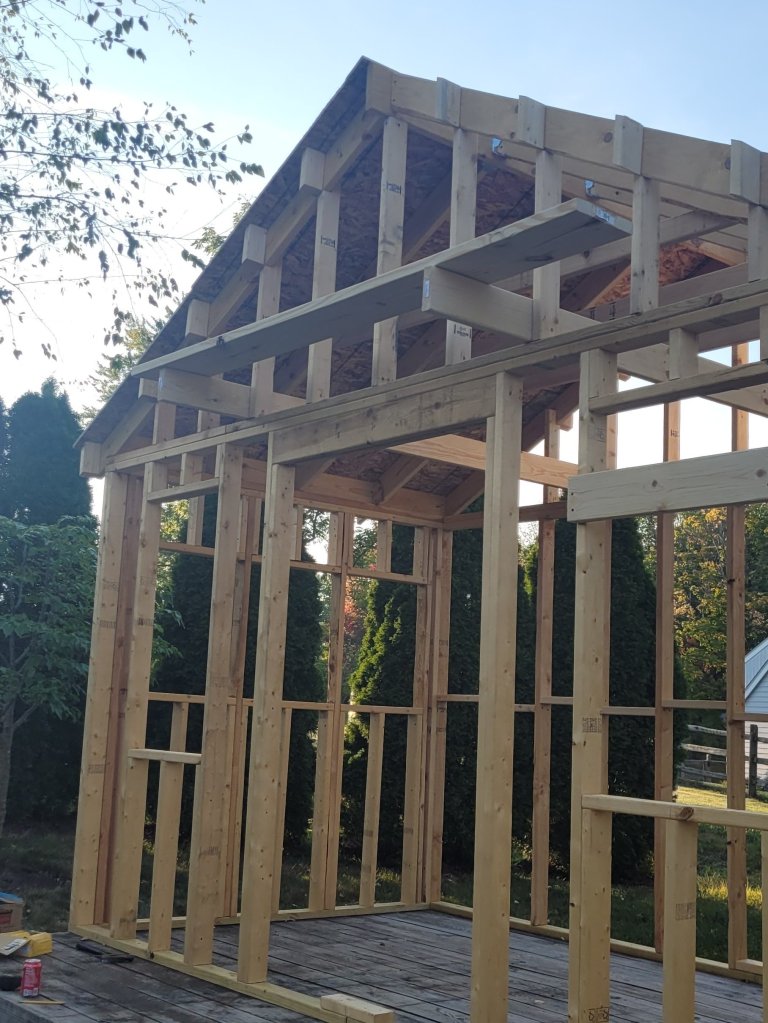
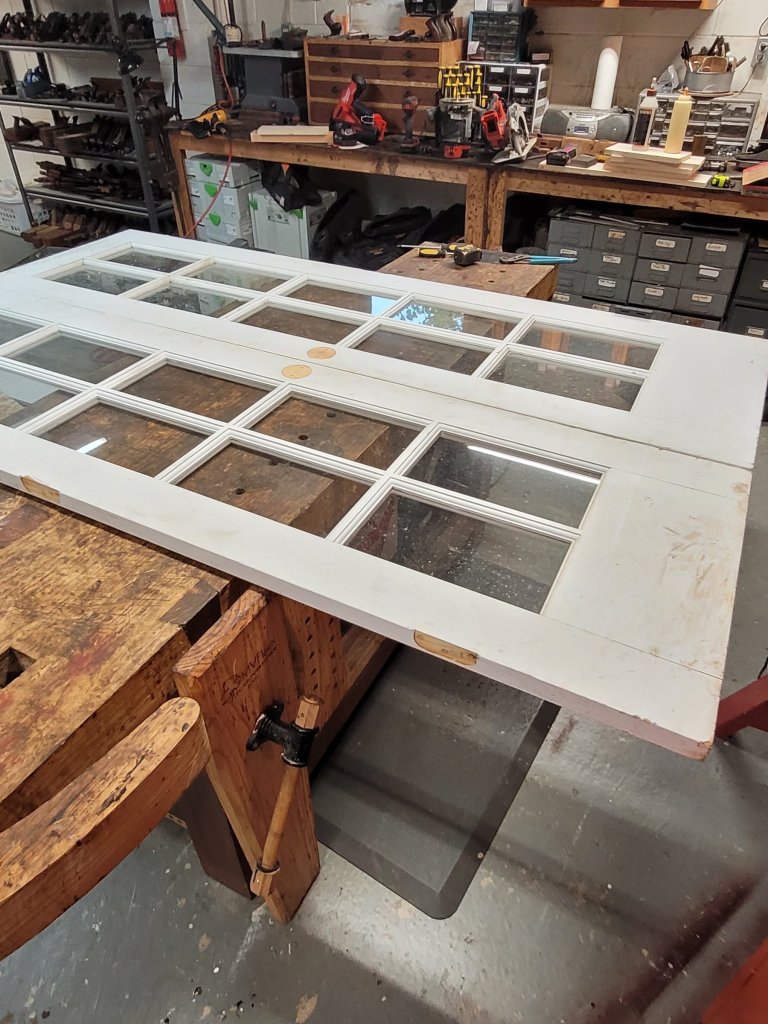
The new shed will have nine windows and two french doors in the front. I built the roof trusses in the opposite direction from the original one with stronger bracing for the wild winds we get.

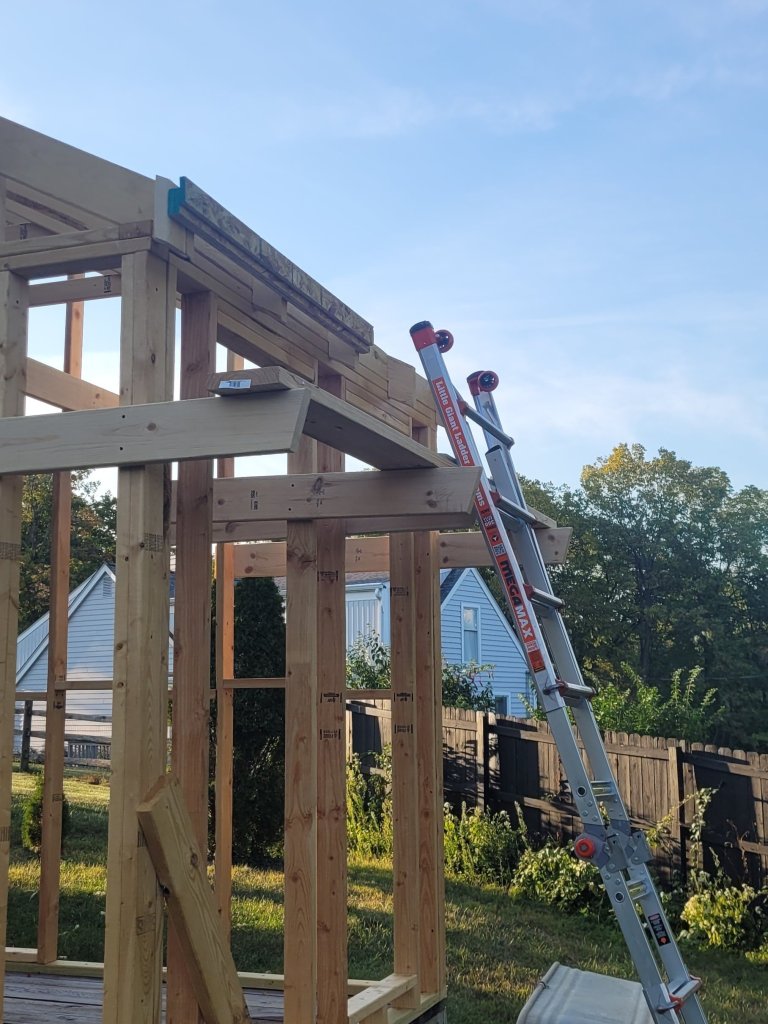
With the framing done, I worked on the roof and sheathing. I had to build platforms made from 2×12’s on three sides of shed in order to work safely.

After the roof shingles and soffit were installed, I put 1/2″ sheathing around the shed. This shed is much stronger than the first one as that had just carsiding nailed onto the 2×4 framing.

I spent some time working on the doors and windows. We bought wooden windows at Menards, and I built frames around them in order to function. Four large windows are fixed while the other five swing open.

I wrapped the shed with 8″ wide shiplap and ran it vertical. Then, I spent time installing the doors, windows, and trim. Next, we need to paint the shed, but we may have to wait until spring until it gets warm again. In the meantime, I’ll work on the inside of the shed. It’s taken me three months to get this far working on it during the weekends, and I still have a bunch more to do.

Buckeye No 5 Plane

Several weeks ago, I won this Buckeye No 5 plane at auction. The look of the plane was something I had never seen before. I wanted to see how it would perform, so I took a closer look at the plane’s functions.

Buckeye planes were made by the Buckeye Saw Company, which was in business from 1904-1929, and they are known for this patented plane by John Muehl, who more likely sold his patent to The Buckeye Saw Co.

The plane has no frog. The blade simply rests on the casting of the bed, and the Norris style adjuster, pins into holes on the blade.

The lever cap acts as the cap iron as well, which usually is not a good sign for quality. The Norris style adjuster swings from left to right in order to adjust the blade from side to side.

The simplicity of the plane makes it impossible to adjust the gap in the plane’s mouth to produce a thin shaving.

I sharpened the blade to see how it performed. Because the plane is so primitive and basic, I couldn’t get a nice shaving out of it even after messing with it for a few minutes. At best, the plane would only be good for rough carpentry work, like trimming a door and not for fine cabinetmaking.

In the end, my opinion about the quality of this plane is……it sucks!