The End of an Era

Today was the end of an era for my truck. My 2003 Ford Ranger was getting old and tired like an old dog. So much so, the past few weeks I was starting to get afraid to drive it far away from home. I work as a sales rep for Oldcastle selling patio block to Home Depot and Lowes and have been given some new stores to call on in Indianapolis and surrounding cities. I didn’t feel confident anymore that my truck could stand all the extra miles without breaking down. The last thing I wanted was to be in West Lafayette, Indiana and have to call my wife to come pick me up three and a half hours away because my truck broke down.

My truck starting falling apart a few years ago when quirky little things would break, like the interior lights or a remote door opener that wouldn’t open the doors all the time. I lived with the quirks because they weren’t a big deal to me. As much as I hate buying new vehicles I prolonged the pain for as long as I could.

As time progressed, bigger and bigger things would go wrong. My gas gauge would no longer work and I had to count the trip miles so I knew when I needed to buy gas. The radiator leaked antifreeze so I had to add it every once in awhile. The door molding that contained the door handle and power window buttons broke off and I had to close the door by grabbing it up by the window. Then the truck bed started to rust through, the rear gate wouldn’t open and my CD player stopped working.

I never fixed anything because every time I got a quote it was nearly a $800 to repair. Plus, at the time, I really didn’t feel like spending that much money on a truck with nearly 200k miles on it. Then about a week ago, I noticed that one of my struts was poking through my truck bed. I asked a co-worker about it and he told me that if it broke while I was driving, the bed would fall down onto the tire causing me to wreck which would be bad news. Everyday I checked the strut poking through my bed and noticed it was getting worse. In the back of my mind, I knew I didn’t have much more time.

My driveway doesn’t slope to the left. My bed was leaning that much because of the strut popping through.

I ended up getting 263,700 miles from my Ranger. When I originally bought it back in 2003 it had 23k miles on it. My goal was to drive it to 200k miles and accomplished that goal nearly two years ago. Once I achieved that goal, my new goal was 250k miles. Then last fall when I passed 250k miles, I was praying it would last another 50k miles, but knew that probably wouldn’t happen. I’m satisfied how long it lasted although it was tough to see it go today. My 2003 Ranger was a good truck that didn’t give me too much trouble. The engine ran good and the transmission was still smooth after all those miles.

My new vehicle is a 2011 Ford Edge with 25k miles on it. This SUV is nearly loaded with all the bells and whistles. It has power everything, a dual sun roof, navigation, tow package and built in satellite radio. I plan on buying a trailer so I can buy plywood and my wife can take her furniture to shows. I’m also going to tint the windows and buy better speakers for my radio. I always wanted to upgrade my stereo system in my Ranger, but never did. So a better sound system is my new goal for the Edge. Oh, and 200k miles.

Sharpening a Pitted Plane Blade

I bought a Millers Falls No 7 Jointer Plane a few weeks ago that had a pitted blade in it. While most people would look at a blade like this and immediately think that it belongs in the trash, I decided to see if I could get it to work well enough to slice thin shavings off a piece of cherry.

The first thing I do when I sharpen any of my blades is to whip out my Tormek sharpening wheel. I’ve owned the Tormek for several years now and have never regretted the coin I paid for it. I set the machine up to grind a 25 degree angle on the blade and go to town.

A few minutes on the Tormek puts a real nice edge on the blade. The problem is the back of the blade is still pitted causing the blade to cut ridges in the work piece while using it in the plane.

I used the side of the wheel of the Tormek to try to flatten the back of the blade, but after a few minutes I wasn’t really getting anywhere. It did help, but it would have taken hours to remove all the pits.

I decided to give the old ruler trick a try made famous by David Charlesworth and remove only the metal at the front of the blade. I stick a thin ruler at the back of the blade and sharpen the backside of the front of the blade by moving it back and forth on a piece of 320 grit sandpaper. This in theory changes the cutting angle of the blade by a few degrees, but honestly, who cares? There is very little difference between a blade with a 25 degree angle and one with 24 or 23 degrees. It may make a difference with hard exotics, but I normally use poplar, cherry, maple and southern yellow pine. I’m too cheap to buy hard exotic wood.
As you can see if you look closely, the ruler trick worked. The very front edge of the back of the blade is clean of any pitting and will hold an edge better.

I then switched to my water stones and hone the edge created on my Tormek. I use a combination stone of 800/4000 grit and a final 12000 grit stone. I use water stones as opposed to oil stones simply because the Tormek is a water stone. Oil and water don’t mix.

Here is my final sharpening of the blade. Pretty good if you ask me.

Here’s the blade in action cutting cherry. After a few adjustments with my plane, I was able to produce nice clean shavings. The cherry underneath was glass smooth after it was planed with the blade.
How thin were my shavings? About .003″ thin. Not too shabby for a piece of crap blade that most people would have never even given a second chance and would have just thrown in the garbage.

Now That’s a Leg Vise

While traveling between Greenville, OH and Richmond, IN for work, I stopped in an antique store in New Paris, OH and came across this behemoth. The flywheel on this leg vise must have been 18″ in diameter and was very smooth when I turned it.

Some of you may be aware of Jameel Abraham from Benchcrafted who makes reproduction flywheel hardware similar to this for workbench leg vises. I’ve tried one at the Woodworking in America conference a few years ago and loved it.  I even considered buying one for my bench before I built my Roubo workbench a few years ago. This thing would beat up his flywheel and take its lunch money.

The screw mechanism for the flywheel is so big and heavy that it needs its own shelf. I imagine the leg vise can open up to at least 12″.

Even the flywheel on the bottom was no slouch. It was probably about 8″ in diameter. It keeps the leg vise parallel to the leg of the workbench to hold the piece more snug. Put a little grease on these babies and you’ll be ready to go.

The bench sat on casters that could be rolled around the shop. For $1500 it can be all yours. I told the shop keeper that the flywheels were probably worth $500 – $800 just by themselves. What an impressive beast.

Sandpaper Cutter

Every few years I run across the same sandpaper cutting jig in woodworking magazines’ Tips and Tricks section. While the design may vary, the concept is always the same; screw a hacksaw blade to a piece of wood and use it to cut sandpaper in half.

I made this jig twenty five years ago and I’m amazed that nearly every time I see it in a woodworking magazine, it wins Best Tip. I originally saw this jig in a book called Making Woodwork Aids & Devices by Robert Wearing published by Sterling Publishing Co. which is a great book on making jigs and fixtures for your shop. It’s so good, the publisher released a third printing of the book a couple of years ago. If you don’t own this book, buy it!

The concept is so simple, you may feel dumb you didn’t think of it yourself. Basically cut a piece of scrap wood that is half the width of your sheets of sandpaper. Then draw a line down the wood that is half the length of your sandpaper.

After cutting the paper in half, stack the sheets on top of each other, turn it 90 degrees and line up the end with the pencil line and rip it again.

Viola, you have four equal sheets of paper, perfect for a 1/4 sheet palm sanders or for hand sanding. Go ahead and send this tip to your favorite woodworking magazine and win a set of Bosch power tools for Best Tip. You can thank me later.

Brown Tool Auction Winnings

Every few months Clarence Blanchard from the Brown Tool Auction holds an antique tool auction in Pennsylvania. Even though some his auctions are within a day’s driving distance for me, I’ve never been to one. It’s just too easy for me to place a bid online and pay a $3.00 absentee bidder fee for every auction I win. Plus at $3.00, it’s a lot cheaper than spending the money on gas and a hotel room.

I never know what or if I win until about a week later when UPS drops of a box at my door. So you can imagine the excitement when I see a big box at my door. Typically the bigger the box, the more tools I have won.

As soon as I open it up I see molding planes neatly bubbled wrapped up. I love molding planes. To me they’re the router bits of hand tool woodworking. With a little bit of work, molding planes tune up nicely and create some of the nicest profiles that you can’t even produce with common router bits.

After unpacking the box, the results were in. Seventeen molding planes and two Stanley bench planes. All of the planes were in good shape and need only a little bit of tuning to bring them back to working condition.

Of the two Stanley planes I won, one was the Big Boss of Stanley planes, the No 8C Corrugated Jointer. This plane is in excellent condition and with a little bit of work, it will clean up to be a top shelf tool. The other bench plane was a nice Stanley 5 1/2C corrugated plane. Collectors go crazy for the corrugated soles as they tend to bring in higher prices, but for me, the corrugations just act as a place for dried glue to hang out. The theory behind corrugated soles was that they tend to be easier to push because of the less mass on the workpiece, and they were easier to fettle the bed because you didn’t have to remove as much metal. I haven’t found either one of those benefits to be true.

The molding planes were nice with a wide variety of profiles in the mix. Over the next few weeks I’ll tune them up and list them for sale on eBay.

As you can see, I have a soft spot for molding planes. The day I figured out how to tune one up and make it sing, I was hooked. I intend to sell some of my duplicate profiles on eBay in the coming weeks.

Trying to Antique Pine

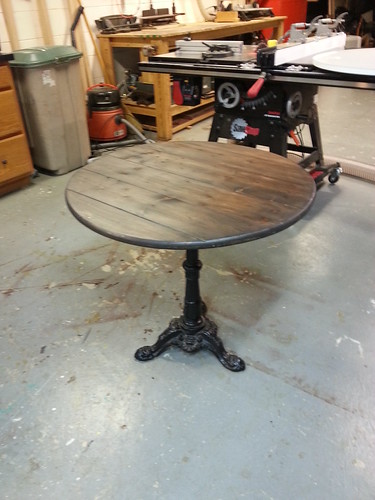
My wife asked me to make a new table top for this table she bought. She wanted the top to look like old worn pine with a gray tone to it. Even though I had never tried it before, I thought it should be something that I could accomplish.

The first thing I did was to buy a couple of 2 x 6’s from Lowe’s and cut them so that I could create a 30″ round table top.

I wanted the 2 x 6’s to have some strength between them. I plowed a 1/4″ channel about 3/8″ deep though all the pieces so that I could fit a piece of poplar down the middle. Looking back at it, this may have been an unnecessary step as the glue should have held the pieces together good enough anyway since they were being edge glued. To give the top a bit of character, I chamfered the boards on each side so that the top would have the look of planked boards.

This is how the planks looked right before glue up. You can see how the slightly chamfered edges gives a little bit of character to the top making it look a bit old.

The next step was to cut it to a 30″ radius. I simply set up my plunge router to a circle jig and plunged the bit down a few times to cut out the circle.

Making the top was the easy part, but now I needed to antique it. I’ve heard about using distilled vinegar and steel wool to antique wood, but I never tried it before, so I bought a bottle of vinegar and dipped a steel wool pad in jar leaving it overnight.

When I applied the mixture, the wood immediately turned a dark brown. However, after it dried overnight the wood had a purple hue to it. It also raised the grain a little bit so I hit it with 220 grit sandpaper to remove the grit from the top.

Another big issue with the top, which is hard to see, is that it warped. When I was testing what type of dyes, stains or waxes to uses, I did it on the underside of the top. I think that all the oils and stain put the wood out of equilibrium causing the wood to warp. Oops!

After the vinegar/steel wool mixture dried I wanted the top to be a little darker so I applied a coat of ebony Briwax. The top took on a darker color, but a little too dark for my taste. I probably should have tried some other type of wax or added another coat of vinegar/steel wool mixture to see how that would have turned out.

Overall the top came out okay, but it wasn’t the look I was going after, plus it’s warped. When doing things I have never done before, sometimes I get it right and other times I stink it up. I think this top may be headed out as fire wood. What do you think? Where did I screw up and how can you antique pine to a grayish tone?

The Golden Section Explained by Walt Disney

Tonight while visiting a woodworking forum I host called The Burl, I was reading a post about a member who was asking people if they use the Golden Section 1.618 to design their furniture. One of our members, JerryPacMan1, posted a YouTube video by Disney called “Donald in Mathmagic Land”. Made during the 1950’s, this video explains the golden ratio in a very simplistic way that is easy to understand. The golden section portion start around the 7:00 mark, but the entire film is worth watching. Enjoy!

My New Years Resolution

It’s a brand new year and I’m not getting any younger. I’ve been thinking over the past few days about what I’d like to achieve this year with my woodworking. The answer was clear. 2014 has to be the year where I finally get into and learn blacksmithing. For years I’ve been farting around with the idea of incorporating metal work into my furniture. I took a blacksmith class from Welch chair maker Don Weber of Paint Lick, KY in 2008 where I made a couple of hold fasts and a cold chisel, but unfortunately, I never took anymore classes from him. I use the hold fasts all the time and I’m very proud of them, I just wish I would have taken more classes. Don’s shop was nearly three hours away and I believe he has since retired as his website has been down for several months.

I really want to learn blacksmithing for a few reasons. I want to make hardware for furniture, handles for cutting boards and be able to heat-treat blades for tools. I bought a set of handles for cutting boards from a guy at an art festival a few years ago and the design is simple enough that I’m sure I could reproduce it with a little practice. If I make cutting boards I would add handles like these and sell them through my Etsy account.

I have been a member of Southern Ohio Forge and Anvil (SOFA)  for a few years and I attended their annual meeting in Troy, OH back 2011. SOFA offers classes on blacksmithing but Troy is an hour and a half from my house. Ten weeks of driving back and forth from Troy on the weekends doesn’t sound like that much fun.

I do have a few books on blacksmithing, but the best by far is The Backyard Blacksmith by Lorelei Sims. She writes about setting up a simple shop and teaches some basic beginning projects. It’s a great first step in learning blacksmithing.

Awhile ago I bought the first piece for my blacksmith shop, a 150 lb anvil, at a local auction. My wife warned me that I would buy an anvil and it would just sit in the garage for six months before I would even use it. Well she was wrong. It’s been sitting in there for a year and a half. I need to make an anvil stand for it, but that shouldn’t be too hard. I’ll probably write a blog about it when I do.

I have three blacksmith vises that I bought at a tool auction a few years back. I only use one of them right now as the other two are sitting underneath my shelving where I store my wood. The one I do use is fantastic and works much better than a metal machinist vise that is bolted on top of a workbench. If you ever have a chance to buy a blacksmith vise for a good price, do it, you won’t be disappointed.

Last fall, I bought the final piece of my shop at an antique show, a forge. It’s really nice with a hand crank blower. I would like to eventually make my own chisels or blades for molding planes and a forge like this is ideal for that task. Maybe I can even get good enough to shape my own carving tools.

Now that I have all the major tools for my blacksmith shop, I could set it up in the garage, but that is where my wife stores her furniture or parks her car. We’re talking about getting a shed in the backyard in the spring. If we do, that would be an ideal spot where I can pull out my anvil and forge and work in the yard. All I know is that it has to finally happen this year. I just wish there were blacksmith classes around Cincinnati I could take.

Hiding a Blemish on the Top of a Desk

My wife Anita bought this desk at a local auction house a few weeks ago. The overall condition of the desk was really good, it just had a tear on the veneered top. She sanded and filled the missing area with wood putty hoping that when she applied a dark stain, it would blend in with the rest of the top. My dog Bentley photo bombed the shot.

Unfortunately, but not surprisingly, the repaired area stuck out like a sore thumb. Determined not wanting to paint the entire top and lose the look she was going after, she opted to add a stencil in the area where the blemish was.

She chose a large French postage stamp stencil and angled it across the top. Since the patched area was a little bit on the right side of the desk top, she couldn’t simply center the stencil on the top and completely hide the blemish.

She used a few colors of paint and painted the stencil completely hiding the patch. The stencil now adds quite a bit of character to the desk.

This is how the desk turned out after it was painted and she added a few coats of hemp oil to the top. She has received a lot of postive feedback on her facebook account. You can check out her page here; https://www.facebook.com/bellachicdecor

Can you find the blemish? I sure can’t.