Making a Shaker Table from a 2×8

Earlier this week I grabbed a 2×8 that was 8 feet long for $6.00 at Lowe’s with the intentions of making a shaker table out of it. I’ve made a lot of furniture out of Southern Yellow Pine dimensional lumber over the past couple of years. One of the best things I like about it is that it’s dirt cheap. The other is that it comes 1 1/2″ thick so when making legs, I don’t have to laminate two 3/4″ boards together exposing a glue line down the leg. The biggest downside is that the wood is very soft and easily dents however, lately I’ve been building things to look old, and a few dings and dents will only add character to the piece.

Making the legs of the table is a synch. Rip four pieces 1 1/2″ wide x 1 1/2″ thick. The next is ripping down the stock to create the carcass of the table. Because the 2 x 8 is exactly 1 1/2″ thick, getting two pieces that are 3/4″ in thickness is next to impossible. I settle for ripping it down the middle and yielding two pieces 5/8″ thick after I clean them up in the surface planer.

After I rip the stock to 5 1/2″ wide, I don’t just rip the piece all at once on the bandsaw. I set my table saw up to rip it in the middle and run a kerf on each side of the board.

Then I take it to the band saw and rip the rest of the way. This does several things. One, it saves my band saw motor as it doesn’t have to fight ripping five and a half inches of wood. Instead it only has to rip about 2 1/2″. Plus the kerf of the table saw blade creates a channel for the band saw blade to ride in so I don’t get blade drift. It’s also much faster than ripping 5 1/2″ and it also creates less dust.

Once I have my side and legs milled, I need to route the joinery to attach everything together. Using my handy-dandy Colt plunge router, I route all the mortises in the legs and sides to accept loose tenons. The process is so fast and simple I wished I would have created that Micro Fence jig ten years ago.

After the joinery was cut, I tapered the legs with my taper jig.

For the top I wanted to use 3/4″ wood as 5/8″ would be a little too thin. This is okay because I still need stock for the drawers which will be 1/2″ thick. So I simply rip the next pieces at 7/8″ on the table saw and follow-up on the band saw like I did previously.

The parts came out clean but the two pieces for the top were a little narrow. Together they were about 15″ but I needed the top be 16″ wide so I grabbed a piece of off-cut scrap and glued it in the middle.

After the top was glued, I flattened it with my 16″ surface sander and beveled the edges with a 45 degree chamfer router bit.

I needed to assemble the carcass so I dovetailed the rail on top of the drawer and loose tenoned the bottom rail to the two front legs.

The carcass fitted together nicely so I sanded the parts with 150 grit sandpaper and then glued it all together. Now I needed to work on the drawer.

The drawer sides and back are made with the 1/2″ stock. I planed a groove down each side and the back of the drawer front. I then cut them to size and routed a dado in the side to accept the back.

I cut half blind dovetails into the drawers and used my Colt plunge router to rout the majority of the waste and cleaned out the joint with chisels. Luckily I had a piece of scrap plywood for the drawer bottom lying around so I didn’t have to buy more wood. After I cut all the joinery for the drawer, I glued it all up.

As far as scrap goes, this is about it. Nearly everything from that 2×8 was used when I finished installing the drawer runners. Luckily I didn’t have any major screw ups where I would have to use more lumber because I didn’t have it.

The table came out pretty nice for $6.00. I plan on painting it (or my wife will) and give it away to my local PBS station. Next month they have an on air auction they call “Action Auction” where they auction off items from local businesses. I participated in it a couple of years ago donating this same shaker table only out of cherry. Back then, the table sold for about $135.00. It’ll be interesting to see where this one ends up. But for $6.00 and a few hours of work, it’s a good investment for getting my name on TV.

Making loose tenons

I recently outfitted my Colt plunge router base with a Micro Fence and I plan on using it a lot so I need a way to make a lot of loose tenons quickly.

When making the tenons, I grab some scrap maple I have lying around, rip it down to 3/8″ on the band saw and plane it to size on the planer.

The router bit I use is 1/4″ spiral up cut bit so the tenon stock needs to be 1/4″ in thickness to match the mortise.

Once I have the tenon stock sized, I run a veneering plane over both sides of the work piece to plane grooves into it. The grooves will give the glue a place to spread so that the tenon will fit in the mortise snuggly.

The router bit I use creates rounded ends in the mortise so I run the beading part of a 1/4″ beading plane over the tenon stock to round its sides.

Making the tenon stock is done, but now I need to cut them to length so I decided to quickly build a table saw sled with some more scrap wood.

I took a piece of 1/2″ plywood about 15″ long and laid it over my table saw with wooden runners in the dados of my table saw. I made sure the plywood was square to the saw and quickly glued and pinned the plywood to the runners.

I then cut up a 2 x 4 to create the front and back of the sled making sure that everything was square. The sled is not pretty but I don’t work for Woodsmith Magazine so I’ll skip the hard maple and cabinet grade plywood when building jigs. As long as it works, it’s fine by me.

I marked 3/4″, 1″, and 1 1/2″ lengths on the bottom of the sled to act as quick reference marks for certain sizes of tenons.

In no time at all, I can cut a multitude of precisely fitted tenons and store them in sandwich bags for easy storage.

Adding a Micro Fence to a Bosch Colt plunge router base

After the last month of cleaning and selling a bunch of antique tools on eBay I bought last fall, I was finally able to get back in the shop. For months I’ve always had a Festool Domino on my wish list but for the nearly $1000.00 for one, I never pulled the trigger. So after cleaning out my router cabinet one day, I came across the Micro Fence I bought about ten years ago collecting dust. I bought it for my Porter Cable laminate trimmer and had intended to use it for inlay work. Needless to say I never used the damn thing as I don’t do inlay work. So I got the idea of using it with a Colt plunge router base for routing mortises for loose tenon joinery.

The first thing I had to do was retro fit the jig to work with the plunge router base. I had to custom make the bar that attached the base to the jig so I used a piece of scrap maple I had lying around. I went to Lowe’s and bought 7/16″ round bar stock and fitted them into the sliding section of base.

Next I threaded the rod and reamed the holes with a 7/16″ 14 TPI tap and die set. Took me a while to get that done because everywhere I looked, didn’t carry both the tap and die. I ended up buying the die at Menards and the tap at O’Reilly’s Auto Parts. A big pain in the ass.

After the base had the bar installed, I lined up the Micro Fence to the base, marked where the holes went and threaded those holes with a 5/16″ tap.

The finished piece was tight and clean with the Micro Fence able to come into full contact with the plunge router base.

I got lucky as the handle from the base was able to extend all the way down without touching any part of the Micro Fence. The distance between the handle and the brass screw is about 1/32″.

Once I got the fence to work, I quickly realized that the center hole on the base was too big to work with plunging mortises into end grain as the work piece would literally fall through the hole. So I had to buy a piece of 1/4″ acrylic plastic and make a zero clearance insert for the base.

The base worked well but the only caveat is that when routing, there is no place for the chips to escape the hole. I have to plunge a little bit, then vacuum or pry out the shavings from the hole, then deepen the cut. Not a big deal to me as I always turn off the router in between depth settings anyway.

The Micro Fence works well but thought it would be nice to add a little light so I could see what I was doing better. I stumbled upon this little book light at Half Price Books for $5.00 and hoped I could get it to work on the router.

I snapped off the piece that slides in a book, grabbed some double stick turners tape and stuck the light on the back of the router. The thing works perfectly. Like it was made for the tool. It has an easy touch on, touch off switch which makes it slick to use.

Now I just needed to put the tool to work to see how it performs.

After cutting a couple of loose tenons, I laid out where I wanted them on the piece to be mortised.

A couple of reference marks and some quick passes with the router, I got a perfect fit. I think this will quickly become one of my favorite tools. Not as slick as a Festool Domino but for the price of the plunge router base at $100 and an unused Micro Fence, I think it’s a really good bargain.

Using a Circular Plane

If you get into woodworking much, you’re bound to get tired of always building square cabinets and start incorporating curves into your work. With modern woodworking equipment, it’s easy to cut shapes on the band saw then clean up the edges with random orbit sanders but if you’re a hand tool enthusiast, there is a long forgotten plane you should bring into your arsenal.

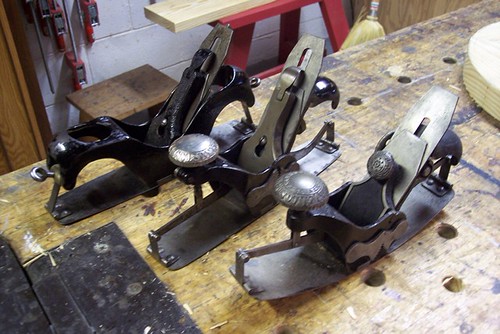
Stanley made several versions of circular planes in their hay-day. Out of the three versions; Stanley No 13, No 20, and No 113, the No 113 is by far the most commonly available in the marketplace. When Stanley introduced it, sales took off because its top center wheel allowed the user to adjust both sides of the bed at the same time.

The 113 came in different versions as the years went by. A side-wheel blade adjuster later became the more common Bailey blade adjuster. My personal No 113 is the side-wheel adjuster. It was the first 113 I ever bought and I tuned it up nicely. However many people prefer the Bailey adjuster since it works just like a normal bench plane.

By turning the top center wheel, you flex the bed in a concave or convex shape. The shape of the bed doesn’t necessarily have to be the exact shape of the wood you’re planing. The idea is to support the bed enough so that the blade will make constant contact with the wood.

The blade on a 113 is the same width of a Stanley No 3 so finding replacement blades shouldn’t be a problem. In fact, the mouth is a large enough at the base you can even use after market blades from Hock or Lie-Nielsen. However, after market chip breakers will not work because of the position of the frog adjustment tongue hole.

Using a circular plane is much like using a spokeshave. You want to plane down the grain as much as possible which means you’re going to constantly change the position of the plane on the work piece. If you plane up the grain, you’ll get blade chatter and tear out as the plane will literally bounce off the work piece. Skewing the blade at an angle will help produce a better cut as the blade will shear the wood fibers the same way a vegetable slicer cuts a cucumber.

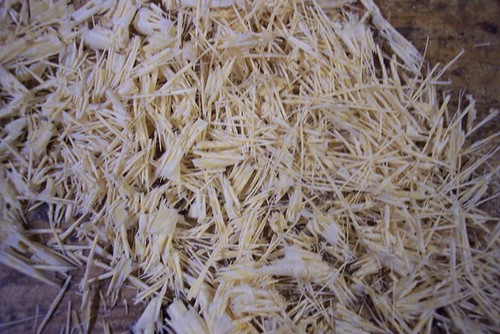
Because of the divergent and changing grain, it’s critical that your blade be sharp. When planing, you’ll often produce two types of shavings. The first being regular shavings as you plane with the grain, then finer curly shaving as if you were planing end grain.

The true benefit of using a circular plane is the consistency you get when shaping the curve. Any high spots will get planed first revealing low spots in the work piece. After more planing, the piece will take on a consistent shape.

If worst comes to worst and you can’t remove plane chatter and tear out due to the grain rising, you can always remove it and smooth the shape with a sharp spokeshave.

One of the most common misconceptions about using circular planes is that people think that they only work with wood that is circular in shape. That’s simply not true. You can plane ovals and soft curves just as well. In fact a few years ago when I built my Roubo workbench, I used the No 113 to finalize and smooth the shape of my crochet.

The only manufacturer that makes a new circular plane nowadays is a company called Kunz which will run you $300 on Amazon. I have never used one so I can’t tell you how well they work. Neither Lie-Nielsen nor Lee Valley have versions of their own so buying an old Stanley may be your best bet. They run between $100-200 depending on condition. All I know is that if you’re in the market for one, buy it now before Chris Schwarz writes a blog about them making their prices double.

When it’s Time to Say Goodbye

When I was thirteen my Grandpa gave me this Stanley No 77 dowel making machine. I was just getting into woodworking at the time and the machine sitting on top of a cabinet in his shop caught my eye. When I asked what it did, he told me it makes dowels out of any wood you shove into the cutter. It was the coolest thing I had ever seen. A few months later he ended up giving it to me and I have kept it to this day as something I would never sell.

After being diagnosed with NMO/Devic’s Disease earlier this week, I started to put things into perspective. With treatment, I should be okay but the vision loss in my left eye and the tightness in my legs and groin may never get better. Nevertheless, I realize what is truly important in life.  I think of all the tools I own and the tools I’d like to buy if I’d just had the money.

I have wanted a Apollo HVLP sprayer for the past few years but they’re about $800-1200. Not the kind of cash I have just lying around. So I keep looking at some of the tools I own but never use to help pay for the sprayer. The dowel making machine is on top of the list.

I’ve kept the dowel machine for sentimental reasons along with its cool factor. The only problem, is that I never use it. I’ve owned it for over twenty-five years, probably longer than my Grandpa, and have only played with it a few times. I really don’t think my Grandpa used it either. My Grandpa was more of a mechanic than a woodworker restoring old Model T’s when he was alive. The only time he got involved with woodworking was when he repaired the spoked wheels on the cars. I never saw dowels lying around his shop where he was cranking them out with his Stanley No 77. So why did he own it? I have no idea. Maybe he picked it up at a yard sale thinking it would come in handy someday.

It may be the very reason he gave it to me. Since he never used it, he thought with my budding woodworking aspirations that maybe I would. But I never have. I don’t use dowels all that much, and when I do, I go to the store and buy some. Even if I needed a dowel out of a certain hardwood, I could simply turn it on the lathe. Not only that, but the only cutter I have for the dowel machine is 3/8″ so I’m screwed if I need a different size. Forget about buying additional cutters for it. They run about $100 a pop and a $100 will buy a whole bunch of dowels.

Screw it, I’m done. I’m selling the machine and using the money toward a HVLP sprayer. Something that I’ll actually use. I don’t think my Grandpa would care.

The Perfect Drawer Bottom Plane

I recently won an auction for a Record No 043 plow plane on Ebay from a seller in England. I have always wanted one of these but the prices for these things is a bit high in the States. Not too many of them were sold on this side of the pond so the collectors who have them want about $100 for theirs. The sad part is that Record is no longer in business so buying a new one is virtually impossible.

What makes this plane so nice is its size and simplicity of use. Its small stature and ease to set up makes it an ideal tool to cut the grooves in bottoms of a drawers. In the past, I cut these grooves on the table saw which meant I had to take off the riving knife on my table saw, set the blade to cut a kerf about a 1/4″ high, then move the fence over to widen the groove to the size of a piece of 1/4″ plywood that I was using. This set up was time-consuming and making the groove the perfect width on the table saw was not always fool proof accurate.

Setting up the plane is a synch. I simply used a 3/16″ brass bar to set the blade from the fence and the height of the depth stop. It came with a 3/16″ and 1/4″ cutter but I’ll probably just use the 3/16″ exclusively as 1/4″ plywood is actually 3/16″ thick.

I own a Stanley No 45 and could use it as a drawer bottom plane but the 45 is a little too big and awkward to use when planing such a delicate groove. At 5 1/2″ long, the Record No 043 is half the size of the 11″ long No 45 and grips easily holding the back of the plane in the palm of my hand. With a little practice one could learn to use the plane with only one hand as long as you can keep the fence against the stock tightly.

As you can see, it creates a perfect fit for 1/4″ plywood which is what I primarily use when building drawers. As far as speed, it’s just as quick to plane these grooves as it is with a table saw. A few passes with the plane and the groove is cut.

http://www.leevalley.com/US/Wood/page.aspx?p=69788&cat=1,41182

Even though the Record 043 is no longer made, Lee Valley released a small plow plane a few years ago. The Veritas Small Plow Plane is a nice plow as I was able to use one at The Woodworking in America show last year. At 9″ long, that plane is smaller than a Stanley No 45 but still a little bigger than the Record No 043. You can buy the plane with a set of five blades for $275.00 so the guys who want $100 for the Record No 043 on Ebay may not be such a bad deal after all.

Replacing a stretcher bar on a stool

My wife was considering picking up this stool at an antique mall the other day and asked me if I could replace the stretcher bar in the middle. I told her more likely I could so she should go ahead and buy it.

The old stretcher was completely broken off and only the ends remained in the holes where it was attached. I took an 1/8″ drill bit and drilled a pilot hole in the middle of the holes on each end.

I then took a 1/2″ forstner bit and drilled out the hole cleaning it out. The pilot hole served as a guide for the point on my forstner bit so it would not wander off the center of the hole.

I then found a piece of scrap wood around the shop, measured how long the stretcher needed to be and then turned it so the middle was 1″ in diameter while tapering each end to 1/2″ in diameter.

Once the turning was done, I checked the fit of the stretcher at the hole. If the stretcher was a little tight, I shaved off some of the wood with a spokeshave so that the stretcher would fit in the hole nicely. I also had to loosen the legs a little bit by taking out the screws that held them to the frame to give me enough room so that the stretcher would pop into place. Once in, I screwed the screws back into place.

 A half hour of work and a piece of scrap wood, the stool had a replaced stretcher. Now it’s my wife’s turn to finish the stool.

Empire Wine Bar

 A few months ago my wife bought a dresser from a local auction company. When we picked it up, we noticed that the bottom drawer was so badly damaged that is was not worth repairing. Plus the drawers were only 10″ deep which doesn’t really fit with today’s needs. So, we decided that we would turn it into a wine cabinet.

The first thing I needed to do was take out the drawers and remove the frame that held them. It was a pretty easy process as the drawer runners were simply screwed in place.

I knew the part that held the wine bottles would need a cabinet of some sort so I glued 1/4″ panels to the inside to create a box. I also had to add boards to the bottom of the cabinet to support the bottom of the interior.

After much thought about how many wine bottles I wanted the cabinet to hold, I drew numerous options of the interior. I wanted the grids to go at 45 degrees and hold the maximum amount of bottles yet fit the opening of the cabinet. At first I designed the cabinet opening to hold nothing but wine bottles but after several drawings, I finally decided to make one half hold wine bottles with 4 1/2″ openings and the other half a shelf.

I built a divider down the middle and attached it with pocket hole screws. I installed plugs in the pocket holes and sanded them flush.

The fun part was making the grids. I made them from 3/4″ poplar and custom fitted each piece inside the box. The grids are attached together with dado’s and were painted brown before they were glued in.

I kept the girds shy of the face of the cabinet so that I could glue sapele on top of the poplar. Sapele is a poor mans mahogany which is what the dresser was made from. When stained, the sapele, mahogany and the painted poplar will blend together nicely.

After the interior was done, my wife painted the outside with chalk paint. She took the time to tape off the area that is stained and applied two coats of paint. After the paint dried, she rubbed some of it off to distress it, then added a dark brown glaze over the details of the piece to get in the cracks and appear old.

I applied four coats of General Finishes Arm-R-Seal oil & urathane topcoat to the top, the front of the drawers, and the grids to give the cabinet a nice sheen. We dragged it upstairs from the basement which was a big pain in the ass as it weighs nearly 200 lbs and decorated it in our dining room.

You can see how the distressing looks. The idea is to make the cabinet look old which is exactly what it is. After the glaze dries, Anita applied a light wax over the piece to protect the paint.

The design of the inside of the cabinet came out well. The grids hold eight bottles of wine and all of our various glasses. So far one of the drawers stores our wine bottle opener. Unfortunately, the other drawer will probably end up as a junk drawer.

The Empire dresser spent its first 150 years as a dresser. Now it will spend the next 150 years as a wine cabinet. Not a bad 300 year life if you ask me.