Oh Boy, I Did It Again

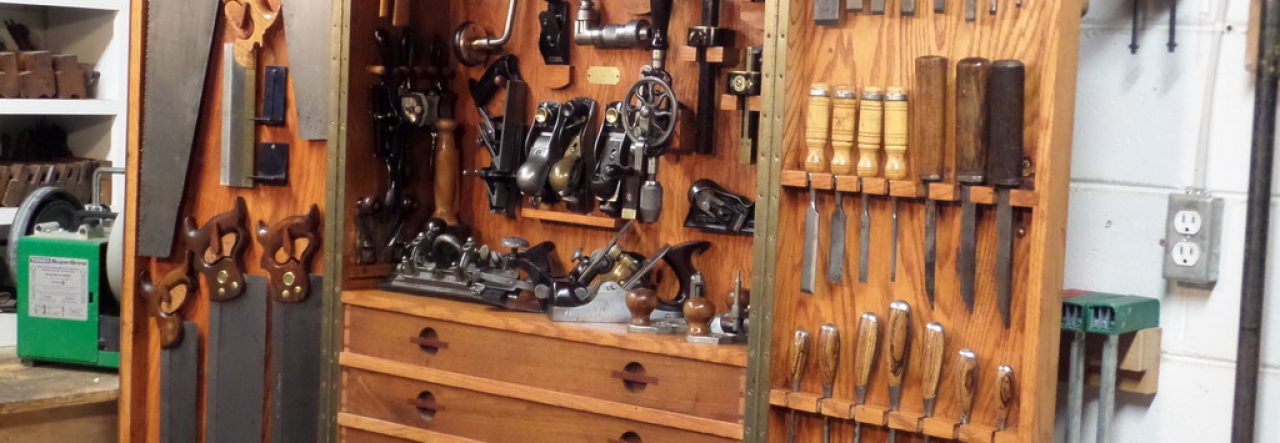
Well I went to another antique tool auction yesterday. This one was in Jeffersonville, OH about half way between Cincy and Columbus and good deals were to be had as you can see in the photo.

I only picked up a few Stanley bench planes. After the auction I went to in Indy a couple of weeks ago, I have enough Stanley planes to last me awhile.

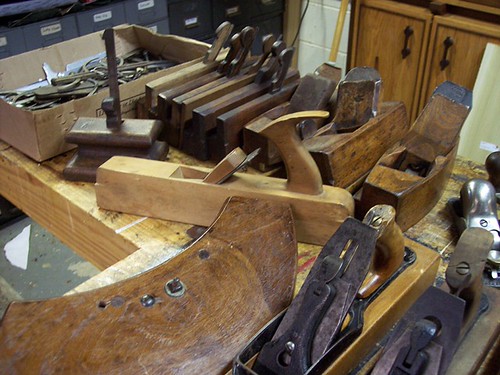
I’m a sucker for molding planes and these were too good of a deal to pass up. Several of them I snagged for under $10.00 each.

All the profiles of the molding planes I bought. I realize that you can make nearly every molding profile with a good set of hollow and rounds which I already have, but I can’t resist the opportunity to buy some complex molders. Some of these I’ll keep for myself, the rest I’ll sell.

I also picked up a few hand saws as well for under $5.00 a piece. Three of them were Disston thumb hole saws that are gaining popularity on eBay lately. I’ll clean them up and throw them on eBay to see what they bring.

Here’s a neat pair of shears I picked up for $6.00. I really don’t know anything about old shears and have no idea what they’re worth but my wife will stick it in her booth for sale.

A couple of sash molding planes a froe. I had a nice sash molding plane before and sold it only to regret it later so I’ll probably keep one of them. I’m definitely keeping the froe. Working green wood has always been an ambition of mine and this froe will come in handy. It looks like it was made from old leaf spring from a car.

The two scores I got were a Stanley No 141 with the fillister bed and blade and a Stanley No 603C corrugated bench plane. I may hold onto the 141 until I find some regular blades for it and then sell it.

All I know is that I’m going to be very busy for a while cleaning all the tools I bought this past month.

The Nicest Plane You’ll (Probably) Never Buy

If you’re in the market for a smooth plane, chances are you’ll probably consider one of two options. Buy a new one from a top tool-maker like Lie-Nielsen or Veritas which can set you back $200-350, or buy an old Stanley and fix it up. However there should be a third option on your list.

The Millers Falls No 9 smooth plane is one of the nicest production smooth planes you can buy for the money. In most cases, you can buy one for a lot less than a comparable Stanley No 4 plane and get the same quality of plane.

The differences between a Stanley No 4 and a Millers Falls No 9 are minimal. Both planes use 2″ wide blades. Both are about 9″ long and weigh about 4 lbs. They both have a frog adjustment screw in the back (some older Stanley’s don’t have this feature). In fact, the only main difference between the two is that the Millers Falls uses a two piece hinged lever cap that supposedly holds more pressure on the blade and chip breaker reducing blade chatter.

Both planes are about 9″ long with the Millers Falls being 1/8″ longer. If the bed is pitted a little bit it’s not a big deal as the pits won’t affect the plane’s performance. Consider them micro corrugations.

These two planes both have a frog adjustment screw in the back making it easier to adjust the opening of the mouth for the blade. Stanley’s made before 1907 don’t have this feature but I don’t think it’s a really big deal since once you set the opening of the mouth, you rarely reset it.

The handles on Millers Falls are made of beech hardwood with some older ones being made from cherry. In my experience, these are actually better than the rosewood Stanley used. Although prettier than the stained beech, a lot of Stanley’s with rosewood handles tend to break at the tip since the rosewood is more brittle than beech or cherry.

The nicest difference the Millers Falls No 9 has over the Stanley No 4 is the price you can pick one up for. Basically nobody really wants these things because all the collectors want Stanley’s. Even woodworkers when buying old tools typically gravitate toward Stanley’s more than their competitors since there are far more Stanley’s in the market place. However, if you keep a keen eye out, you can buy an old Millers Falls for about $10.00. I know because I just picked up a few Millers Falls No 9’s for $10.00 each a few weeks ago at antique shows.

As far as the price of Stanley No 4’s expect to pay $40.00 or more for a nice one since dealers will want top dollar for them. I’ve seen some mint Stanley No 4’s go for $150 on eBay.

Getting the Millers Falls No 9 cleaned up and ready to use is no different from an old Stanley. If rusty, dip the parts in citric acid for a few hours and then polish the metal to a shine with steel wool. If necessary, fettle the bed flat with 220 – 400 grit sand paper then sharpen the blade. The results will be stunning for a $10.00 plane as I was able to achieve a plane shaving of .003″ by only sharpening the blade. So thin in fact, that you can literally see through the wood shaving.

As a final note, if you’re the type of person who likes to use several smooth planes with a different cut setting, (hence the reason you don’t need to reset the blade with the frog adjustment screw), a good idea is to have a Stanley No 4 set to a medium-cut and a Millers Falls No 9 set to a fine-cut so it’s easy to determine which plane has the proper cut set to it.

Using Pinterest to Promote Your Blog

I’ve been a member of Pinterest for a few months and have added a few Pins onto my Boards but never messed around with it too much. It’s a fun site where I get ideas on furniture designs or things that just catch my fancy but I never really knew of its potential as a marketing tool.

Then tonight while I’m browsing Pinterest, I see a stool with yardsticks as a seat. I’ve seen them before in stores and always wanted to make one but haven’t gotten around to building one yet so I decided to pin it. When I looked at the photo I clicked on it and it took me to the lady’s blog where she talked about making it.

When that happened I thought, I’ll be damned, how did she do that? Every pin I ever uploaded came from a picture off my computer. The Link box was already filled with where the picture was being pulled from. I had no idea how they were linking their pins to their blog.

After messing around with one of my pins for a while I figured it out. First I added the picture and pinned it. Then I went back in and edited the Link to my blog page. Too simple. 

What can I say, I’m not the most tech savvy guy out there. I’m still trying to figure out what Twitter is for.

Here’s one of my pins. http://pinterest.com/pin/134052526380084266/

My Wife’s First Tool

My wife Anita has been repurposing old furniture and selling it in an antique store the past few months and often the repurposing requires upholstery work. A few days ago I was out-of-town and the upholstery stapler she was using kept failing. She called me on the phone and told me the driver would not retract when she shot a staple out of it. The stapler was a twenty-five year old Senco J tool that I bought for $5.00 when I worked for Senco so the fact that the driver gave out was no surprise. I told her that they probably don’t make parts for it anymore and she would be better off just buying a new gun. So she ends up going to a local Senco dealer and buying a SFW09 for $110 and she was back in business.

She uses the gun to upholster chairs with new fabric. This cloth is nothing more than a 10′ x 12′ painters drop cloth she bought a Lowe’s for $5.00. She washes the fabric then paints words on it with stencils. The result is quite impressive with the seat looking like it was upholstered with expensive $35/yard fabric.

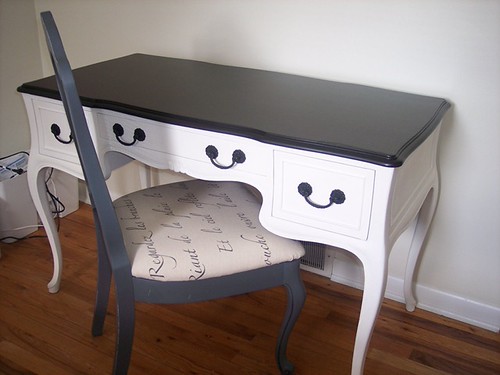
The chair is for her sewing desk she’s been working on the past few weeks. The desk is the same desk I wrote about a few months ago about having to remake the feet.

https://mvflaim.wordpress.com/2012/09/16/repairing-a-desks-legs/

The desk was painted with chalk paint and the top was painted with enamel. She originally stained the top which I thought looked nice but she didn’t so she redid it. Regardless it still came out really nice with the total cost of the desk and chair under $100.

This how the feet finally turned out. As you can see, you can’t even tell they’ve been remade.

As far as the J tool goes. It was connected to the compressor but the compressor wasn’t on. So as she kept firing staples, the compressor gradually ran out of air and it prevented the driver from going back up into the piston. Oh well, at least now she has a gun that will last longer and give her more power than the old J tool. Oh I forgot to mention, I’m not allowed to touch her new stapler. : (

A day at a tool auction

Last weekend I went to an antique tool auction in Indianapolis and picked up a few planes. Needless to say I went hog-wild with my bidding. All the planes were sold in lots which brought the price per plane down a bit. Even with all the good deals I got, I never spent so much at a tool auction.

I bought several Stanley circular planes as well as No 3’s, 4’s, 6’s, Gage 5C, block planes, and No 71 1/2 router. All of them are in nice shape with nice clean rosewood handles, full blades and no rust.

I also bought a lot of transitional planes but they were all sold in lots with five or more so I couldn’t refuse.

I also won a box of woodies which had a cooper’s croze, old woman’s tooth router and two cute little panel raisers. One of those panel raisers I’ll keep while the rest I’ll sell.

I’m a sucker for old molding planes. I have over 150 in my arsenal and still counting. I’ll more likely keep all these unless I already own that profile then I’ll sell it.

Box of measuring instruments. Lots of calipers and dividers in there and a few do-dads I have no idea what they do.

Some of the tools that were in the box I’ll keep for myself. Buy a box full of tools, sell the ones you don’t need to pay for the ones you keep. End up getting free tools which is not a bad deal.

Once I get all these tools cleaned up I’ll throw them on eBay. The money I make will help pay for my medical bills from when I was in the hospital last month. Wish me luck.

Removing a rusted bolt on a Stanley plane

I’ve cleaned up a lot of planes over the years and most of them come apart pretty easy. However once in a while I’ll get one that’s a bugger to take apart. 

This Stanley No 5 I bought was pretty rusted when I picked it up. In fact the only reason I bought it was because the rosewood handles were in nice shape. I as took it apart, one of the bolts that holds the frog down was seized. I sprayed it with BP Blaster several times and tried numerous flat-headed screw drivers to loosen it with no luck.

I knew it was lost cause to save the bolt so I ended up drilling a 1/4″ hole through the top of the bolt and then use a 5/16″ drill bit to widen the hole.

Once the bolt was weakened, I used a cold chisel and a hammer to smack the head of the bolt off and then I was able to remove the frog.

The only part of the bolt that remained was the bottom half that was still screwed into the bed.

I gently unscrewed the threads with some channel lock pliers making sure the threads wouldn’t break off in the bed.

I have a lot of spare bolts from Stanley planes I have taken apart over the years so finding a suitable replacement was a breeze. Not the prettiest Stanley No 5 but with a coat of black japanning, it would look a lot better. Since the body of the plane is so rusty and pitted, the blade will need to be replaced since it too is pitted.

English Layout Square

I was watching The Woodwright’s Shop the other week and saw the episode where Chris Schwarz made an English layout square and thought to myself that it would be a fun project to build.

You can watch the episode here:  http://www.pbs.org/woodwrightsshop/video/3100/3106.html

So I grabbed some quarter sawn cherry I had lying around, ripped it on the band saw and then planed it to 1/4″ thick. Chris made his square 24″ long. Mine is only about 12″ long x 1 1/2″ wide since that was the size of my scrap.

During the show Chris showed how to clean up the half lap joint using a router. Once you set the blade to half the thickness of the wood making the two sides fit together is a breeze. After the joint is cut, simply glue the two pieces together.

I used the front cover of “The Anarchist’s Tool Chest” to sketch a roman ogee design onto a piece of scrap. Then I used it as a template for all the little details on the square. I used a dovetail saw, chisels and a round bastard file to cut the shape into the pieces of the square.

Lining up the center of the cross-bar with the center of the square I marked the edges where the cross-bar meets the sides of the square. I used a pencil but in hindsight I probably should have used a knife to get a crisper line.

After cutting the half lap joint on the cross-bar, I laid it back on the square and marked where the cross-bar laid on the sides and cut the half lap joints on the sides.

By far the hardest part making the square is to properly line up the cross-bar and cut the half lap joints so that they fit perfectly together on both sides. There are a lot of surface areas that need to meet tightly and an error in one end may telescope to the other end of the cross-bar.


As you can see I didn’t quite make a perfect fit on one side. I could have fudged the cross-bar so that there would be a small gap on both sides but I opted to make a larger gap on one side then fill it in with a thin piece of scrap.

Cross bar being glued with thin scrap glued in place. Just don’t tell anybody I screwed up.

For the roman ogee details at the ends I simply used a circle template and scribed a couple of pleasing arches into the wood and cut them at the scroll saw. I really had no rhyme or reason, I just made it look pleasing to my eye.

After the square was glued, I needed to true it up. I laid the square on a board with a perfectly flat edge and ran my pencil down the side. Then I flipped the square over and ran my pencil down the other side. If there were two lines, it’s out of square.

I gauged the distance between the two lines (1/8″) and trimmed half of the amount (1/16″) off the bottom corner of the square. I kept trimming off a little bit at a time off the bottom until there was only one line when I flipped the square over checking its accuracy. When there is only one line, it’s square.

The square turned out fairly nice and was a fun little project to build. I’m sure it’ll be a favorite tool in my shop.

NMO/ Devic’s Disease

A few months ago I wrote about how I lost my vision through atypical optic neuritis and dodge a bullet being diagnosed with multiple sclerosis. Well the past couple of months haven’t been so lucky with me.

It happened eight weeks ago while in Lowe’s I noticed that my left foot was slightly tingling and numb. I blew it off at the time as an odd occurrence although back in my mind I was concerned. I woke up in the morning with excruciating back pain and asked my wife Anita to rub it. The back pain eventually went away but later in the day I noticed that my other foot was starting to go numb. I was still hopeful that it was nothing serious and even asked my older brother Steve if he’s ever had this happen to him. He said he did and that it was more likely just a pinched nerve and it would probably go away in a couple of weeks.

A few days go by and I noticed that my legs and feet were getting worse. The numbness went from my feet through my calves up to the knees while also having numbness in my groin area. It felt like I was sitting on a grapefruit when I sat down and I constantly felt pressure in the area. I knew then that this was no pinched nerve.

Concerned, Anita called my eye doctor to tell him what was going on. He told her to have me visit a neurologist so they could look at me. While at the neurologist, I explained my symptoms and the doctor felt I had transverse myelitis on my spine but would need a MRI to confirm. Transverse myelitis is the inflammation of the spinal cord brought on by environmental factors or a virus. It can be so severe that some people with the condition can not walk after an attack. Unfortunately when an attack does occur, it can take several months to a couple of years before the patient returns to normal.

After I got back from having the MRI, the doctor looked at the images and confirmed that it was transverse myelitis possibly brought on by MS. He told me that I have a mild case of it since I still can walk but it would eventually go away in a few months. He gave me the number of a neurologist who specializes in MS in case I wanted a second opinion. My wife called and made an appointment but the doctor couldn’t see me until Feb 2013. The doctor’s assistant told my wife that if my condition worsens that I should go to the University of Cincinnati Hospital emergency room.

A few days go by and I noticed that my numbness continued to climb up my legs into my thighs. Also my abdominal area was starting to feel numb as well. By this time, I was dealing with this issue for seven weeks with no signs of improvement. My wife Anita pleaded with me to go to the hospital but I wasn’t ready. I didn’t want to overreact and wasn’t too thrilled about going to the hospital anyway.

Then last Wednesday I decided to finally take care of my health and went to UC Hospital. When we get to the emergency room, the nurses and doctors asked me a ton of questions trying to diagnose my condition. They had me walking around on my tippy toes and then walk a line like a DUI suspect. Then they gave me a bunch of neurological tests like smiling and touching my nose to their finger as if I were a stroke patient. They decided they needed to do a bunch of tests on me so they sent me upstairs to be admitted.

While in the hospital, they drew tons of blood from my arm and gave me multiple MRI’s on my back and head. The doctors needed to determine if I had MS or NMO which is Neuromyelitist Optica also known as Devic’s Disease or some other abnormality. The worse part was they needed to do a spinal tap in order to make a conclusive diagnosis. The thought of having a needle stuck in my spine was unnerving. The MS doctor I was planning on seeing in February came to visit me in my room. She thought that I possibly had NMO but would need the results from the spinal tap in a couple of weeks to be sure. In the meantime, she wanted to schedule me an appointment within a week in her office and get me on a drug called Rituxan which should help me with my symptoms.

After three days in the hospital they pumped me with a 1000 mg of IV steroids a day to help alleviate my condition. I was released last Friday but still needed three more days of IV steroids at home. Earlier this week, I went to see the MS doctor. She checked over my condition to see if I worsened and reminded me that I’m extremely lucky that I still have strength in my legs and can still walk. Many of her patients visit her in a wheel chair.

Monday I start treatment of Rituxan which is a form of chemotherapy. I’ll have one treatment Monday and then another on the 22nd. The other day I had another MRI at UC’s imaging center to see if the inflammation has gone down.  I’ll have a follow-up MRI after my second treatment of Rituxan to see how the disease has progressed. By then the results from the spinal tap will be back which should tell what’s exactly wrong with me.

It’s been a trying few weeks but I know I am EXTREMELY lucky. One for not having severe case of transverse myelitis. Two for having a supporting wife and family who help me through this difficult time. And three for having health insurance. I don’t know what the final bill will be for all this but all I know is that if this would have had happened to me three years ago when I was unemployed, I’d be in financial ruin. All I know is you can’t take your life for granted because at any time it can be taken away from you.

Repairing a Desk’s Legs

My wife Anita won this desk at a local auction a couple of weeks ago. She loved the curves of the desk and wants to use it for sewing. What she’s going to sew I have no idea but that ‘s what she wants it for. It was in decent shape with a few spots where the veneer needed to be glued down and the leg needed to be glued back to the frame but that’s easy stuff to fix. What really needed attention were the two legs in the back that were missing part of their feet.

More than likely, sometime in the past the desk sat in some water and both back feet became unglued from their leg. I knew Anita was planning on painting it so I just grabbed some straight grain cherry about 1″ thick and glued it onto both back legs.

Once the glued dried, I started filing away the wood trying to recreate the swoop of the pad. Since the bad legs were in the back, it wasn’t entirely necessary to make perfect matching feet with the ones in the front since no one would really see them while the desk was against the wall but I still wanted to give it my best shot.

I used a variety of rasps and MicroPlanes to shape the curve into the foot. I’ve made cabriolet legs before so I had a basic understanding of how to shape them. Once the general shape was created, I drew the bead onto the blank and used my Dremel to carve it in.

After shaving was completed, 80 and 150 grit sandpaper finalized the foot. I was quite pleased with the results.

One foot down, one to go. It took about 30 minutes for me to finish one foot listening to the Bengals game on the radio.

After I was done with both feet, I flipped over the desk to see how it looks. Not too shabby. Once the desk is painted no one will know that the feet where redone. Anita was impressed as well. She didn’t think I would have been able to match the two in the front. I guess I’m good for something.

Empire Dresser

My wife won this Empire style dresser this week at an online estate auction site for a mere $50.00. When we went to pick it up the guy who ran the auction was telling us it was probably built around the early 1800’s and was a cross between Empire and Federal styles. The dresser was beautiful with its carved columns, mahogany veneer and old brass hardware.

The dresser was in pretty good shape with the only major damage being the bottom drawer was broken off. Fixing the veneer and making it match with the rest of the piece would be a challenge so my wife and I are thinking of taking out all three bottom drawers and turning the dresser into a wine bar with storage for wine glasses and bottles.

While taking the drawers out I was looking for a makers mark just in case this is some rare piece made by famous cabinetmaker. The last thing I want to do is to retrofit some dresser that if left alone and restored could be worth $20,000. Unfortunately I found no makers mark but I did notice that the piece was made by hand.

The drawers were made with hand cut dovetails and the bottoms were chamfered into grooves in the drawers side. No plywood was used which gave me a clue that the dresser was pretty old. Plywood wasn’t being used in furniture until around the 1920’s.

I also noticed that not that much care was taken in cutting the drawer bottoms. One of the bottom’s edge was wavy and looked like it was cut with a bow saw. Why the cabinetmaker didn’t use a hand saw to rip down the bottom is baffling. Maybe he was in a hurry or didn’t have a hand saw around at the time but, it looks like crap and wouldn’t be considered top-notch craftsmanship by todays standards. However, it was perfectly acceptable back then. Maybe there wasn’t as much scrutiny about how things were built as there is today. If I did something like that, all my woodworking friends would call me a hack.


I also could see where the cabinetmaker reused boards that he first cut dovetails for as the drawers backs. The back and the sides are simply nailed together with some finish nails. It’s possible he was planing on dovetailing the back of the drawers but changed his mind for some reason. But nevertheless, apparently back then if the part was not being shown and was hidden from the customers view, then nobody cared what it looked like inside.

The back of the piece gave me another clue as to its age. There were two pockets drilled to accept screws to hold down the top. As I unscrewed one of them, I saw that the screw had a point at the tip. Due to increased machinery technology, manufacturers didn’t start making screws with points until the 1840’s. Before that they were simply blunt and craftsmen would have to pre-drill the hole.

So my guess is this piece was probably built between 1840-1920 by a local cabinet shop who didn’t bother signing their pieces. With no makers mark, there is no way for me to determine who actually built it. I searched the internet for “Empire dresser” in Images to see if a similar dresser appeared with no luck. So in the end, with its major damage to the bottom drawer, I think it’s safe to retrofit this into something new.