CET Action Auction

It’s that time of year again. Time for my local PBS station to hold their Action Auction where they auction off a bunch of items from donors around the Cincinnati area. Nearly every year I donate a shaker style table to them. The first few years, I made these tables out of nice cherry, however, the past couple of years I decided to build them with southern yellow pine to save on the costs. I make these tables out of a single 2 x 8 x 8 I buy from Lowes for around $6.00. I wrote a blog about it a few months ago. http://wp.me/p1gfza-d2

I painted the table using chalk paint which is a limestone based paint that is popular among people who repurpose and paint antique furniture. The paint leaves a chalky feel on the surface and with a bit of sanding, gives the piece an aged look. My wife, Anita, stenciled the lettering on for me to give the table a little bit something extra.

As you can see, the joinery is extremely simple. The stretchers on the top and bottom of the drawers have mortise and tenon as well as dovetail joinery, but the sides are simply pocket screwed together. The table is not going to be under a tremendous amount of stress so I opted not to mortise and tenon the sides to the legs in order to save time.

The custom work is left for the drawers. They are put together with hand cut half blind dovetails, but you can’t really tell since the sides are painted. I probably spend more time cutting those dovetails than I do on the rest of the piece.

It’s a simple piece that will be a nice little accent table in someone’s living room or foyer. The Action Auction takes place in a couple of weeks and my table will be auctioned off sometime during the weekend. The table should do well since painted black furniture is really popular right now. Anytime I make a bookcase for my wife so that she can sell it in her booth, it sells within a week. All I know is that it’s fun to see my furniture on TV.  I really don’t get anything out of it other than a good feeling from helping out my local PBS station that continues to keep The Woodwright’s Shop on the air.

Making a Replacement Handle for a Knew Concepts Saw

Back in October I bought a Knew Concepts saw at the Woodworking in America marketplace in Covington, KY. I always heard that the biggest complaint about the saws were that they came with a cheap handle that didn’t fit with the looks of the saw. I was willing to live with the handle for awhile until I had the time to make a replacement, but I did think it was uncomfortable. In fact, the more I held it, the more I hated it. There is a company on the internet who sells replacement handles for Knew Concept saws out of exotic wood, but those handles are thicker than the original. I don’t want something that is thicker, I want a handle that is thinner.

Then a few weeks ago, I saw this antique knife sharpener in an antique store. I didn’t care about the knife sharpener part. What interested me was the feel of the handle. I knew as soon as I grabbed it, it would make a great replacement for my Knew Concepts saw. So, I ended up buying the knife sharpener simply to use the handle as a template.

In order to make a new handle, I needed to take the old one off. The handle on the Knew Concepts saw had a small little cotter pin that needed to be removed. Unfortunately, I didn’t have a special tool to get the thing out, so I had to do it the old fashioned way.

I basically had to trash the handle in order to get it off. I drilled through cotter pin and tore into the handle to remove all the wood around the pin in order to grab the pin out with a pair of pliers.

Now needed a piece of wood nice enough to make a new handle. I bought a slab of apple from a guy on eBay and cut off about 10″ from the end.

I then milled the piece into two 1″ pieces and a third piece to 1/2″

I took one of the 1″ thick slabs and milled 1″ square blanks. Each blank will be used as handles for something or another.

I attached the apple blank into my lathe and turned a new handle using the knife sharpener handle as a template. The handle is nothing fancy, but it is comfortable to hold.

The handle is turned and sanded. The end of the handle where the ferrule goes is 5/8″ in diameter because the inside of the copper fitting I used to be the ferrule of the handle is 5/8″ in diameter.

I used a 5/8″ socket wrench while the handle was on the lathe and used the wrench as a gauge to know when to stop when I turned it to size with my parting tool. As you can see, the fitting fits perfectly over the ferrule end of my handle. I trimmed the extra part of the copper fitting flush to the end of the handle with a hack saw.

The biggest challenge in making the handle fit, is cutting the mortise slot into the end. I found the center of the handle and carefully drilled an 1/8″ hole straight down the shaft. I then took an 1/8″ chisel and cut a rectangular mortise down the hole. Carefully checking every few minutes, I took my time and pared away the wood so that the entire tang of the saw would eventually fit snuggly into the handle.

Once everything fit well, I figured out where the hole of the tang lined up with the copper ferrule and drilled an 1/8″ hole through the copper. A 16 penny nail fits perfectly into the 1/8″ hole to act as the pin. I cut the nail to size and hammered it with a ball peen hammer to act as a rivet. I also used some JB Weld in the hole to give everything a bit more strength.

With a little oil on the handle, here it is. A Knew Concepts with a much more comfortable handle ready for years of use.

Sharpening a Pitted Plane Blade

I bought a Millers Falls No 7 Jointer Plane a few weeks ago that had a pitted blade in it. While most people would look at a blade like this and immediately think that it belongs in the trash, I decided to see if I could get it to work well enough to slice thin shavings off a piece of cherry.

The first thing I do when I sharpen any of my blades is to whip out my Tormek sharpening wheel. I’ve owned the Tormek for several years now and have never regretted the coin I paid for it. I set the machine up to grind a 25 degree angle on the blade and go to town.

A few minutes on the Tormek puts a real nice edge on the blade. The problem is the back of the blade is still pitted causing the blade to cut ridges in the work piece while using it in the plane.

I used the side of the wheel of the Tormek to try to flatten the back of the blade, but after a few minutes I wasn’t really getting anywhere. It did help, but it would have taken hours to remove all the pits.

I decided to give the old ruler trick a try made famous by David Charlesworth and remove only the metal at the front of the blade. I stick a thin ruler at the back of the blade and sharpen the backside of the front of the blade by moving it back and forth on a piece of 320 grit sandpaper. This in theory changes the cutting angle of the blade by a few degrees, but honestly, who cares? There is very little difference between a blade with a 25 degree angle and one with 24 or 23 degrees. It may make a difference with hard exotics, but I normally use poplar, cherry, maple and southern yellow pine. I’m too cheap to buy hard exotic wood.

As you can see if you look closely, the ruler trick worked. The very front edge of the back of the blade is clean of any pitting and will hold an edge better.

I then switched to my water stones and hone the edge created on my Tormek. I use a combination stone of 800/4000 grit and a final 12000 grit stone. I use water stones as opposed to oil stones simply because the Tormek is a water stone. Oil and water don’t mix.

Here is my final sharpening of the blade. Pretty good if you ask me.

Here’s the blade in action cutting cherry. After a few adjustments with my plane, I was able to produce nice clean shavings. The cherry underneath was glass smooth after it was planed with the blade.

How thin were my shavings? About .003″ thin. Not too shabby for a piece of crap blade that most people would have never even given a second chance and would have just thrown in the garbage.

Now That’s a Leg Vise

While traveling between Greenville, OH and Richmond, IN for work, I stopped in an antique store in New Paris, OH and came across this behemoth. The flywheel on this leg vise must have been 18″ in diameter and was very smooth when I turned it.

Some of you may be aware of Jameel Abraham from Benchcrafted who makes reproduction flywheel hardware similar to this for workbench leg vises. I’ve tried one at the Woodworking in America conference a few years ago and loved it.  I even considered buying one for my bench before I built my Roubo workbench a few years ago. This thing would beat up his flywheel and take its lunch money.

The screw mechanism for the flywheel is so big and heavy that it needs its own shelf. I imagine the leg vise can open up to at least 12″.

Even the flywheel on the bottom was no slouch. It was probably about 8″ in diameter. It keeps the leg vise parallel to the leg of the workbench to hold the piece more snug. Put a little grease on these babies and you’ll be ready to go.

The bench sat on casters that could be rolled around the shop. For $1500 it can be all yours. I told the shop keeper that the flywheels were probably worth $500 – $800 just by themselves. What an impressive beast.

Sandpaper Cutter

Every few years I run across the same sandpaper cutting jig in woodworking magazines’ Tips and Tricks section. While the design may vary, the concept is always the same; screw a hacksaw blade to a piece of wood and use it to cut sandpaper in half.

I made this jig twenty five years ago and I’m amazed that nearly every time I see it in a woodworking magazine, it wins Best Tip. I originally saw this jig in a book called Making Woodwork Aids & Devices by Robert Wearing published by Sterling Publishing Co. which is a great book on making jigs and fixtures for your shop. It’s so good, the publisher released a third printing of the book a couple of years ago. If you don’t own this book, buy it!

The concept is so simple, you may feel dumb you didn’t think of it yourself. Basically cut a piece of scrap wood that is half the width of your sheets of sandpaper. Then draw a line down the wood that is half the length of your sandpaper.

After cutting the paper in half, stack the sheets on top of each other, turn it 90 degrees and line up the end with the pencil line and rip it again.

Viola, you have four equal sheets of paper, perfect for a 1/4 sheet palm sanders or for hand sanding. Go ahead and send this tip to your favorite woodworking magazine and win a set of Bosch power tools for Best Tip. You can thank me later.

Brown Tool Auction Winnings

Every few months Clarence Blanchard from the Brown Tool Auction holds an antique tool auction in Pennsylvania. Even though some his auctions are within a day’s driving distance for me, I’ve never been to one. It’s just too easy for me to place a bid online and pay a $3.00 absentee bidder fee for every auction I win. Plus at $3.00, it’s a lot cheaper than spending the money on gas and a hotel room.

I never know what or if I win until about a week later when UPS drops of a box at my door. So you can imagine the excitement when I see a big box at my door. Typically the bigger the box, the more tools I have won.

As soon as I open it up I see molding planes neatly bubbled wrapped up. I love molding planes. To me they’re the router bits of hand tool woodworking. With a little bit of work, molding planes tune up nicely and create some of the nicest profiles that you can’t even produce with common router bits.

After unpacking the box, the results were in. Seventeen molding planes and two Stanley bench planes. All of the planes were in good shape and need only a little bit of tuning to bring them back to working condition.

Of the two Stanley planes I won, one was the Big Boss of Stanley planes, the No 8C Corrugated Jointer. This plane is in excellent condition and with a little bit of work, it will clean up to be a top shelf tool. The other bench plane was a nice Stanley 5 1/2C corrugated plane. Collectors go crazy for the corrugated soles as they tend to bring in higher prices, but for me, the corrugations just act as a place for dried glue to hang out. The theory behind corrugated soles was that they tend to be easier to push because of the less mass on the workpiece, and they were easier to fettle the bed because you didn’t have to remove as much metal. I haven’t found either one of those benefits to be true.

The molding planes were nice with a wide variety of profiles in the mix. Over the next few weeks I’ll tune them up and list them for sale on eBay.

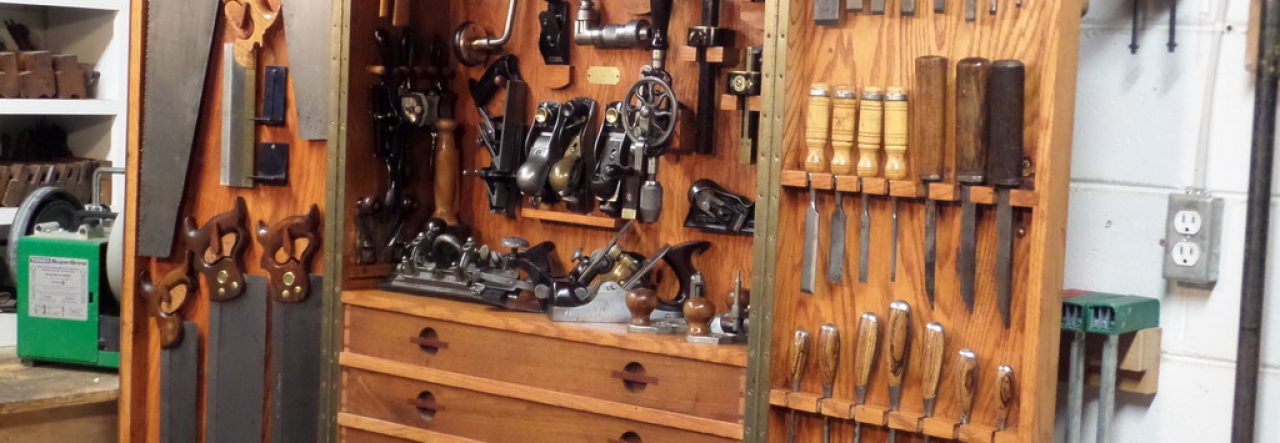
As you can see, I have a soft spot for molding planes. The day I figured out how to tune one up and make it sing, I was hooked. I intend to sell some of my duplicate profiles on eBay in the coming weeks.

Making Chalky Textured Paint

If you’re familiar with Shabby Chic furniture repurposing, then you probably know all about Annie Sloan’s Chalk Paint®. However, if you’re a woodworker who subscribes to every woodworking magazine out there, then you probably have no idea what Chalk Paint® even is.

Chalk Paint®, not to be confused with chalkboard paint, is a very easy to use paint that requires no sanding or priming to the wood. It is often used to revitalized antique furniture and leaves pieces with a warm matte finish. Simply wipe off the dirt on a piece of furniture and start painting. Its ease of use is what makes the paint so popular. The paint get its name from the chalky texture it leaves on the wood. The paint gives a piece of furniture a nice warm tone as opposed to the harsh look lacquer will often give. However, at nearly $40 a quart, the stuff is not cheap.

Annie Sloan is the British lady who invented the paint several decades ago. In fact, just recently her company trademarked the name Chalk Paint® creating a stink around the industry as there are several other companies out there branding their paint as a chalk paint, but only Annie Sloan makes the official Chalk Paint®.

Making paint with a chalky texture is not all that difficult. Many people will add an additive to latex paint like sanding grout or baking soda. Annie Sloan claims that the majority of her additive, but not all of it, is calcium carbonate also known as limestone. You can buy bags of calcium carbonate on Amazon for about $15.00. Each bag will make a couple of gallons of paint. Even though you’re technically not making Chalk Paint®, I found the additive to be close enough that it works just fine for me.

I bought a quart of Flat Black latex enamel at Lowes for about $10.00. Then following the instructions on the bag, I poured half of my paint into a container and added a 1/4 cup of calcium carbonate (limestone) additive to  the paint. I then added just a little bit of warm water to the to container to thin it out since the limestone thickens the paint. After stirring for a few minutes the paint is ready to use.

As you can see in the picture, the paint has a thickness to it. I simply brushed on a couple of coats waiting about an hour between coats. I then lightly sanded the piece with 320 grit sand paper knocking the paint off the corners and edges to give the piece a worn look. After wiping off the dust from the sand paper, I applied a wax to the piece to give it some sheen and to protect the paint.

Up close you can see how the piece is worn away a little bit at the corners and edges. What I like most about making this paint is that its intent is to make the piece look old. If the piece of furniture ever gets banged around and gets dings or dents on it, it will just add more character to the piece.

People who make their own chalky textured paint claim the biggest advantage is that you can make any color you want, which is true. However, my wife has found that the additive slightly changes the color of the paint. So if you go to the paint store and fall in love with a certain color, once you add the additive you may be disappointed with the color you end up with.

Making Walnut Stain

I have a big walnut tree in my backyard that drops hundreds of walnuts on the ground every fall. For some reason the walnuts were excessive this year as I have never seen so many on the ground. It must have been a good year to be a walnut tree.

I usually just trip on them while I cut the grass but I decided it might be fun to try to make my own walnut stain from the nuts.

I looked around for the walnuts that had opened up while the squirrels were giving me dirty looks and took about a dozen of them to my shop. I then wrapped them in an onion bag and tightened them up so the walnuts wouldn’t fall out. Wrapping them in cheese cloth would work just as well.

I grabbed a big pot I bought a few months ago and a hot plate burner to cook the walnuts. There was no way I was going to use a pot from my wife’s kitchen as I didn’t want to get punched in the face. I filled the pot with water with a couple of gallons of water, placed the nuts in it and turned on the hot plate until the water was at a boil.

After the water came to a boil, I turned the hot plate off and let the walnuts sit in the pot overnight. In the morning, I dipped a stick in the water to see how dark the stain was. It wasn’t as dark as I would have liked so I turned the burner on again. After I got the water to a boil, I turned the hot plate to low and let the walnuts simmer in the water for a few more hours.

This was the most frustrating part of the process. I kept testing the stain on some scrap oak to see how dark it was. Every hour I checked, the stain was real light and looked like tea. I started to think it wouldn’t work. So I decided that I probably had too much water in the pot and poured some of it in the sink. After removing about half the water and cooking the walnuts for a few more hours, this is what I was left with.

Satisfied with the color, I poured the stain into a mason jar using a funnel and paint strainer to collect all the gunk that had accumulated in the water from the walnuts.

This is how the stain looks on white oak. It dries a little lighter than this and raises the grain a bit but considering I made it from nuts in backyard is pretty cool.

I marked the date on top of the can so I know how fresh it is. Ideally you would want to store the stain in the refrigerator so it doesn’t go bad, but I doubt I’ll do that. I’ll  keep it around and test it every week to see how long it lasts. Unfortunately, I have nothing to stain right now. Maybe I’ll make a bookcase out of oak in the next few weeks so I can at least use it before it goes bad.

Woodworking in America

I stopped by the Marketplace at The Woodworking in America show in Covington, KY today after work. Living in Cincinnati I’m spoiled that I get to waltz right in like it’s no big deal when the majority of people who attend have to make travel plans and hotel accommodations. I attended the first WIA a few years back in Berea, KY and had a blast listening to presenters like Roy Underhill, Brian Boggs and Frank Klaus. However, the money has been too tight for me to afford to attend any of the seminars since then.

I picked up a few things while I was there, nothing much. I mainly went there to buy the book “By Hand & Eye” by George Walker and Jim Tolpin. I’ve read good things about it and knew Lost Art Press would have a booth so leaving with that was a no-brainer. I also picked up a couple of DVDs about using SketchUp. I’ve been wanting to learn how to use this design software for years but after fiddling around with it in the past, it never clicked. Hopefully the DVD’s will make a light bulb go off in my head.

I stopped by the Knew Concepts booth and looked at their fret saws again. I see them every year but they never bring any inventory to sell. They would give me a card and tell me to go on the website and use it for free shipping. Every year I took the card and just forgot about it. Well not this year. They finally brought saws to sell so I bought one.

I’ve wanted one of these saws for a few years now. They are much stronger and hold the blade much stiffer than an ordinary coping saw. I’ll use it mainly for cutting the waste out of dovetails as well as some fret work from time to time. The difference between a Knew Concepts saw and a coping saw is night and day. I may turn a new handle for it out of cocobolo to beautify it someday, but I’m in no rush for that.

With my Knew Concepts saw, my coping saw is perfectly happy in his new home.

All in all, the Woodworking in America is a good show that’s worth going to. It’s not like The Woodworking Show that travels around the country. It’s mainly focused on hand tool woodworking so you won’t find a lot of power tools or boxes of discount belt sander sanding belts. About three quarters of the vendors focus on hand tools which is fine by me.

I was disappointed not to see Welch chair maker Don Weber again this year. He hasn’t attended in a couple of years and I’m not sure if he will again. I took a blacksmithing class from him a few years ago at his shop in Paintlick, KY. He’s extremely knowledgeable about woodworking and a hell of a craftsman, as well as down right a nice guy. I did talk to a few young chair makers who were selling some sweet ass chair making tools. I wanted to buy a drawknife sharpener and adjustable calipers but my funds were already spent. I got their cards so maybe sometime down the road I’ll buy them off the internet.


Empire Dresser

The Empire dresser is officially done. My wife Anita found some nice oil rubbed bronze drawer pulls on the internet after looking locally for some with no luck. It originally had glass knobs on it, but a few of them were in rough shape and not all of them matched. I think the drawer pulls she picked out look really nice and add to the character of the piece. She applied four to five coats of hemp oil to the dresser. It gives it a warm aged look without making it look too glossy.

I put a few hours in this as well. I had to strip all the old stain off, patch a veneer job, re-band all the drawer fronts with sapele, replace a brass key escutcheon, and reinforce some of the drawer bottoms with pieces of poplar.

She plans on selling this in her booth with her painted furniture and antiques this Saturday at a local street fair in Milford, OH called the Longstone Festival. She was lucky enough to get a booth as there is usually a waiting list every year. Hopefully it will sell there. I will let you know if it does. http://www.longstonestreetfestival.com/