Repairing a Drawer Bottom

Earlier this week, my wife won a chest of drawers from an online auction. Sure enough when we get it home and examine the piece, we discovered there was significant water damage to the chest that the auction company failed to mention (what a surprise!). In fact, one of the drawers was so bad that the bottom plywood was peeling away. She asked me if I could fix it, so I went to Home Depot and bought a piece of 1/4″ X 24″ X 48″ underlayment plywood for about $5.00.

 photo drawer001.jpg

The first thing I did to the drawer was carefully pop off the glue blocks from the under side with a paring chisel as I was planning on reusing them.

 photo drawer002.jpg

I then carefully popped off the drawer runner being careful not to damage it. Fortunately, it wasn’t glued to the drawer bottom making it easy to clean up.

 photo drawer003.jpg

Then with a dead blow hammer, I gently popped off the sides of the drawers hoping not to damage the dovetail joints.

 photo drawer004.jpg

After cutting the new piece of plywood to size, I saw that the new drawer bottom was a little thicker than the original, so I widened all the grooves to the drawer with my table saw.

 photo drawer006.jpg

Once all the grooves were widened, I dry fitted the drawer back together making sure everything fitted properly.

 photo drawer012.jpg

I then glued the drawer back together including the support blocks back on the bottom.

 photo drawer013.jpg

After about a half an hours worth of work, the drawer was back in business and nicely fitted back in the piece.

 photo drawer014.jpg

Langdon Mitre Box Cleaned Up

Over the past couple of months I’ve been going gangbusters cleaning all my old tools I bought during the fall. So much so, that I haven’t really done any woodworking to even blog about. So, I figured I’d show you the massive Langdon Mitre Box that I bough this summer now that it’s all cleaned up. I took a few pictures and shot a video to give a better idea of the miter box’s massive size.

 photo ebay017.jpg

 photo ebay018.jpg

 photo ebay019.jpg

 photo ebay020.jpg

 photo ebay022.jpg

 photo ebay023.jpg

As you can see in the pictures below, the miter box was repaired at some point in it’s life. I don’t think it ruins the value of the box too much as I bet that I could buy a regular sized Langdon Mitre Box and use the parts to swap the foot and locking bar.

 photo ebay024.jpg

 photo ebay025.jpg

Now I’m not sure what I should do with it. On one hand, I think the miter box is really cool and I’ll probably never find another one as long as I live. But on the other hand, I bet I could sell this thing for a pretty penny and pay off some of my credit card bills. I also really have nowhere to store the thing. I really don’t want to sit it in my shop as I’m afraid it’ll get damaged from all the banging and clanging that goes on down there. But, I doubt my wife would approve of it sitting proudly on our mantel in the living room. So, for right now it’s sitting on the shelf with all the other antique tools that I’ll eventually sell on eBay. What do you think I should do with it?

Adding Cross Bars to a French Style Bookcase.

Over the past few months I’ve been making these French style bookcases for my wife. They’re pretty popular as they usually sell within a couple of weeks in her booth. The nicest part of the bookcase is the design of the cross bars that mimic the design of the Eiffel Tower. The design also makes the bookcase lighter and feel more open as opposed as having closed sides making the bookcase feel heavy.

Adding the cross bars isn’t so difficult when you take your time and measure everything correctly. When I start to build the cross bars, I rip 3/4″ square stock out on the table saw and sand them smooth on my drum-sander. I take one of the bars and clamp it to both back styles of the bookcase. I then strike a line to show me the correct angle that needs to be cut.

20140914_175028


I take the bar over to my old school Stanley No 140 miter box and cut it close to the line, but not on it. I could do this on a power miter saw, but I feel that’s way too much power for doing delicate work like this.

20140914_175414

After the cutting the bar on my miter box, I size it to the line by carefully trimming it with my AMT miter trimmer. I love this tool, but a miter trimmer is the Rodney Dangerfield of woodworking. For whatever reason, it simply gets absolutely no respect in the hand tool world. I guess hand tool purest would rather use a shooting board and plane, but this thing has never let me down in the twenty-five years I’ve owned it.

20140914_181649

When the bars are properly fitted, they are super tight against the styles. So much so that it is very tough to even fit them in place. Having the bars fit this tight is actually very important because they will be glued in place without any mechanical fasteners other than a 23 gauge micro pin toe nailed to the styles.

20140914_180408

Once I’m happy with the fit, I then scribe a line on each bar where the bars meet to create a half lap joint.

20140914_180757

With a dovetail saw, paring chisel, and router, I carefully remove the material between the lines. The depth of the router blade is exactly half the thickness of the bar ensuring the bars are flush to each other when they are fitted together.

20140914_181522

After the joint is cut, I test fit the pieces to make sure everything looks good. An important thing I do when installing the bars is to place witness marks on the bars and styles so that I know which direction the bars goes when it’s time for installation.

20140915_182435

The cross bars on the sides of the bookcase are done exactly the same way. When it comes to installing all the cross bars, I glue and nail them to the styles. Because I plan on painting the bookcase, I don’t care about the nail holes. I just fill them in with wood putty. I use 18 gauge pneumatic nails and nail the side cross bars from the front and back of the styles. The back cross bars, I glue and toe nail them with 23 gauge pin nails to the back styles.


Roubo Style Workbench

Walking around an antique store called Ohio Valley Antique Mall in Cincinnati this weekend, I ran upon this massive beast in one of the aisles. An eight foot long authentic Roubo style workbench. I’ve seen dozens of old workbenches before, but for some reason this guy stuck out to me. The previous owner screwed nickel-plated hooks on the front of it for someone reason. Probably to hold coffee cups or some other nonsense.

 photo 20140831_125018.jpg

What made this bench stick out was the splay of the front leg along with the leg vise. I imagine this was done to prevent the workbench from racking when sawing. The cast iron vise hardware turned smooth and could still tighten with something with a good grip.

 photo 20140831_130955.jpg

It had an old planning stop hole used for planning boards. Oddly the area around the hole was all worn down. When I see wear marks on old pieces like this, it makes me wonder what type of work the craftsman did to make those types of marks. Though it does appear he was sawing on the right side of the planning stop.

Another interesting clue is that it is quite possible that at one point there was another vise installed on top. The three holes around the lighter circular area is possibly where he bolted down a machinist vise onto the bench.

 photo 20140831_130947.jpg

The legs were jointed together with a simple bridle joint however, the legs were not jointed into the bench’s top. More likely the top was just bolted down to the legs somehow. I didn’t feel like moving everything around in the booth to get a better look.

 photo 20140831_131003.jpg

The bench top was a good 12″ wide x 4″ thick piece of pine. It had a tool tray in the back that appeared to be in real good shape given it’s age. Notice how there are no bench dog nor holdfast holes in the top.

 photo 20140831_131011.jpg

Who knows where this bench will end up. Probably in someone’s home as a kitchen island, but for a cool $700 it can be all yours.

 photo 20140831_125018.jpg

Making a Bench from Dimensional Store Bought Lumber

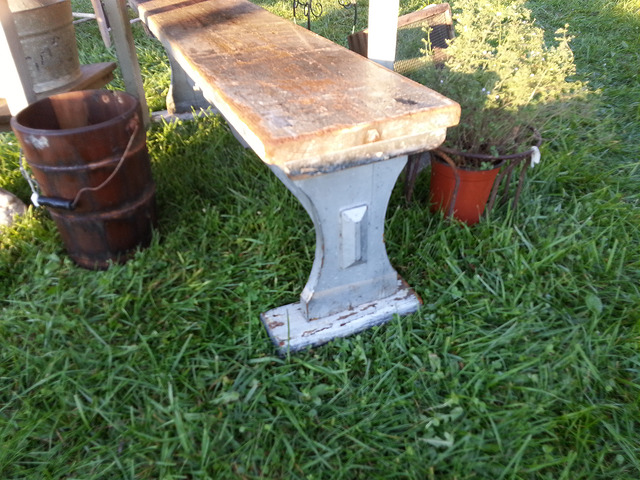
When my wife Anita does shows, I’m always looking for something that I can make fairly quickly that she can sell in her booth to help pay for some of her fees. After helping her do shows over the past couple of years, I’ve noticed that small benches are quite popular. They’re nice to stick out on front porches or foyers or even mud rooms. In fact, some people even use a bench as the seating for one side of their kitchen table.

10407335874_d0e82a20d0_z

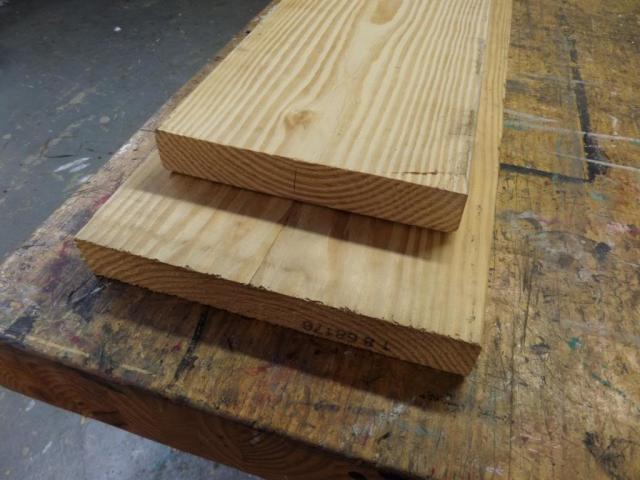
I designed this bench to be made from a 2″ x 12″ and a 2″ x 8″ that are eight feet long. However, if you change the dimension of the stretcher a little bit, it could be made form a 2″ x 12″ x 10′. The only issue doing that is you need to make sure your 2″ x 12″ x 10′ is choice wood with no splits at the end of the board because you’ll need nearly every inch of it. It doesn’t matter to me because I can’t fit a ten foot board in my car anyway, so I bought a 2″ x 12″ x 8′ and 2″ x 8″ x 8′ for under $20.00.

ww001

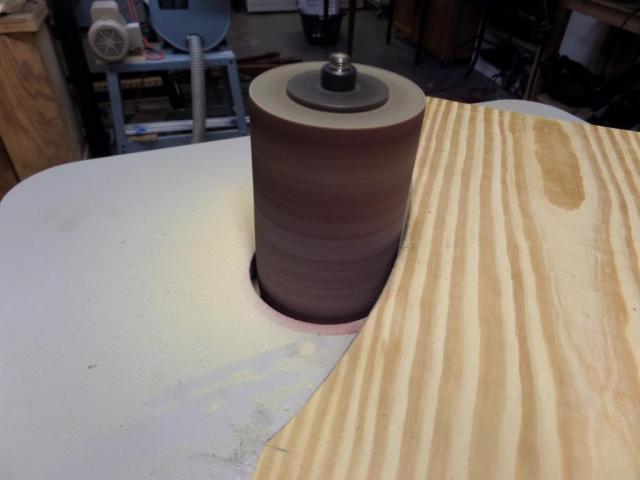
The construction of the bench is super simple. I make the legs 9″ wide x 16″ long. I measure down 2 1/2″ from top and bottom on each side and use the lid from my garbage can to draw an arch connecting the two marks. Then I cut it off the arches on my band saw. I sanded the arches smooth on my oscillating spindle sander.

ww012

The feet are 5″ wide x 10 3/4″ long. I draw a 1″ radius on both sides and remove the material with chisels, planes and files.

I want the bench to have four feet so I take two of the pads and cut grooves in them on my table saw. Once all the grooves are cut, I remove the waste with my bench router and plane everything smooth.

When designing the stretcher, I did nearly the same thing as the legs. I measured 2 1/2″ from each side and make a mark. Then I find the stretcher center and mark 2 1/2″ off each side of the center. I swing a compass set at a 12″ radius connecting the marks creating the arches for the stretcher.

ww015

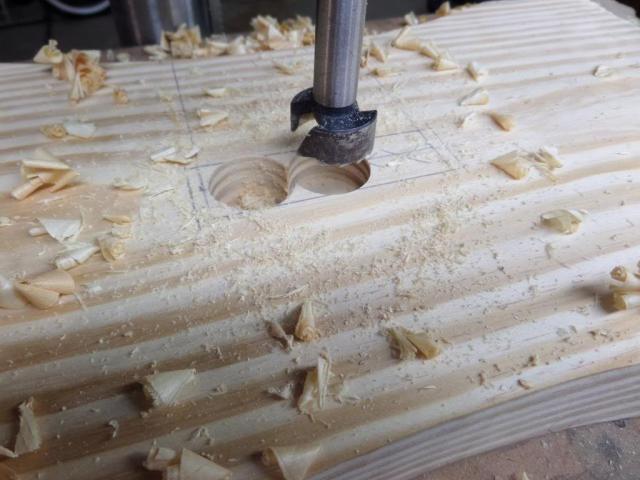
In order for the legs to attach tot the stretcher, I bored a 1″ x 4″ mortise through the legs with a 1″ forstner bit and cleaned it up with chisels. The tenons I cut on the table saw and band saw and cleaned them up with my rabbet plane.

After all the parts are sanded, I dry fitted everything together to make sure the bench looked right. I wanted the tenons to have a mechanical fastener along with the glue, so I drilled two 1/4″ holes through the side of the legs going through the tenons.

20140823_123357

I grabbed some scrap oak and split a few splitters of wood with a chisel. The pins run down the grain making them exceptionally stronger since the grain follows the strength of the wood. I sized the pins by punching them through my Lie-Nielsen dowel plate. I shaved the pins a little bit with my spoke shave so they would start to fit through the 1/4″ hole of the dowel plate. Once the pin starts to fit in the hole, I pound the hell out of it.

20140823_123402

After I was satisfied with the way the bench stretcher fitted to the legs, I started gluing and screwing everything together, I placed glue of the pins and inserted them into the tenons of the bench. I didn’t bother draw boring the holes of the tenon. I was already satisfied with the tightness of the joint.

20140825_171145

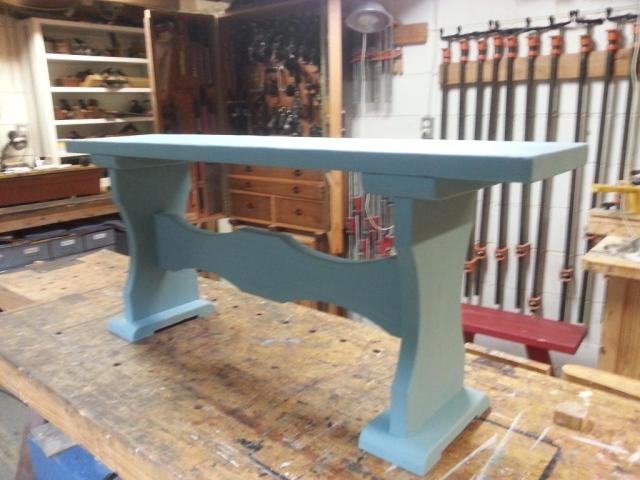
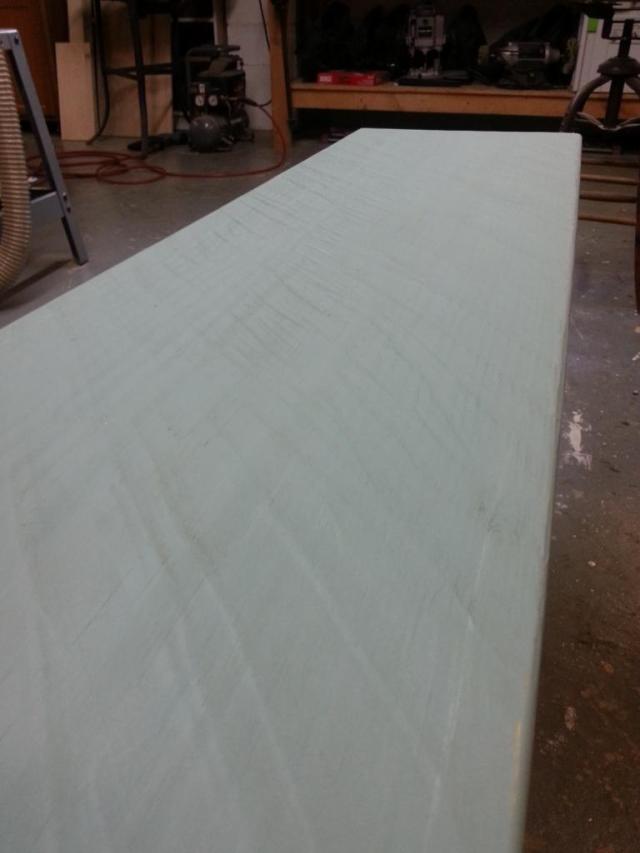
The bench was painted a duck egg blue and waxed over top. The next bench I make will probably be a different color. Maybe a black or grey as neutrals are always popular.

20140825_170758

You can see the detail of the top where the scrub plane left little ridges in the wood giving the bench a bit of detail. It definitely looks better than having a plain board for the seat of the bench.


The World’s Longest Yard Sale 2014

My wife and I got back from The World’s Longest Yard Sale today which runs down US 127 from Michigan to Alabama. We left Wednesday morning before it officially began and drove down US 127 looking for bargains stopping at dealers who sat up early. We ended up in Chattanooga, TN for a couple of nights.

 photo YARDSALE.jpg

When we woke up in Chattanooga, we headed south toward Alabama because last year we had heard that that’s where all the good deals are. Going below Tennessee on the yard sale can be tricky because US 127 ends in Chattanooga. The yard sale continues on the Lookout Mountain Parkway which takes all different routes as it changes onto different state roads.

Once we got into Alabama we didn’t necessarily see a lot of good deals, just a bunch of dealers selling antiques. I did spot tons of anvils for sale. I could have bought 20 anvils if I was in the market for one, but I still have an anvil I bought two years ago sitting in the garage waiting for me to make a stand for it.

After we got back to the hotel we stayed for another night then headed up Tennessee in the morning. Tennessee had a bunch of professional dealers as well. My wife and I were buying a few things here and there, but the prices people wanted weren’t “yard sale” prices.

Everything was going fine until somewhere in the boon docks of Tennessee I got stung by a damn bee. What made the situation worse is that I just got stung in my lip by a bee a couple of weeks ago when I was doing mulch in my yard which made my lip swell up three times its normal size.  Now another son of a bitch comes right toward my face and stings my eyelid. I’ve never been an anti-bee person, but I think I’m going to start pissing on my wife’s flowers so the little bastards can inject my urine into their bodies.

We drove to the nearest pharmacy 20 miles away and picked up some Benadryl and ice to prevent the sting from swelling up. I put ice on it all day, but sure enough when I woke up in Lexington, KY the next morning, my eye was swelled shut. We considered calling the trip and just head home, but I told Anita that I was fine and it’s best for us to just keep moving along.

Photo: I got stung again!!!!! Twice in three weeks. This is bullshit!

Kentucky had the most tools. However, a lot of dealers were around selling their tools at retail. There’s nothing wrong with selling retail, I’m just a picker so it needs to be a good deal for me to buy it. I found the best places to buy tools were the little road side sales with only a couple of yard sales. Not these big tent cities where there are 150-200 vendors in one spot.
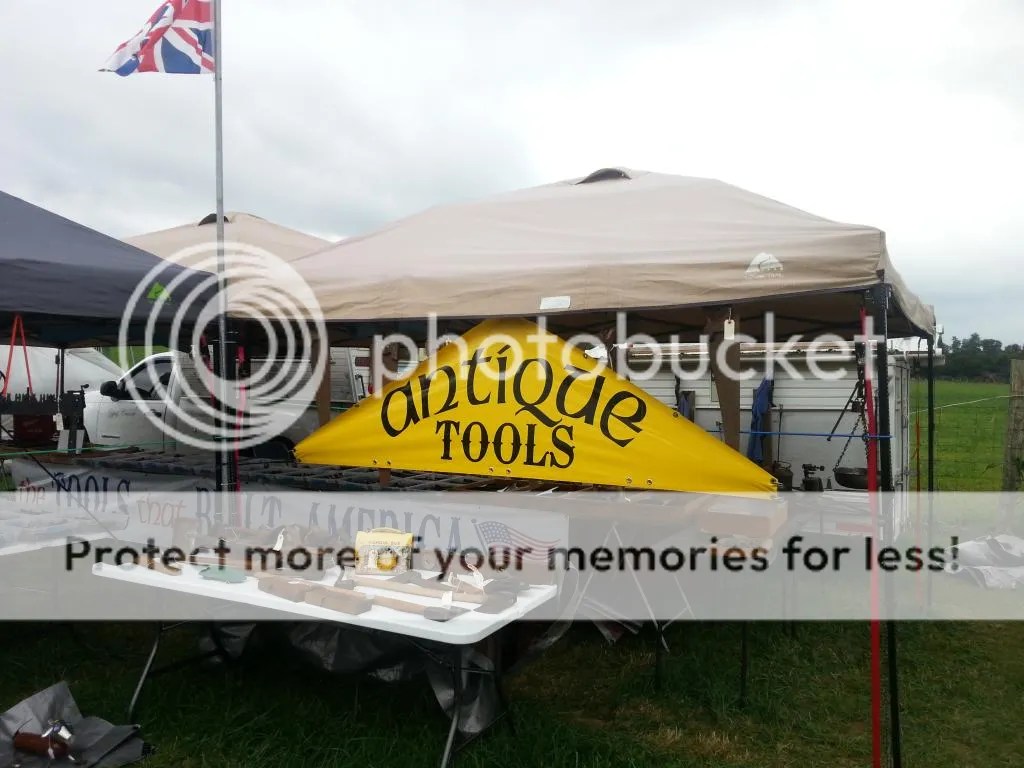
 photo 20140809_105618.jpg

 photo 20140809_105940.jpg

 photo 20140809_105655.jpg

We got back home last night and headed out this morning to check out Ohio. Ohio had the best deals on items. They were true yard sales with “yard sale” prices with very few dealers. When we were all done this afternoon I got a few tools. Nothing major considering we did it for nearly five straight days.

 photo 20140810_170416.jpg

Out of all the tools I bought, the neatest was a panel raising plane I bought in Tennessee. It appears to be of German descent so it’s quite possible that a German immigrant made the plane when he came to America. There is no makers name on it so it’s definitely an owner made plane.

 photo 20140810_170435.jpg

The guy who sold it to me told me that it was from the 1700’s, but I highly doubt that. I would guess anywhere in 1800’s. One of the clues that could determine its age is the bore hole made by whatever drilled it. If I can figure out what kind of drill bit that bore that hole, I could estimate the plane’s overall age.

 photo 20140810_170455.jpg

Another nice find was this Disston stair case saw. I believe these little guys are somewhat rare so I was happy to pick him up at an extreme bargain.

 photo 245e42f1-dcc7-4fab-82c1-27d5a18f2064.jpg

The yard sale is a lot of fun and you should definitely do it if it’s ever been on your bucket list. I’m not sure if we’ll go all the way down to Alabama next year, but we are already planning our next trip.

The Beginning of The World’s Largest Yard Sale

image

We’re on our way to Chattanooga today for the World’s Longest Yard Sale this weekend. We’re stopping at spots on US127 on our way down. Vendors are now setting up today since it officially starts tomorrow.  Follow me on Facebook if you want to see pictures as we go through the yard sale this weekend.  Simply click on my Facebook icon on the left and “like” my page. My pictures will be a part of your feed. 
Langdon Mitre Box

One of the nice things about my job is the autonomy I get when I travel through my sales territory calling on Lowe’s and Home Depot’s in Cincinnati, Dayton and Indianapolis. Often during lunch, I’ll stop by a nearby antique mall and look for old tools. Yesterday I was in an antique mall near Dayton when I stumbled upon this beast. I’ve been buying antique tools for over twenty-five years and have never seen a miter box like this at any tool auction, tool collectors convention or even eBay.

 photo 20140617_164553.jpg

It’s a huge Langdon Mitre Box with a Disston Miter Saw. On the front it has the patent date of Nov 15th 1864 and was made in Millers Falls, Mass. The front and the wood are painted green, but have no idea whether or not if it’s original paint.

 photo 20140617_164557.jpg

The saw’s blade is an incredible 7 1/2″ deep and still straight. The etching is barely visible and may be able to pop out with a little bit of restoration. This behemoth must be something they used to install the crown molding at The Biltmore Estate.

 photo 20140617_164753.jpg

The previous owner flipped the board upside down for some reason. I guess they felt it was nearly all used up so they wanted a fresh surface to cut on. I’m just glad they didn’t throw it away as it looks to be the original board.

 photo 20140617_164614.jpg

It’s a Disston Saw with an apple handle, but is marked Langdon Mitre Box on the spine. The main saw nut is dirty, but it’s stamped Disston and Sons. I think Langdon Mitre Boxes eventually became part of the Millers Falls Tool Company, but I’m not entirely sure.

 photo 20140617_164623.jpg

 photo 20140617_164658.jpg

The saw has split nuts on the back which gives a clue as to how old it is. The problem is that I don’t know enough about saws to be able to date it, other than the 1864 patent date on the box. However, that doesn’t necessarily mean it was built during that time.

miter box saw photo output.jpg

Since I’m not too familiar with miter boxes, I was hoping you might be able to help me out.

1) Does anyone know anything more about this miter box? How rare is it?

2) How old is it considering it has split saw nuts?

3) Is the green paint original to the miter box?

Any information would be greatly appreciated!

UPDATE 6/22/14: It was recommended by Trevor that I contact “The Langdon Mitre Box Guy” John Leyden and see if he could give me any more information on the miter box. After I sent John an email, he was nice enough to respond and send me this link. http://oldtoolheaven.com/miter-boxes/northampton-langdon.html. The miter box and saw appear to be the same one I own.