Restoring a Stanley No 10 Carriage Maker Rabbet Plane

Several months ago I picked up a Stanley No 10 Carriage Makers Rabbet plane with a welded sole at a local auction. I wanted to restore the plane and make it usable again so I took it all apart and soaked everything in a citric acid solution for a few hours.
SAMSUNG CAMERA PICTURES

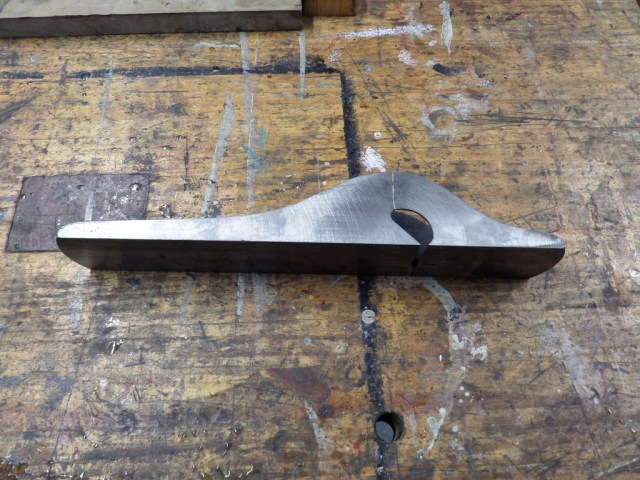
Even thought the weld was done fairly well, the plane’s sides were no longer straight. Not the best situation for a plane that needs straight sides in order to cut a clean rabbet.

Fortunately, because the plane cracked only on one side, the bed was still relatively flat when it was welded back. If the bed would have been out of whack, I may have resorted to the garbage can as it would have been too much work to fettle flat.

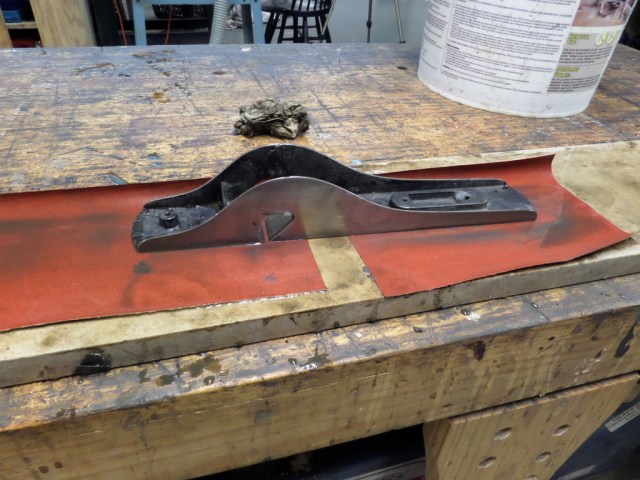
I wanted the black removed from the sides as the previous owner painted the sides to cover up the weld. I spread some paint remover on it and let it sit for a few minutes before removing it with a putty knife. I then needed the sides to be straight so I started to fettle them with sandpaper on a marble base. Rubbing the bed back in forth, I could see the high and low spots on each side.

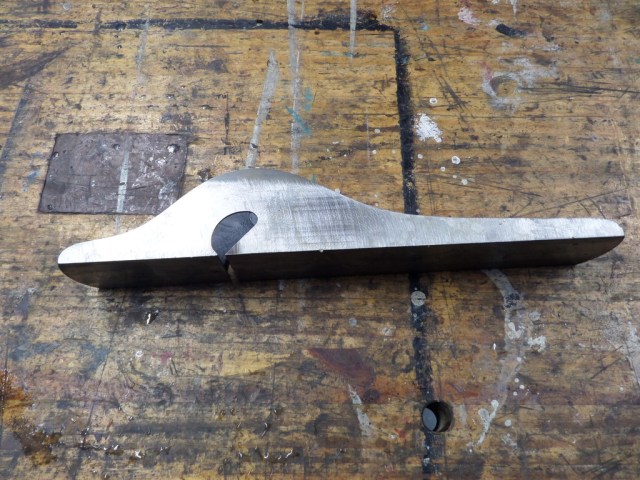
There was a lot of metal to remove, so I decided to take the bed to my stationary disc sander and carefully grind the bed using 80 grit sand paper.
SAMSUNG CAMERA PICTURES

Using the disc sander saved a lot of time, but it scratched the hell out of the surface. I made sure I moved the bed back and forth so that I wouldn’t do more damage than good.

Because the disc sander made a lot of scratches on the sides, I took the bed back to my marble base and used a variety of sand paper grits to remove as many scratches as I could.

SAMSUNG CAMERA PICTURES

I then focused on the bed, fettling it flat. I used a variety of sand paper from 150-400 grit. I worked on it for a few minutes until I was satisfied with the results.
SAMSUNG CAMERA PICTURES

Once the bed was done, I sharpened the blade using my Tormek sharpening wheel and water stones.
SAMSUNG CAMERA PICTURES

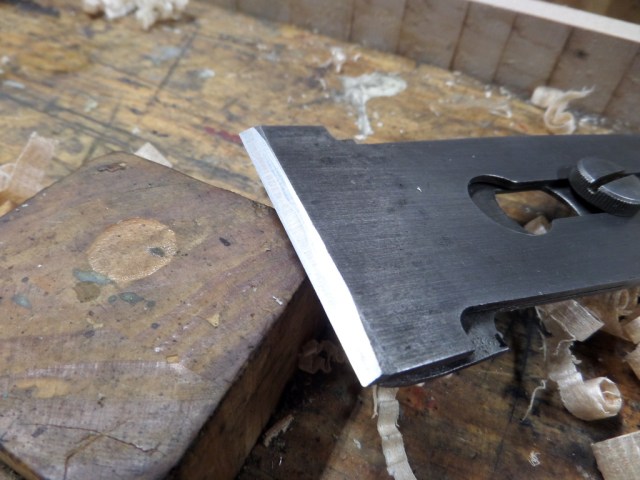
Since I ground some of the thickness of the sides away, you can see where the blade protrudes farther out of the side than normal. I could grind away the sides of the blade, but I wanted to wait and see how it performs first. If I was able to cut a clean rabbet with the way it was, I would just leave it alone.

SAMSUNG CAMERA PICTURES

Here she is after all the work has been done. It looks a lot better than the way I bought her, but I still needed to see if she works.

SAMSUNG CAMERA PICTURES

After setting the blade to the right depth, I tried it out on a scrap piece of wood. It cut nice little shavings with ease and can now be put in my arsenal of planes for use. Even though I spent a good day tuning this plane up, it gives me great satisfaction resurrecting an old tool back to life. Plus it saved me a ton of money versus buying a new rabbet plane.

SAMSUNG CAMERA PICTURES

Updated Tool Cabinet

I built this cabinet nearly fifteen years ago and every few years I end up updating the tools that go inside it. It’s been about three years since I updated it, so I decided it was time for a change.

As you can see in the photo below, at one time I loved MicroPlane rasps. I stuck everyone I owned onto the left door. While they are nice rasps to use, I decided to delegate them to a nearby drawer instead. The Stanley short box handsaw had to go as well. I never used it, so it was pointless to have it take up so much valuable space.

SAMSUNG CAMERA PICTURES

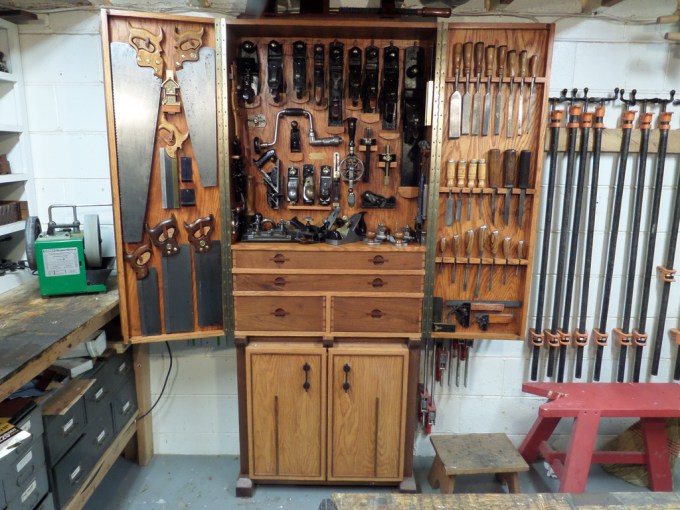
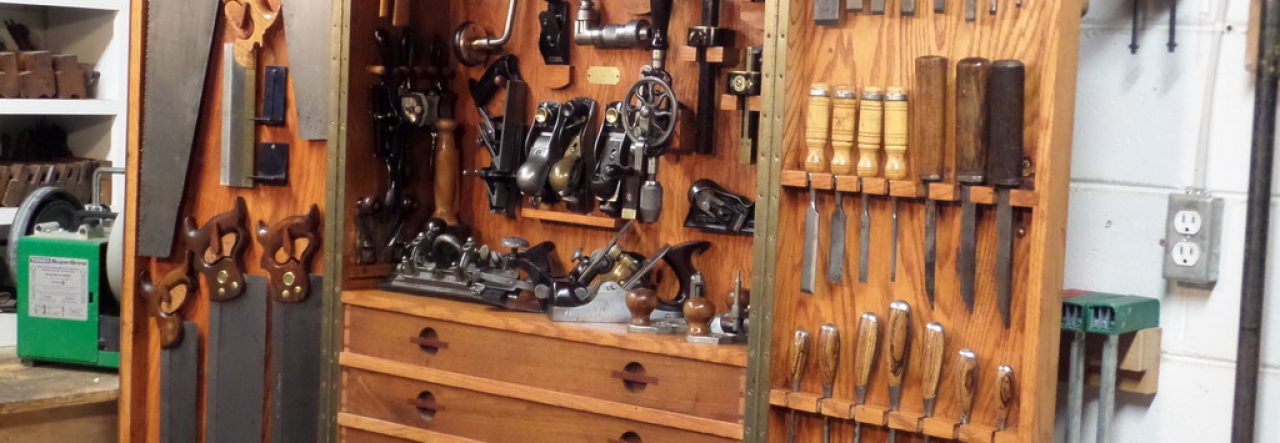
This is how the cabinet looks today. Over the years I’ve been learning a lot more about hand saws, so my collection of usable hand saws that I have restored has grown. I knew I wanted to incorporate them into the cabinet somehow which is one of the main reasons I decided to redesign the tool cabinet.

SAMSUNG CAMERA PICTURES

Hanging on the top of the left door, I have a E C Atkins rip saw that I made a new handle for it out of cherry, and a short Superior panel crosscut saw. In the middle is my original Lie-Nielsen dovetail saw I bought twenty years ago. Below it is another dovetail saw and two Disston back saws, one filed to saw rip and the other filed for crosscut.

SAMSUNG CAMERA PICTURES

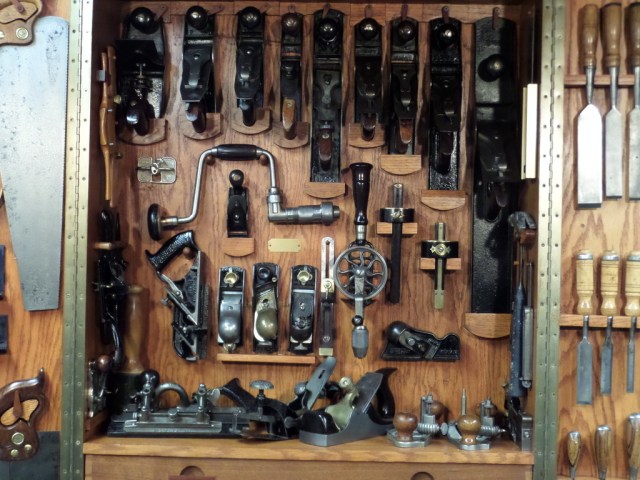
I stuck my hammer on the right side by my Stanley No 8 jointer plane. By the hammer, I hung a couple of bevels and a Nobex square. Underneath the screwdrivers on the right door is where I hung more measuring tools. Since I’ve updated this cabinet numerous times over the years, if you look closely, you can see where the oak veneer has been torn off the plywood substrate. To conceal the damage, I stained the entire inside of the cabinet with Nutmeg Gel Stain. Thank God I didn’t make this thing out of African Mahogany as I have no qualms about damaging oak plywood.

SAMSUNG CAMERA PICTURES

The left side of the cabinet is where I stock a lot of my spokeshaves and Stanley No 66 Beader. I’d like to build a little rack for all my blades for my beader, but that will be another project for another day.

SAMSUNG CAMERA PICTURES

The middle of the cabinet was left untouched as there’s really no room to do any changes. Maybe the next time I update my tool cabinet, I’ll make room for all my Festool accessories. haha


The World’s Longest Yard Sale 2014

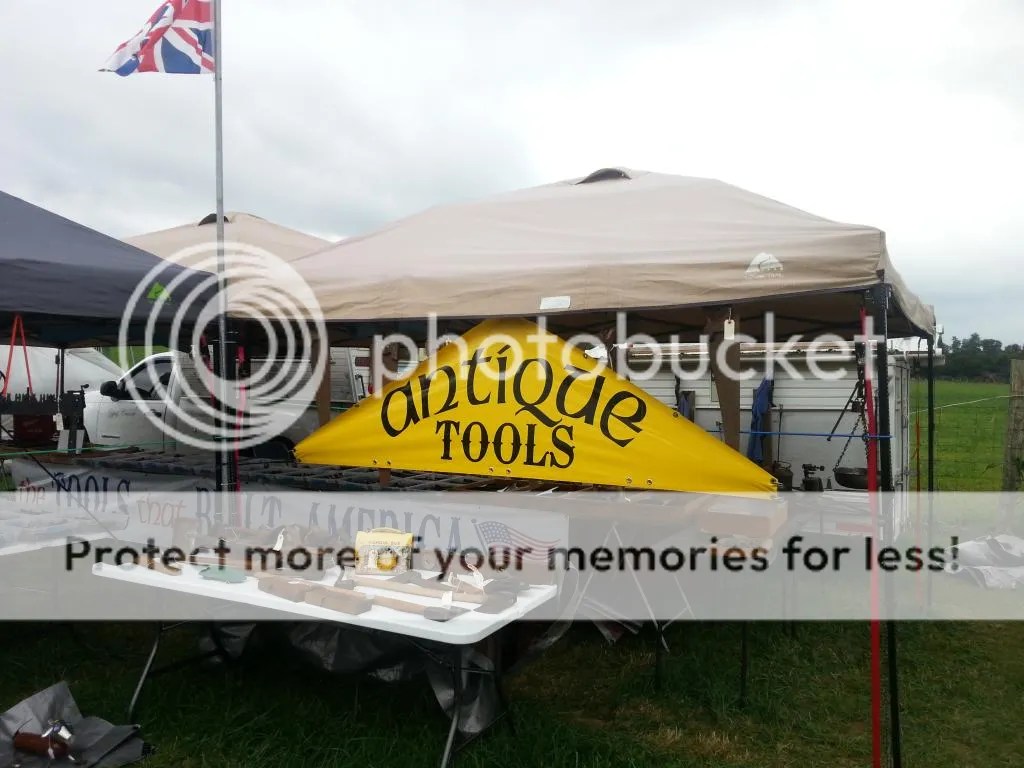
My wife and I got back from The World’s Longest Yard Sale today which runs down US 127 from Michigan to Alabama. We left Wednesday morning before it officially began and drove down US 127 looking for bargains stopping at dealers who sat up early. We ended up in Chattanooga, TN for a couple of nights.

 photo YARDSALE.jpg

When we woke up in Chattanooga, we headed south toward Alabama because last year we had heard that that’s where all the good deals are. Going below Tennessee on the yard sale can be tricky because US 127 ends in Chattanooga. The yard sale continues on the Lookout Mountain Parkway which takes all different routes as it changes onto different state roads.

Once we got into Alabama we didn’t necessarily see a lot of good deals, just a bunch of dealers selling antiques. I did spot tons of anvils for sale. I could have bought 20 anvils if I was in the market for one, but I still have an anvil I bought two years ago sitting in the garage waiting for me to make a stand for it.

After we got back to the hotel we stayed for another night then headed up Tennessee in the morning. Tennessee had a bunch of professional dealers as well. My wife and I were buying a few things here and there, but the prices people wanted weren’t “yard sale” prices.

Everything was going fine until somewhere in the boon docks of Tennessee I got stung by a damn bee. What made the situation worse is that I just got stung in my lip by a bee a couple of weeks ago when I was doing mulch in my yard which made my lip swell up three times its normal size.  Now another son of a bitch comes right toward my face and stings my eyelid. I’ve never been an anti-bee person, but I think I’m going to start pissing on my wife’s flowers so the little bastards can inject my urine into their bodies.

We drove to the nearest pharmacy 20 miles away and picked up some Benadryl and ice to prevent the sting from swelling up. I put ice on it all day, but sure enough when I woke up in Lexington, KY the next morning, my eye was swelled shut. We considered calling the trip and just head home, but I told Anita that I was fine and it’s best for us to just keep moving along.

Photo: I got stung again!!!!! Twice in three weeks. This is bullshit!

Kentucky had the most tools. However, a lot of dealers were around selling their tools at retail. There’s nothing wrong with selling retail, I’m just a picker so it needs to be a good deal for me to buy it. I found the best places to buy tools were the little road side sales with only a couple of yard sales. Not these big tent cities where there are 150-200 vendors in one spot.

 photo 20140809_105618.jpg

 photo 20140809_105940.jpg

 photo 20140809_105655.jpg

We got back home last night and headed out this morning to check out Ohio. Ohio had the best deals on items. They were true yard sales with “yard sale” prices with very few dealers. When we were all done this afternoon I got a few tools. Nothing major considering we did it for nearly five straight days.

 photo 20140810_170416.jpg

Out of all the tools I bought, the neatest was a panel raising plane I bought in Tennessee. It appears to be of German descent so it’s quite possible that a German immigrant made the plane when he came to America. There is no makers name on it so it’s definitely an owner made plane.

 photo 20140810_170435.jpg

The guy who sold it to me told me that it was from the 1700’s, but I highly doubt that. I would guess anywhere in 1800’s. One of the clues that could determine its age is the bore hole made by whatever drilled it. If I can figure out what kind of drill bit that bore that hole, I could estimate the plane’s overall age.

 photo 20140810_170455.jpg

Another nice find was this Disston stair case saw. I believe these little guys are somewhat rare so I was happy to pick him up at an extreme bargain.

 photo 245e42f1-dcc7-4fab-82c1-27d5a18f2064.jpg

The yard sale is a lot of fun and you should definitely do it if it’s ever been on your bucket list. I’m not sure if we’ll go all the way down to Alabama next year, but we are already planning our next trip.

Langdon Mitre Box

One of the nice things about my job is the autonomy I get when I travel through my sales territory calling on Lowe’s and Home Depot’s in Cincinnati, Dayton and Indianapolis. Often during lunch, I’ll stop by a nearby antique mall and look for old tools. Yesterday I was in an antique mall near Dayton when I stumbled upon this beast. I’ve been buying antique tools for over twenty-five years and have never seen a miter box like this at any tool auction, tool collectors convention or even eBay.

 photo 20140617_164553.jpg

It’s a huge Langdon Mitre Box with a Disston Miter Saw. On the front it has the patent date of Nov 15th 1864 and was made in Millers Falls, Mass. The front and the wood are painted green, but have no idea whether or not if it’s original paint.

 photo 20140617_164557.jpg

The saw’s blade is an incredible 7 1/2″ deep and still straight. The etching is barely visible and may be able to pop out with a little bit of restoration. This behemoth must be something they used to install the crown molding at The Biltmore Estate.

 photo 20140617_164753.jpg

The previous owner flipped the board upside down for some reason. I guess they felt it was nearly all used up so they wanted a fresh surface to cut on. I’m just glad they didn’t throw it away as it looks to be the original board.

 photo 20140617_164614.jpg

It’s a Disston Saw with an apple handle, but is marked Langdon Mitre Box on the spine. The main saw nut is dirty, but it’s stamped Disston and Sons. I think Langdon Mitre Boxes eventually became part of the Millers Falls Tool Company, but I’m not entirely sure.

 photo 20140617_164623.jpg

 photo 20140617_164658.jpg

The saw has split nuts on the back which gives a clue as to how old it is. The problem is that I don’t know enough about saws to be able to date it, other than the 1864 patent date on the box. However, that doesn’t necessarily mean it was built during that time.

miter box saw photo output.jpg

Since I’m not too familiar with miter boxes, I was hoping you might be able to help me out.

1) Does anyone know anything more about this miter box? How rare is it?

2) How old is it considering it has split saw nuts?

3) Is the green paint original to the miter box?

Any information would be greatly appreciated!

UPDATE 6/22/14: It was recommended by Trevor that I contact “The Langdon Mitre Box Guy” John Leyden and see if he could give me any more information on the miter box. After I sent John an email, he was nice enough to respond and send me this link. http://oldtoolheaven.com/miter-boxes/northampton-langdon.html. The miter box and saw appear to be the same one I own.

My 100th Post

Well this is my 100th post on my blog. I just want to thank all of you who find what I write interesting enough to subscribe to my blog. It was just six months ago when I told everyone that I had 100 followers. Today I have 175 and growing.

I started this blog because for years I’ve always wanted to write a book about restoring antique tools similar to Michael Dunbar’s book Cleaning, Restoring and Tuning Classic Woodworking Tools. It’s been out of print for years and I felt that the it was a side of woodworking that wasn’t paid enough attention to. However, sitting down and writing a book is for the birds as I don’t have the patience for that. I could however take a bunch of pictures of tools I was cleaning up, write about the processes and throw them on a blog. That’s why a lot of my posts are about old tools. I don’t know if I’ll ever write the book about restoring old tools though. I just found out a couple of weeks ago that Popular Woodworking is working on a second edition of Dunbar’s book.

I never thought I would ever get anything out of this blog. I mean sure it would be nice to have some advertising on the side of the page and make a little bit of money off of it. Hell, I’d use the money to pay for my golf league or take my wife out to dinner. But I’m not doing this trying to make a living or make a name for myself. For the most part, no one even knows who I am. I’ve never been mentioned on any other woodworking blogs like Chris Shwarz’s blog or The Wood Whisperer. So the fact that I have 175 followers after a couple of years isn’t half bad.

I did get a call from American Woodworker magazine editor Glen Huey a couple of weeks ago. As you may know, F+W Media which owns Popular Woodworking bought New Track Media a few months ago which owns American Woodworker. With the change over, Glen was appointed to be the editor of Am Wood. He contacted me asking if I would be interested in writing a few articles about making furniture from construction grade material like 2 x 8’s or cheap hardwood like poplar. He has read my blog and was impressed with some of the stuff I’ve been able to make with it and thought it might make a good article for the magazine. I jumped at the chance as writing for woodworking magazines has been a dream of mine ever since I was 11 years old when I bought issue #3 of Wood magazine. I ran down to the corporate office in Blue Ash, OH last week and met with Glen for about an hour. I’m in talks with him right now about some ideas of furniture I could make so, hopefully I’ll have a couple of articles under my belt by the end of the year.

Sharpening a Pitted Plane Blade

I bought a Millers Falls No 7 Jointer Plane a few weeks ago that had a pitted blade in it. While most people would look at a blade like this and immediately think that it belongs in the trash, I decided to see if I could get it to work well enough to slice thin shavings off a piece of cherry.

The first thing I do when I sharpen any of my blades is to whip out my Tormek sharpening wheel. I’ve owned the Tormek for several years now and have never regretted the coin I paid for it. I set the machine up to grind a 25 degree angle on the blade and go to town.

A few minutes on the Tormek puts a real nice edge on the blade. The problem is the back of the blade is still pitted causing the blade to cut ridges in the work piece while using it in the plane.

I used the side of the wheel of the Tormek to try to flatten the back of the blade, but after a few minutes I wasn’t really getting anywhere. It did help, but it would have taken hours to remove all the pits.

I decided to give the old ruler trick a try made famous by David Charlesworth and remove only the metal at the front of the blade. I stick a thin ruler at the back of the blade and sharpen the backside of the front of the blade by moving it back and forth on a piece of 320 grit sandpaper. This in theory changes the cutting angle of the blade by a few degrees, but honestly, who cares? There is very little difference between a blade with a 25 degree angle and one with 24 or 23 degrees. It may make a difference with hard exotics, but I normally use poplar, cherry, maple and southern yellow pine. I’m too cheap to buy hard exotic wood.

As you can see if you look closely, the ruler trick worked. The very front edge of the back of the blade is clean of any pitting and will hold an edge better.

I then switched to my water stones and hone the edge created on my Tormek. I use a combination stone of 800/4000 grit and a final 12000 grit stone. I use water stones as opposed to oil stones simply because the Tormek is a water stone. Oil and water don’t mix.

Here is my final sharpening of the blade. Pretty good if you ask me.

Here’s the blade in action cutting cherry. After a few adjustments with my plane, I was able to produce nice clean shavings. The cherry underneath was glass smooth after it was planed with the blade.

How thin were my shavings? About .003″ thin. Not too shabby for a piece of crap blade that most people would have never even given a second chance and would have just thrown in the garbage.

Now That’s a Leg Vise

While traveling between Greenville, OH and Richmond, IN for work, I stopped in an antique store in New Paris, OH and came across this behemoth. The flywheel on this leg vise must have been 18″ in diameter and was very smooth when I turned it.

Some of you may be aware of Jameel Abraham from Benchcrafted who makes reproduction flywheel hardware similar to this for workbench leg vises. I’ve tried one at the Woodworking in America conference a few years ago and loved it.  I even considered buying one for my bench before I built my Roubo workbench a few years ago. This thing would beat up his flywheel and take its lunch money.

The screw mechanism for the flywheel is so big and heavy that it needs its own shelf. I imagine the leg vise can open up to at least 12″.

Even the flywheel on the bottom was no slouch. It was probably about 8″ in diameter. It keeps the leg vise parallel to the leg of the workbench to hold the piece more snug. Put a little grease on these babies and you’ll be ready to go.

The bench sat on casters that could be rolled around the shop. For $1500 it can be all yours. I told the shop keeper that the flywheels were probably worth $500 – $800 just by themselves. What an impressive beast.

Antique Tool Improver

I’ve been cleaning antique tools for over twenty-five years. When I was fourteen years old my Grandpa gave me a Stanley No 77 dowel machine that took square stock and turned it into dowels. Since that day, I was hooked on old tools. There was something about taking an old neglected tool that was just sitting around collecting dust and bringing it back to life that appealed to me.

I’ve cleaned hundreds if not thousands of tools over the years. When removing all the dirt and rust from an old tool, the final step is to protect it with a penetrating oil so it doesn’t rust again. For years I used Kramer’s Antique Improver and loved the way it protected the wood and metal of the tool giving it a nice sheen. The only problem I had with the oil was the price. At $20.00 for a 8 oz bottle, the stuff wasn’t exactly cheap, but it worked so well I kept using it even though my wife couldn’t stand the smell of the stuff.

Since my wife was no fan of the smell when I used Kramer’s Antique Improver, it got me wondering if I could make something that worked as well for pennies on the dollar. I didn’t want to reproduce Kramer’s exactly because John Kramer uses turpentine and solvents to make his oil. I wanted something simple that I could whip up in a jiffy using only natural products.

I started with melting beeswax. I bought a small 100% beeswax candle and cut a small 1/4″ slab off of it and melt it in the pot. You can always buy granule beeswax at a woodworkers store if you can’t find a 100% beeswax candle.

Once the wax has melted, I add equal parts of orange oil and mineral oil to pot and cook them for one minute. They sell mineral oil at a woodworking supply stores as butcher block oil however, I found mineral oil at the pharmacy for a whole lot less.

Once the oils have cooked in the pot for a minute I pour it in a container. As you can see, my container is nothing more than a Sweet Leaf Ice Tea drink I bought one day.

Using a paper towel, I rub the oil all over tool penetrating it in every spot. You can see the difference of the tool with just one coat of the oil. I usually coat the tool three or four times letting the oil penetrate the entire surface.

The oil works on wood just well as metal. In fact, I coat all my molding planes with the oil. The great thing about my oil is that it’s completely natural, there is no odor and it lasts just as long as Kramer’s. Not to mention that it’s dirt cheap to make.

A Day at the Auction

My wife and I went to an auction today in Germantown, OH. I saw the auction listed on Auctionzip.com last night and noticed they had some tools listed. They also had a few pieces of furniture that my wife was interested in so we headed out in the morning. This is what I won, but I didn’t want most of this junk.

When we got there, I bid on a couple of boxes of auger bits. I won each lot paying $5.00 for one and $12.00 for the other one, so I was happy with that. They’re both complete but I’m not too sure that some of the augers are original but I do have some extras.

A few minutes later I won a measuring wheel. I’ve seen Roy Underhill use one of these on The Woodwright’s Shop one time and thought it was neat enough to buy. I believe these were mainly used by blacksmiths for measuring. They had a lot of blacksmith tools for sale there so I figured it went with all the other stuff.

As the auction moved down the tables, I had my eye on a Spear & Jackson back saw. It looked in pretty good shape with split saw nuts and a small bend in the blade which is typical for old saws. I waited patiently for about 45 minutes as the auctioneer was approaching the saw. When he got to the table his helper was moving items toward him. Once he got to the saw, the helper grabbed a bunch of other junk and pushed it to the auctioneer. I got pissed because I just wanted to bid on the saw and not have to compete against other bidders for the stuff he put with it.

Luckily no one else really wanted the saw or the crap that went with it as I won the lot for $15.00. After I won, my wife grabbed a box and threw everything in it and I took it to the truck. Walking to the truck I peaked in the box out of curiosity to see what else I won.

As I said, most of it was junk. I won an old hammer, a sickle of some sort, an assortment of hog ringers, oil can, saws, wire brush, an old blue tool box, pruners, an axe, and a cigar box. I’ll throw the hog ringers in the tool box and sell them on eBay as one lot. As far as the rest, I may just throw them in the garbage with the exception of the axe and wire brush.

When I looked in the cigar box, it was filled with old cut nails which was a pleasant surprise. While I have never used cut nails in the past, it’s nice to know that I now have them in case I plan to make a proper antique reproduction. I thought about selling them on eBay but they only go for about $10/lb, so screw it, I’ll keep them.

As far as my wife and her bids on furniture, she got skunked as everything she was remotely interested in went too high. I too got skunked on the planes that were at the auction. Most of them went for more than I was willing to pay but that is how the game is played.