Restoring a Potting Table

I bought this table last year at a flea market for $4.00. Missing the drawer, the guy selling it considered throwing the table away as he thought it wasn’t worth much. At the last minute, he decided to bring it to the flea market and see if anyone would buy it. Well I guess I was the sucker because I whipped open my wallet and handed him four crisp one dollar bills for it.

I’m not quite sure if the table was built with the two bins in it or if it was retrofitted later on with them. In any event, I decided to keep them and see if I could bring the table back to life.

blog

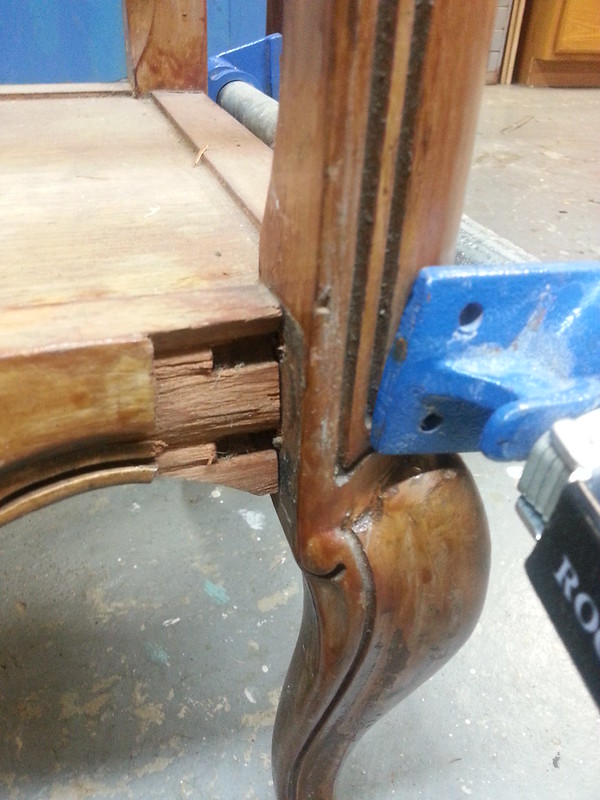
Other than missing a drawer, the real big problem with the table was that there was a piece missing off the front near the leg where the dowel joints failed. I shaved away the roughness of the front with a rasp so that I could attach a new piece of wood to it.
blog

Once I carved out a new piece out of poplar, I glued everything together. I’m by no means a carver, but I was satisfied with the end result. I knew the table would eventually be painted so it wasn’t a big deal if the moldings didn’t match up perfectly.

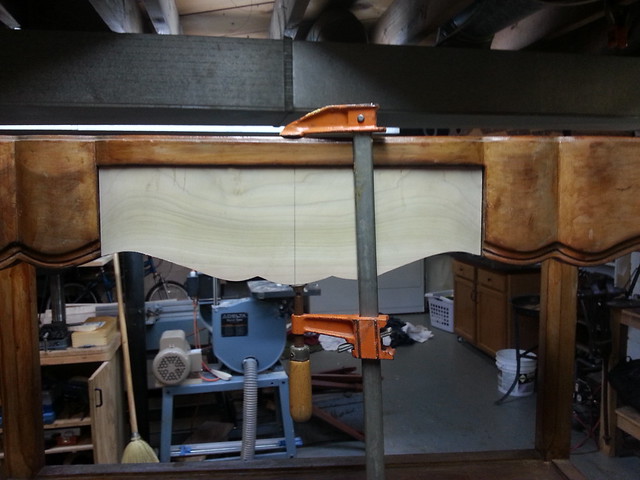
Next I had to make a new drawer. I grabbed some more poplar and traced out the front of drawer by mirroring the shape of the back of the table. I also had to shape the contour of the front to match the curve of the front of the table. I did everything on the band saw and smoothed the wood with rasps and sandpaper.
blog

Back to more carving. I used my carving chisels and scooped out the front to match the curvature of the molding. I then used my Dremel and carved a 1/16″ groove down the front to match the groove of the molding. It took about an hour to do all the carving.

blog

Deciding how to attach the drawer front to the sides of the drawer, I opted to simply use a stopped rabbet joint and pin the sides to the front. I considered using a router bit and my router table to cut the stopped rabbets, but I figured I could cut them by hand just a s quick. I used my marking knife and scored the fibers of the wood where I wanted the rabbet to be. Then I very carefully pared away the wood with a chisel. Once I got so deep, it became easier to remove the waste without damaging the drawer front. It was very similar to chopping out the waste on the side of a tenon.

blog

The drawer was built using 1/2″ poplar and 1/4″ plywood for the bottom. The biggest deal with making a drawer is making sure the thing is square. Having a drawer shaped like a rhombus is just asking for trouble.

blog

The running stick was still in the table so I had to make a new runner for it. Whipping one up on the table saw and fastening to the table was no big deal. In order for the drawer to run properly, I used double stick tape and fastened to the runner to make sure it was in the right spot. Once the drawer fitted perfectly, I glued the runner to the bottom of the drawer.

A few hours in the shop and the new drawer fits nicely in the table.
blog

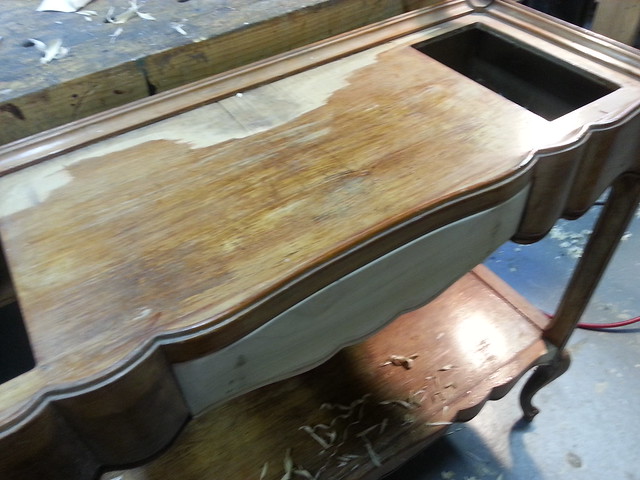
The table had some water damage to the top which caused the veneer to chip and break away. Making a new top for the table didn’t appeal to me, so I tried and out-of-the-box approach. I mixed up a batch of auto body filler and spread it over the top where it was missing the veneer and left it to dry.

blog

I did this step outside because the body filler stinks to high heaven. After the Bondo dried, I sanded the high spots with 80 and 150 grit sandpaper.

Here’s the finished table with a few coats of paint. My wife Anita painted it and sanded through the coats to give the table a worn look. I don’t think the table turned out too shabby considering I only paid $4.00 for it.

Making a Farm House Table

My wife Anita was getting ready for a design show she was doing called Over the Moon in Lawrenceburg, IN. She asked me to make a farm house table from basic 2 x 8’s I bought from Lowe’s. So I bought the wood and laid out the boards on the floor to see how big of a table she wanted. We ended up deciding on a table that was around 3′ x 5′.

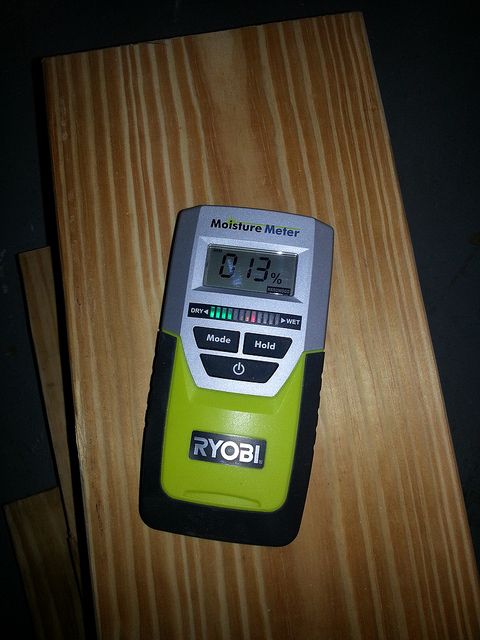
When I bought the lumber, I chose boards with the straightest grain possible with very little or no knots. However, most of the boards I chose were still high in moisture content so I had to let them acclimate in my shop so they could dry out a little bit.

After milling the boards to one inch thick, I stickered them on the floor and placed a fan near them to help the boards dry out a bit. I placed weights on the top board just to prevent it from cupping. The paper towel underneath the weight is to prevent the iron of the weight staining the wood.

After about a week, the boards were down to a workable moisture content. You wouldn’t think that simply laying boards down for a week would change the moisture content that much, but it did.

Anita already bought legs at an antique show back in the fall for about $10.00. All I had to do was make the frame and top and assemble it all together. I used a 3/8″ beading molding plane to put a bead on the sides of the table to give it a bit of detail.

It doesn’t get much simpler than this. I used pocket screws to attach everything together. The idea of a farm table is keep the joinery simple.

Anita stained the top with gel stain and painted the base with chalk paint. The table was too wide to get through my basement door so I had to finish it in the living room.

I asked Anita if she wanted me to attach the boards from the bottom so the fasteners wouldn’t show. She told me no. She said “just screw down the boards and fill in the holes with plugs”. So I did just that leaving about a 1/8″ gap between the boards for expansion and contraction of the wood. After I was done, Anita sanded the top again with 220 grit sand paper and reapplied some more stain.

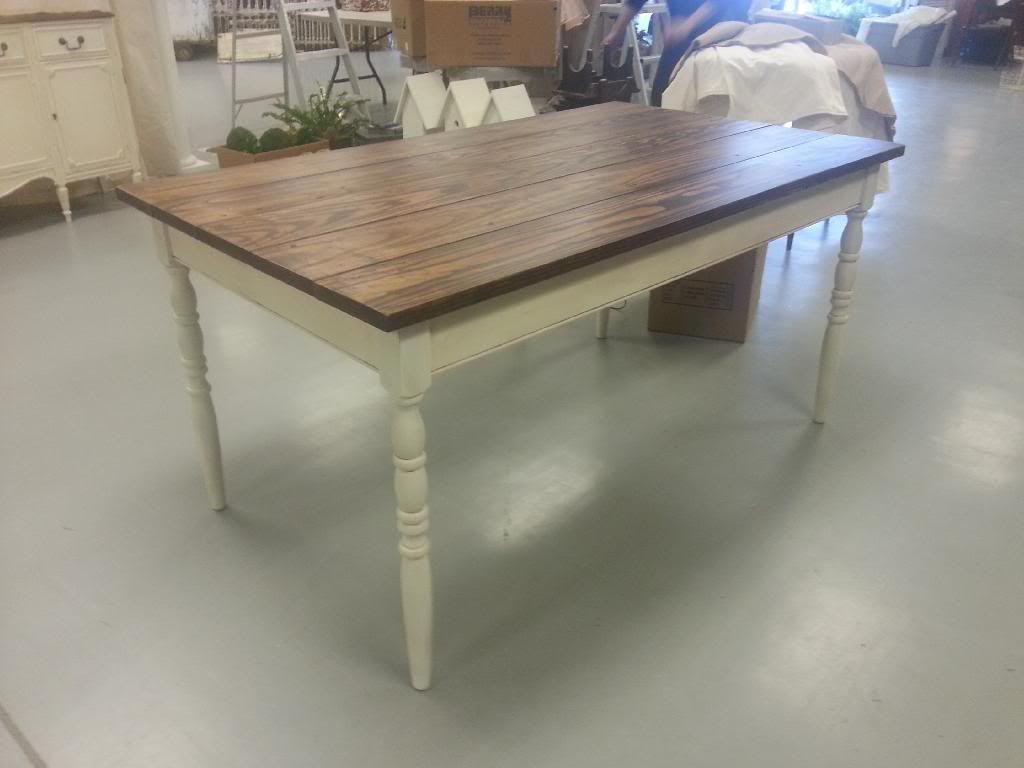
This is how the table looked when it was done and ready for the show. Anita applied a dark wax to the paint to highlight the details of the legs. She also waxed the top to give it some luster.

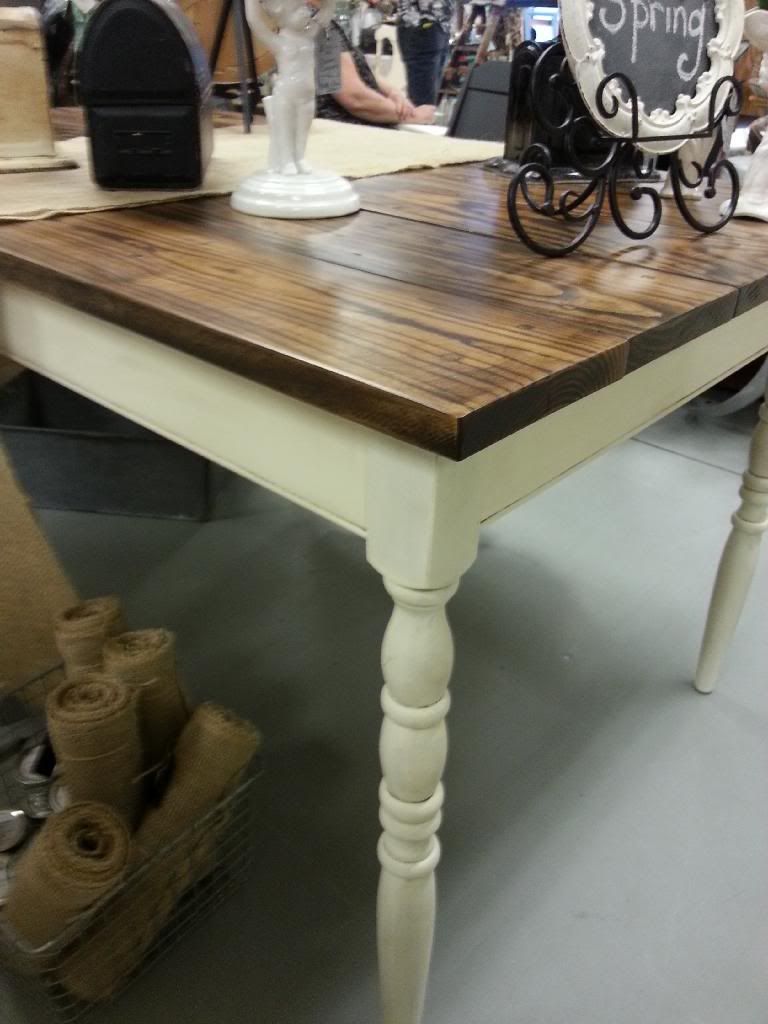
You can see some of the dark wax detail here.

Anita posted this picture of the table on her Facebook account right before the show started. One of her followers saw the picture and private messaged her asking Anita to hold the table, however Anita never saw her message. When the show opened, the young woman ran to her booth and asked if the table was still available. Anita said it was and the woman bought it right on the spot. It’s nice to know someone likes my work. haha.

Making a Shaker Table from a 2×8

Earlier this week I grabbed a 2×8 that was 8 feet long for $6.00 at Lowe’s with the intentions of making a shaker table out of it. I’ve made a lot of furniture out of Southern Yellow Pine dimensional lumber over the past couple of years. One of the best things I like about it is that it’s dirt cheap. The other is that it comes 1 1/2″ thick so when making legs, I don’t have to laminate two 3/4″ boards together exposing a glue line down the leg. The biggest downside is that the wood is very soft and easily dents however, lately I’ve been building things to look old, and a few dings and dents will only add character to the piece.

Making the legs of the table is a synch. Rip four pieces 1 1/2″ wide x 1 1/2″ thick. The next is ripping down the stock to create the carcass of the table. Because the 2 x 8 is exactly 1 1/2″ thick, getting two pieces that are 3/4″ in thickness is next to impossible. I settle for ripping it down the middle and yielding two pieces 5/8″ thick after I clean them up in the surface planer.

After I rip the stock to 5 1/2″ wide, I don’t just rip the piece all at once on the bandsaw. I set my table saw up to rip it in the middle and run a kerf on each side of the board.

Then I take it to the band saw and rip the rest of the way. This does several things. One, it saves my band saw motor as it doesn’t have to fight ripping five and a half inches of wood. Instead it only has to rip about 2 1/2″. Plus the kerf of the table saw blade creates a channel for the band saw blade to ride in so I don’t get blade drift. It’s also much faster than ripping 5 1/2″ and it also creates less dust.

Once I have my side and legs milled, I need to route the joinery to attach everything together. Using my handy-dandy Colt plunge router, I route all the mortises in the legs and sides to accept loose tenons. The process is so fast and simple I wished I would have created that Micro Fence jig ten years ago.

After the joinery was cut, I tapered the legs with my taper jig.

For the top I wanted to use 3/4″ wood as 5/8″ would be a little too thin. This is okay because I still need stock for the drawers which will be 1/2″ thick. So I simply rip the next pieces at 7/8″ on the table saw and follow-up on the band saw like I did previously.

The parts came out clean but the two pieces for the top were a little narrow. Together they were about 15″ but I needed the top be 16″ wide so I grabbed a piece of off-cut scrap and glued it in the middle.

After the top was glued, I flattened it with my 16″ surface sander and beveled the edges with a 45 degree chamfer router bit.

I needed to assemble the carcass so I dovetailed the rail on top of the drawer and loose tenoned the bottom rail to the two front legs.

The carcass fitted together nicely so I sanded the parts with 150 grit sandpaper and then glued it all together. Now I needed to work on the drawer.

The drawer sides and back are made with the 1/2″ stock. I planed a groove down each side and the back of the drawer front. I then cut them to size and routed a dado in the side to accept the back.

I cut half blind dovetails into the drawers and used my Colt plunge router to rout the majority of the waste and cleaned out the joint with chisels. Luckily I had a piece of scrap plywood for the drawer bottom lying around so I didn’t have to buy more wood. After I cut all the joinery for the drawer, I glued it all up.

As far as scrap goes, this is about it. Nearly everything from that 2×8 was used when I finished installing the drawer runners. Luckily I didn’t have any major screw ups where I would have to use more lumber because I didn’t have it.

The table came out pretty nice for $6.00. I plan on painting it (or my wife will) and give it away to my local PBS station. Next month they have an on air auction they call “Action Auction” where they auction off items from local businesses. I participated in it a couple of years ago donating this same shaker table only out of cherry. Back then, the table sold for about $135.00. It’ll be interesting to see where this one ends up. But for $6.00 and a few hours of work, it’s a good investment for getting my name on TV.

Since when do woodworkers buy furniture from other woodworkers?

I have to admit, I’d never thought that a woodworker would buy a piece of handmade furniture from another woodworker. After all we’re woodworkers, we could just easily make it ourselves. But what has happened over the past few months has changed my opinion.

It started a couple of years ago when I made four Shaker side tables out of cherry. I had plans of listing them on Etsy and turning a handsome profit. At first it seemed easy with a sale within the first week. The problem was that the person who had “bought” the table was a scammer trying to pull some over payment cashiers check trick and then have me send him the difference back. Luckily Etsy saw the scam and cancelled the transaction.

I had the tables out on Etsy for a few months with no other bites so I decided to delist them. I was them stumped as to what to do with them so I had the idea of donating one to my local PBS station’s Action Auction. The auction went well and I had my table on TV for several minutes as well as MVFlaim Furnituremaker listed on the PBS station’s website. So, the next year I decided to do it again. Even though I didn’t get any money for them, I felt good about the exposure and helping out my local PBS station with the donation.

Then last summer I got a call from one of the people who had won the auction for one of the tables. They wanted another one! So I gave them a price and went over to their house to deliver it. I met with the woman’s husband and he started talking about woodworking and took me out to his shop. I looked around in his shop in confusion. The man obviously had a nice set up. Nice enough to be able to build the table himself. Why was he buying mine? I asked him why and he told me that while he dabbles in woodworking, he doesn’t possess the skills that I have to build the table as nice as I did. I was extremely flattered by that.

Three tables down one to go. My wife decided to stick the last one in our spare bedroom and use it for a few months. It looked nice but didn’t quite match the French country decor she was going after so she listed it on Craigslist. A couple of days ago a guy called and asked if he could have it for a certain price. My wife and I agreed to the offer and told him to come pick it up. The man came to the house, introduced himself and started asking about what type of joinery I used to build the table. I couldn’t believe it. Another woodworker! Here’s another guy who would rather buy a nice handmade table than make himself. What is going on? He told me that he spends all his time at work and really doesn’t have time to build things he wants but appreciates nice furniture when he sees it. He even told me that he went down to Tennessee to Lonnie Bird’s school to take his Dovetailing class a few years ago so he definitely had a passion for woodworking.

All I know is that I learned something new today. Even though people possess the skill to build something themselves, they’ll still pay a fair price for the work of others. I didn’t get rich from the sale of the tables. In fact, I barely got my money back from the cost of the wood, but it still felt good helping out my local PBS station the past couple of years and meeting new friends.