Building the Shed Part II

It’s been months since I updated about the shed I’ve been building. I originally broke ground on it back in September. I hadn’t done anything on it for weeks because my wife and I didn’t want the floor of the shed to be plywood. While looking at sheds that Weaver Barns make, we saw that they used a 2 x 8 tongue and groove pressure treated lumber flooring. We both loved it, so we searched around to see who carried it.

 photo 20151019_092930.jpg

I have a friend who works for Universal Forest Products (UFP), so I asked him if he knew anything about it. He told me it’s called V Groove Decking, and that he could get it for me since Lowe’s nor Home Depot carried it in stock. Well, after waiting a couple of weeks, I knew that was a dead end. Anita found that Menard’s carried it in stock, but the boards were 20 feet long and about $30 a board. We really didn’t feel like driving 20 miles to Menard’s to pick them up so I went to Home Depot down the street and asked how much it would be to special order from them. The price was a lot cheaper, but it would take three weeks to get them delivered to the store. I wasn’t in a real rush so I went ahead and ordered them.

 photo 20151220_131443.jpg

Well, three weeks turned into six as I found out that UFP doesn’t manufacture the boards, only treats them. They were waiting for the manufacture to make the boards which caused the delay. What really sucked was that Cincinnati had mild weather during that time and there were many weekends where the temperature rose to 70 degrees. All I could do was stand in my dining room looking back at the frame wishing my boards were in.

 photo 20151220_140423.jpg

I finally got the board in early December, dragged them out to the base and laid them out to see how much overhang I had on each side. Luckily I ordered the right amount of boards as I had only a couple of inches overhand on each side.The boards were 16 feet long so I had a foot of overhang on each of the long sides.

 photo 20151220_140638.jpg

The best part was that the floor was completely level on all four sides with the floor laid down.

 photo 20151220_143536.jpg

I took my time and went through the boards to find the straightest board and screwed them to the base crown up so that they were as straight as possible. I screwed three screws per joist which totaled over 600 screws used to attach all the deck boards.

 photo 20151220_155956.jpg

The last boards were the most warped so I grabbed a couple of 6 foot long pipe clamps and squeezed the boards to the rest of the decking and screwed them down.

 photo 20151224_133134.jpg

Once all the boards were attached, I trimmed off the excess with a circular saw and flush cut them with a router bit. Thankfully Christmas Eve was warm as I was working on the shed in only a t-shirt.

 photo 20151224_140230.jpg

Hopefully we’ll have a mild winter as the next part is to start framing the walls. I work outside during the winter building displays for my day job, so as long as the temperature is over freezing, I’ll be fine. I just doubt I’ll be able to get any of my friends to help me.

Stretching a Board

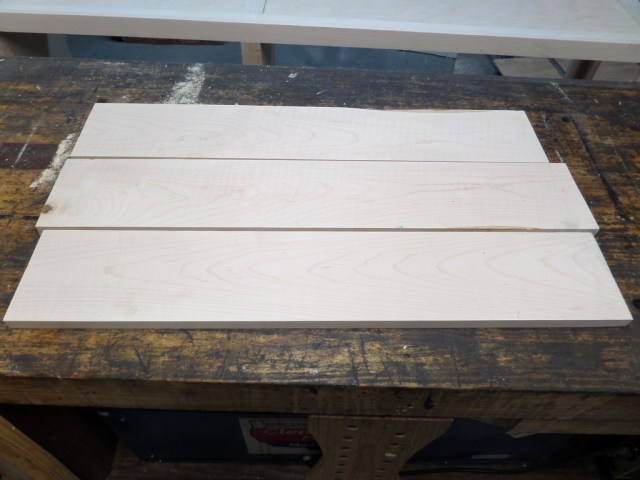
I’m in the process of building a new cabinet for our bathroom to hold towels and toiletries. I work on it in between work and building my shed. Because I work on it only when I have the time, it opens up the opportunity for brain farts to happen. Last Monday, I went back into the shop to start making the top of the cabinet and grabbed a board of maple, looked at the 31 1/4″ measurement I had written down on a scrap piece of wood on my bench, and cut the board into 32″ segments. As soon as I cut the board, I realized my error. The top of the cabinet is 33 1/2″ long. The 31 1/4″ measurement is the width of the 1/4″ back for the cabinet. I didn’t measure twice and cut once like Norm Abram would always tell me to do. After spewing a few cuss words, I had to decide what to do next. I had two options. I could either go back to the lumber yard and buy a new board for $15.00, or somehow make these boards work. So, I decided to “stretch” these boards.

Stretching a board is often a gag placed on an apprentice in a cabinet shop.  One of the veteran cabinet makers will ask the newbie to go get the Board Stretcher. The newbie will look around the shop and then ask other cabinet makers where the board stretcher is. After a couple of minutes, everyone in the shop will turn around and laugh at the apprentice making him feel like a dumb ass. I know this story first hand.

However, you can legitimately stretch a board if you know the trick. There are a couple of criteria that makes board stretching possible. One, the board you’re stretching has to be wider than the final width you need . The second, is the grain of the board should not be pronounced highlighting the fact that the board has been cut and re-glued. This cabinet will be painted white, so I wasn’t concerned about the grain. And, the width of the three boards together is 16″ while the top only needs to be 13 3/4″ wide, so I was good to go.

SAMSUNG CAMERA PICTURES

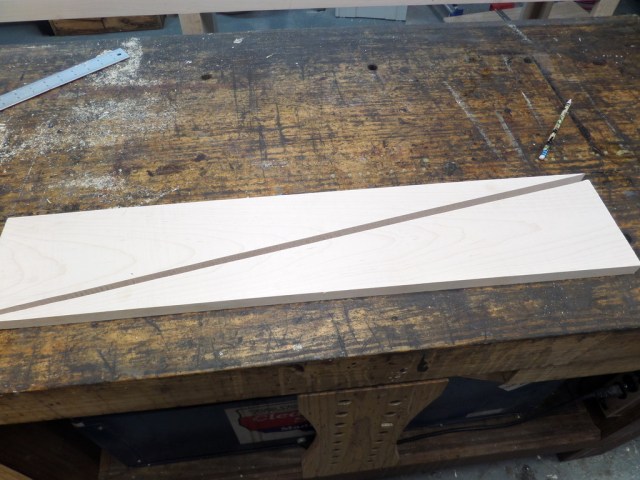
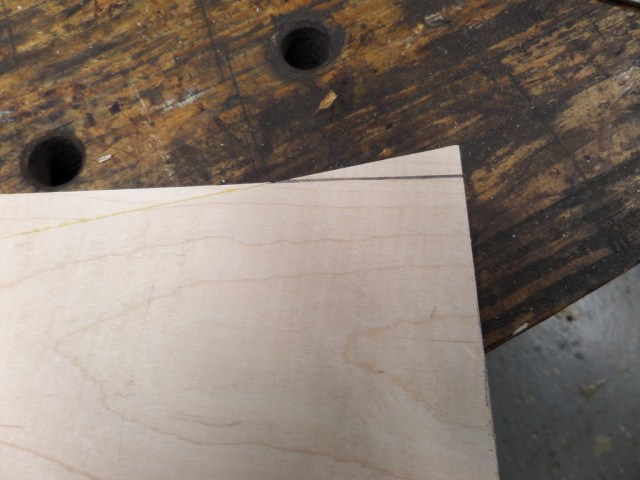
The first step in stretching a board is slicing it diagonal down it’s length on a band saw. Try to make sure the cut is as straight as possible so you don’t lose more of the board’s width than necessary.

SAMSUNG CAMERA PICTURES

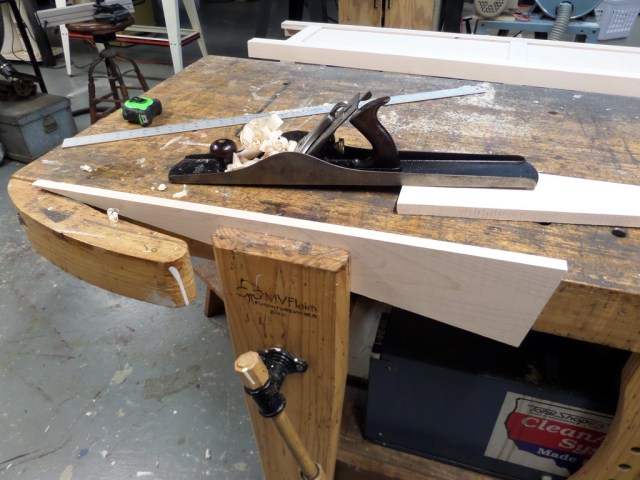
Next, plane the diagonal edge straight with a jointer plane to get a nice tight seam where the two halves are glued back together.

SAMSUNG CAMERA PICTURES

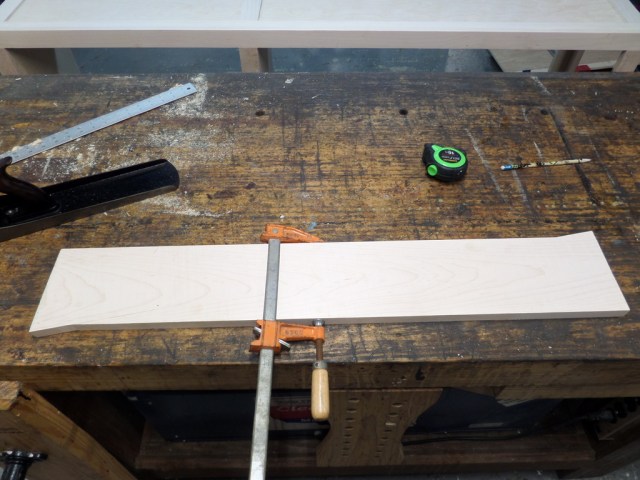
Bring the two diagonal halves together and slide them so that the length of the new board is where you need it. Since my top is 33 1/2″, I glued the board 34″ long. I’m sure there’s a mathematical formula that can determine how much width of board you lose for every inch you lengthen it but, I haven’t taken trigonometry in twenty years, so unfortunately, I can’t help you with that.

SAMSUNG CAMERA PICTURES

After the glue dries, you’ll have a little triangular shaped area you’ll need to remove with a hand plane. After you plane that area away, joint the whole edge straight with the jointer plane, and rip the other side straight on the table saw.

SAMSUNG CAMERA PICTURES

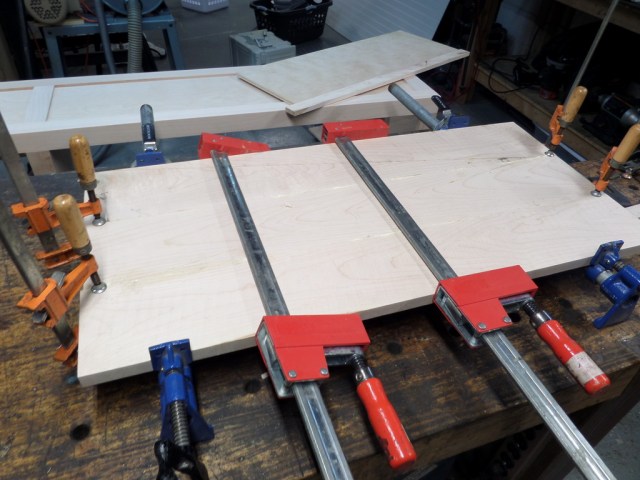
After I stretched all three boards and trimmed them square, I edge glued all three pieces together. This board is now 34″ long x 15″ wide.

SAMSUNG CAMERA PICTURES

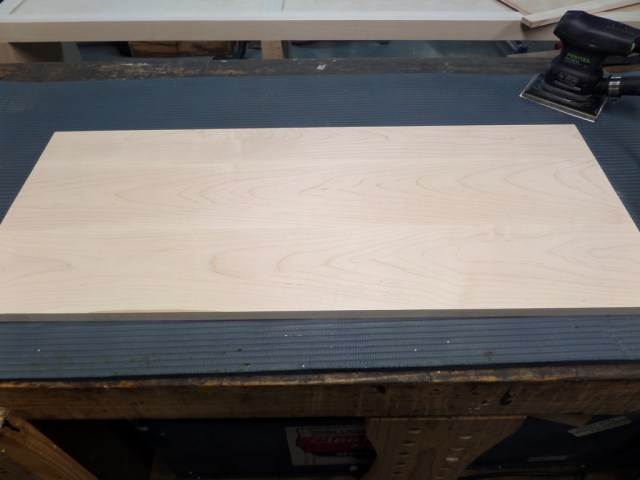
Here’s the board after it was sized to the final dimension of the top of the cabinet and sanded to 220 grit sand paper. This top will work perfectly fine and no one will ever know I screwed up.

SAMSUNG CAMERA PICTURES

Here’s a close up shot of the board. If you look closely, you can see the diagonal glue lines that pass through the grain. However, it still looks really nice even if the grain of the board would be shown in the piece of furniture.

Merry Christmas everyone!

Corradi Gold Rasp Handles

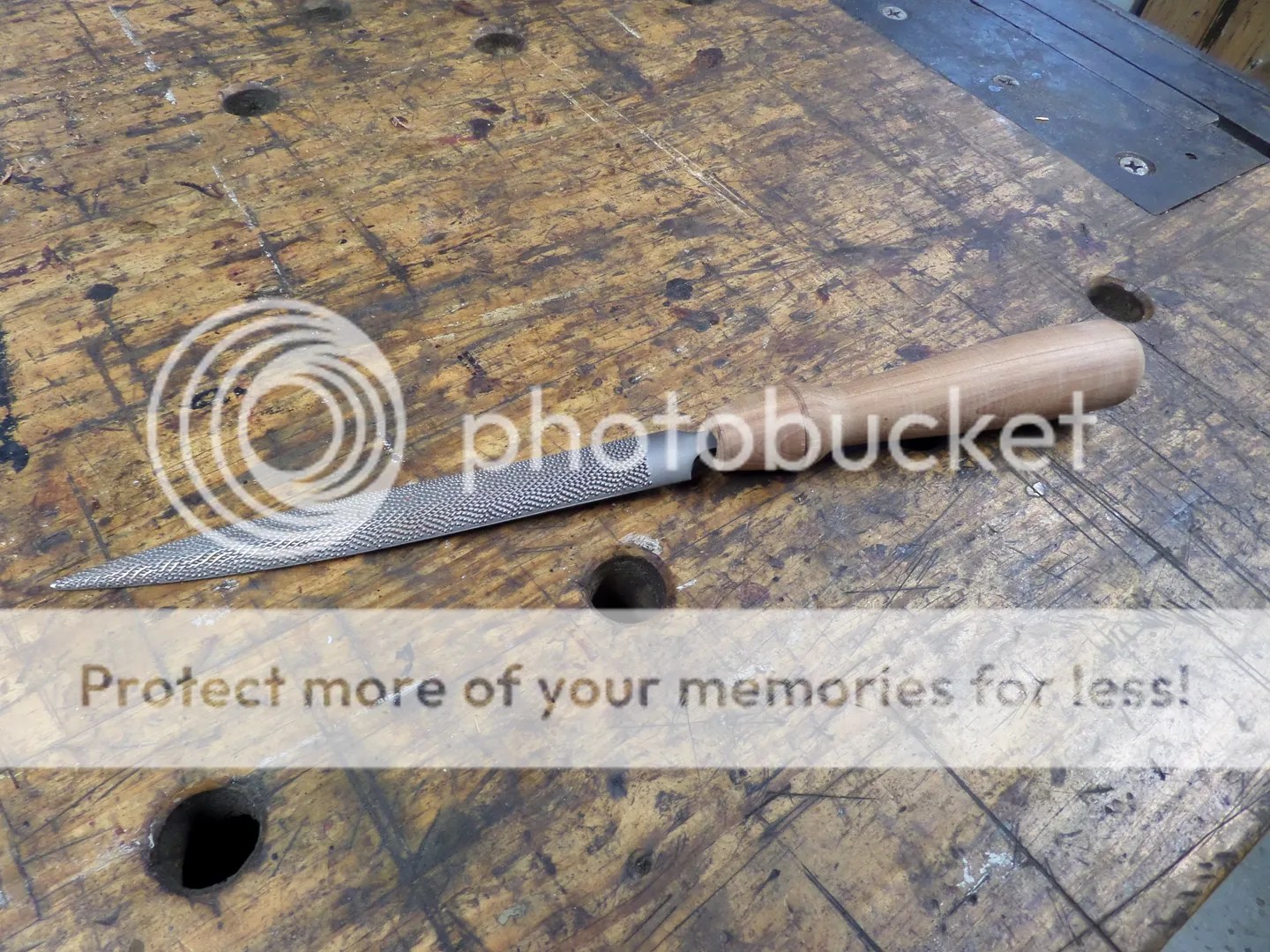
Last year I bought a couple of Italian made Corradi Gold Rasps direct from Italy; a 6″ round and a 10″ cabinet rasp. While I absolutely loved using them, they were painful to use without a proper handle. The tip of the tang would dig into the palm of my hand causing great pain. Corradi sells handles for their rasps, but I figured I could make my own easily enough.

http://www.corradishop.com

 photo files 002.jpg

I use these rasps to shape and make new pieces of wood for the top of my rosewood plane totes. Their small size makes it nice to work into the tight curves of the handle and the small hole for the threaded rod. At a 6 cut, they are aggressive enough to make quick work of removing the wood, but with their advanced stitching, they don’t leave big tool marks on the wood’s surface. In the photo below, there is a small black line near the top of the tote that distinguishes the original Brazilian rosewood and the new piece of cocobolo. I use cocobolo because Brazilian rosewood is nearly impossible to get nowadays and cocobolo is in the same species of wood. While the color of the woods are not an exact match, they’re good enough to make the tote look nice again.

 photo files 013.jpg

I started making the handle with a scrap piece of apple about 12″ long and chucked it into my lathe.

 photo files 005.jpg

Then, using a template handle I had when I bought an old knife sharpener, I used my parting tool and calipers to mark and measure the details of the handle.

 photo files 006.jpg

After everything was turned to my satisfaction, I took some of my lathe shavings and burnished the wood to a nice sheen.

 photo files 007.jpg

In order for the handle to fit in the tang of the rasp securely, I drilled a small pilot hole as plum as possible down the center of the handle. The drill bit was the size of the very tip of the tang of the rasp so it would fit tight when driven into the handle.

 photo files 008.jpg

Next, I took my blow torch and carefully heated the tip of the rasp so I could burn into the handle. It took a couple of tries as I didn’t want to burn it in all at once. On the second burn, the rasp seated nicely into the handle and I was unable to pull it out.

 photo files 009.jpg

The final touch was to simply apply a couple coats of oil on the handles. These handles were extremely simple to make. In fact, it took less that 30 minutes to make both. Why I didn’t make them last year when I originally bought the rasps I have no idea.

 photo files 011.jpg


Updated Tool Cabinet

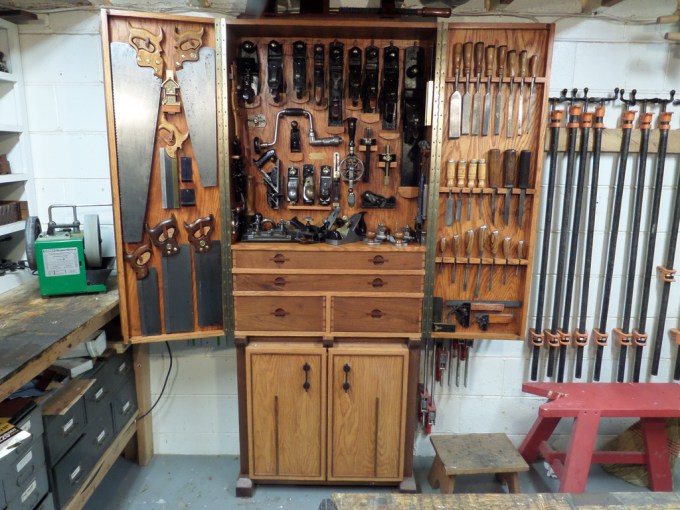
I built this cabinet nearly fifteen years ago and every few years I end up updating the tools that go inside it. It’s been about three years since I updated it, so I decided it was time for a change.

As you can see in the photo below, at one time I loved MicroPlane rasps. I stuck everyone I owned onto the left door. While they are nice rasps to use, I decided to delegate them to a nearby drawer instead. The Stanley short box handsaw had to go as well. I never used it, so it was pointless to have it take up so much valuable space.

SAMSUNG CAMERA PICTURES

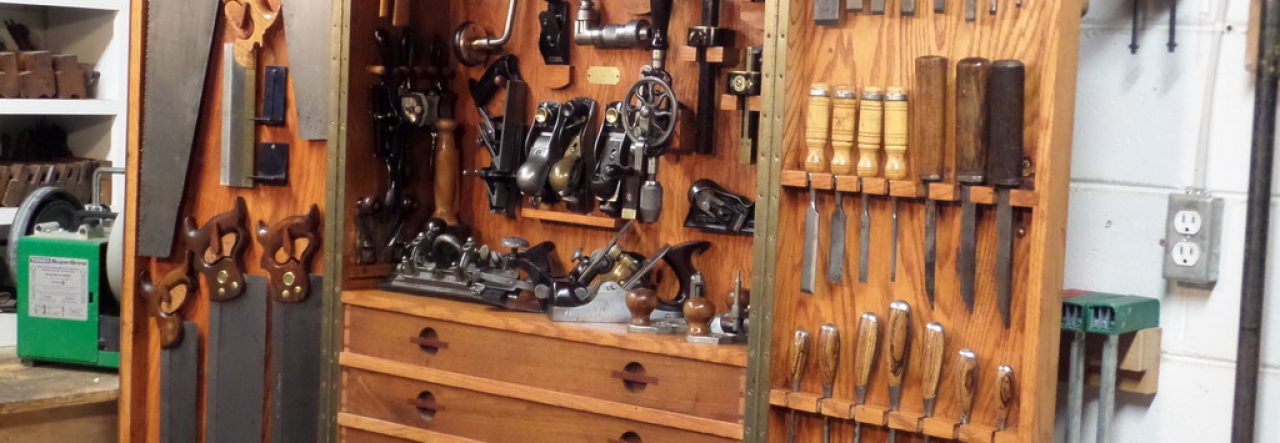
This is how the cabinet looks today. Over the years I’ve been learning a lot more about hand saws, so my collection of usable hand saws that I have restored has grown. I knew I wanted to incorporate them into the cabinet somehow which is one of the main reasons I decided to redesign the tool cabinet.

SAMSUNG CAMERA PICTURES

Hanging on the top of the left door, I have a E C Atkins rip saw that I made a new handle for it out of cherry, and a short Superior panel crosscut saw. In the middle is my original Lie-Nielsen dovetail saw I bought twenty years ago. Below it is another dovetail saw and two Disston back saws, one filed to saw rip and the other filed for crosscut.

SAMSUNG CAMERA PICTURES

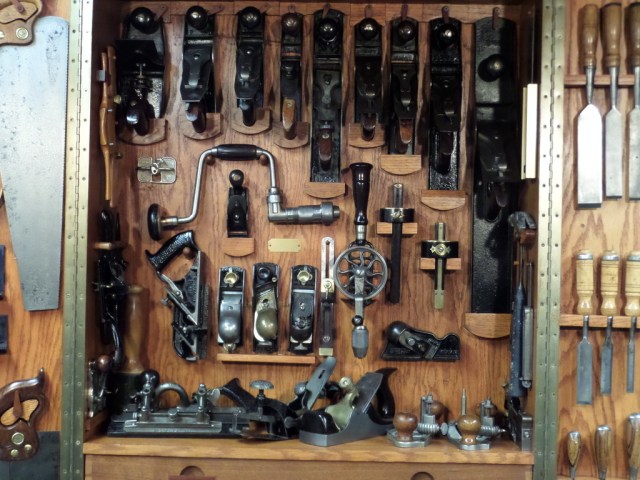
I stuck my hammer on the right side by my Stanley No 8 jointer plane. By the hammer, I hung a couple of bevels and a Nobex square. Underneath the screwdrivers on the right door is where I hung more measuring tools. Since I’ve updated this cabinet numerous times over the years, if you look closely, you can see where the oak veneer has been torn off the plywood substrate. To conceal the damage, I stained the entire inside of the cabinet with Nutmeg Gel Stain. Thank God I didn’t make this thing out of African Mahogany as I have no qualms about damaging oak plywood.

SAMSUNG CAMERA PICTURES

The left side of the cabinet is where I stock a lot of my spokeshaves and Stanley No 66 Beader. I’d like to build a little rack for all my blades for my beader, but that will be another project for another day.

SAMSUNG CAMERA PICTURES

The middle of the cabinet was left untouched as there’s really no room to do any changes. Maybe the next time I update my tool cabinet, I’ll make room for all my Festool accessories. haha


LED Shop Lighting

My wife and I were shopping at Costco this afternoon when we ran across these LED shop light bulbs. On the box it said that all that was needed is to simply replace these bulbs with your current shop bulbs. I was intrigued because I always thought you would have to replace the baluster as well, not just the bulb when switching over to LED lighting.

 photo light 006.jpg

The energy savings using LED over fluorescent is incredible along with the fact that LED light bulbs last a long time. The box said they’ll last 45 years and use 47% less energy.

 photo light 004.jpg

I stuck them up, and sure enough they worked. Not only did they work, they lit up my workbench like I have never seen before. The difference between these LED bulbs and regular fluorescent is like night and day. It was like direct sunlight was lighting my bench.

 photo light 003.jpg

It’s really tough to show you how much brighter these bulbs are in a photo so I took a shot of a molding plane under my fluorescent bulbs and then another under these LED bulbs.

 photo light 001.jpg

You can see how much lighter and crisper the plane’s body is in the photo here. I can’t wait to see how the pictures of my tools I list on eBay will look under these bulbs. It should help my customers see better details of the tools I sell. Now I’ll have to go back to Costco and pick up seven more boxes to replace the rest of my shop lights. At $37.00 a box, these things aren’t cheap, but they should help me save money on my electric bill.

I thought these were expensive until I saw them on Amazon for $61.00 a pack. http://www.amazon.com/Feit-Electric-LED-Tubes-Fluorescent/dp/B00TSQVEWA/ref=sr_1_5?s=hi&ie=UTF8&qid=1446497898&sr=1-5&keywords=led+shop+lighting+feit

 photo light 002.jpg

Reclaimed Lumber in the Cincy/Dayton Area

If you’re in the need for some reclaimed lumber and live n the Cincinnati, Dayton area, there is a new place inside the Antiques Village Antique Mall in Centerville, OH that may have what you’re looking for. The booth is called Dayton Reclamation and Restoration Architectural Salvage and is in the back right of the antique mall.

 photo 20151028_124636.jpg

The booth is somewhat new as it’s only been open for a few months however, they do have a lot of reclaimed wood and architectural salvage like old doors and windows to choose from.

 photo 20151028_124241.jpg

 photo 20151028_124225.jpg

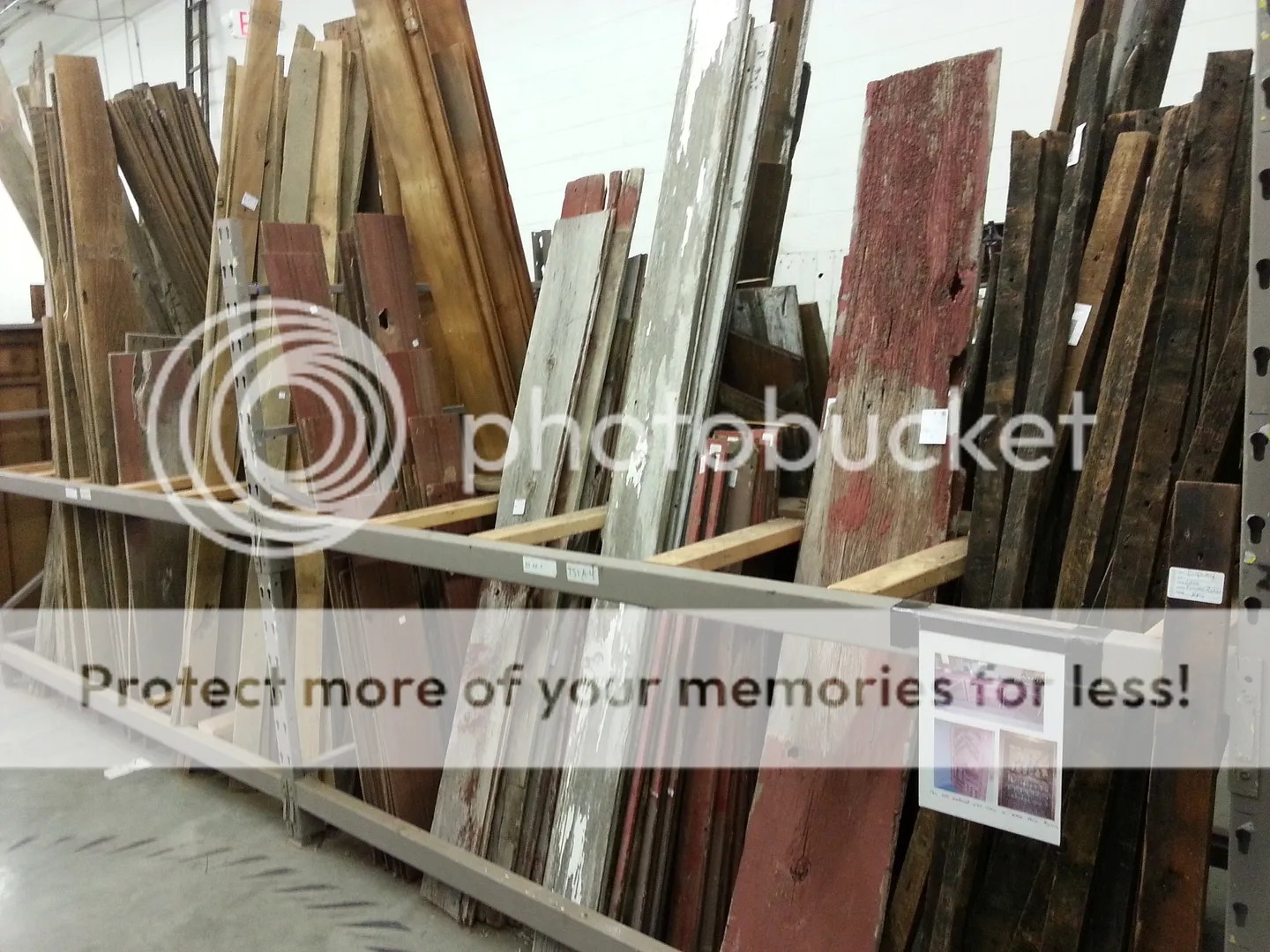
They also have a couple of racks of dimensional reclaimed wood in the front. The pricing is not bad with some 2″ x 6″ x 48″ pieces only being $4.00 a board. I didn’t buy anything because I have too much on my plate right now and don’t have a need for reclaimed lumber, but it’s nice to know where I can get it when I need it.

 photo 20151028_124214.jpg

This picture stinks, but it shows some of the longer pieces they have in stock. I didn’t notice any chestnut in the rack so I’m sure the majority of the wood is either oak or poplar. I’m sure the longer they’re in business, they’ll add to their inventory.

 photo 20151028_124203.jpg

And so it Begins- The Shed Part 1

I tore my old shed down one fall day and told myself that I would build a new one in the spring. That was seven years ago. Well, after seven years, I finally got my act together to build a new shed. One of the biggest issues in building it was how to build it level with a yard that is sloped downhill. I considered using deck blocks, but after watching a few YouTube videos, I decided to build a framed base.

 photo 20150830_143127.jpg

My wife, Anita, and I decided how big of a shed we wanted and where to put it in the yard. We opted for a 10′ x 14′ and laid it out in the yard with stakes and strings. I then used a line level to see how far off the ground the right side of the shed would be in the air. It’ll end up being about two feet in the air on the back right side which won’t look bad once we plant some shrubs around the shed.

 photo 20151011_161104.jpg

After we went to the home center to pick up the lumber. I cut and screwed the 2×6’s together into a 10′ x 14′ box. I measured corner to corner to make sure the box was square then attached boards on all four corners to keep it that way. I then grabbed some spray paint and sprayed the ground at the corners to show me where to dig my posts. After I dug the four holes 30″ deep, I stuck the 4×4’s in the ground and used clamps to hold the box to the posts. Then using a level, I leveled the box on all four sides, held it in place with clamps, then concreted the posts in place letting them dry over night.

 photo 20151011_150413.jpg

In the morning, I bolted the box in place with 3/8″ galvanized lag screws using four screws on each post. I then marked where my stringers would be and dug holes for two more posts in the middle of the shed so that the floor won’t sag.

 photo 20151019_092930.jpg

Attaching all the stringers and covering the base of the shed with 3″ deep of gravel stone with landscaping fabric underneath, the shed has a nice base. Now I need to go back to the home center to pick up more lumber.

 photo 20150830_143104.jpg

This is a drawing of the shed I designed. We already bought three old windows for the shed last year, so I incorporated them into the design. We’ll see how close the final shed will look to this drawing.

David Marks on Rough Cuts

Watching TV this morning I ran across a Rough Cuts episode that featured David Marks. He was showing Tommy Mac how to make one his famous turned vessels with an applied chemical patina. I’ve been a big fan of David Marks ever since I first saw him on his TV show Woodworks which was on HGTV and DIY Network many years ago. In fact, it was the main reason I ordered cable when I first moved into my house. I watched  his show religiously for about six years until HGTV and DIY pulled his show off the air by not renewing another season. I always thought that if Woodworks was on PBS, it would probably be still on the air today.

Woodworks was an awesome woodworking show where David made some awe inspiring modern looking furniture. David did a lot with bent wood lamination which helped me figure out how to build the back on my Windsor chairs since I had no access to fresh green lumber and a wood steamer. One episode David showed how to make your own plywood which motivated me to buy a vacuum press. It seemed that there was nothing that he couldn’t make. While he did have some nice tools, it seemed that everything he made was within a modest woodworkers budget. However, I still long to own one his Multi-Routers.

When I saw David today, it made me wish he still has his TV show. Maybe some PBS station out in California where David is from will offer him his own show again. Lord knows we could use another one. You can watch the episode of David on Rough Cut here.

http://www.tommymac.us/blog/episode-601-master-showcase-with-david-marks/

At one time you could watch old episodes of Woodworks online for free, but I haven’t been able to find the link. However, you can buy an entire season of his episodes on his website. If you’ve never heard of David Marks, or seen his work, I highly recommend you check him out.

http://www.djmarks.com/product-category/seasons/